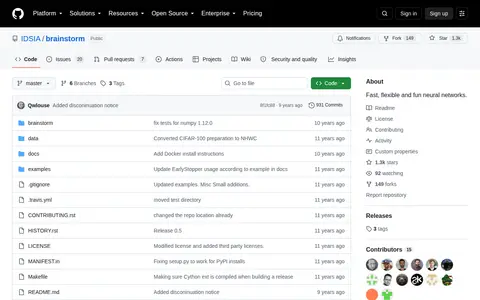

Brainstorm is a GitHub repository for a neural network library developed by IDSIA. It is designed to be fast, flexible, and fun for neural network development, with documentation and support resources available for users implementing the library.
Directory
Search results
Published directory entries matching your search.
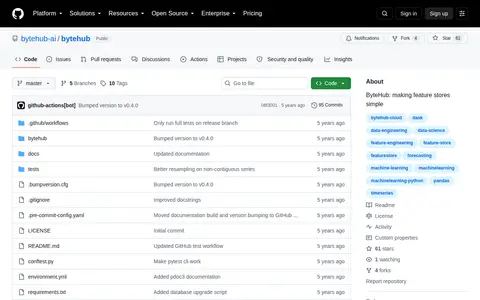
ByteHub is an open-source tool designed to simplify the creation and management of feature stores. It is maintained as a public repository on GitHub under the bytehub-ai organization, with documentation and tutorials available for users.
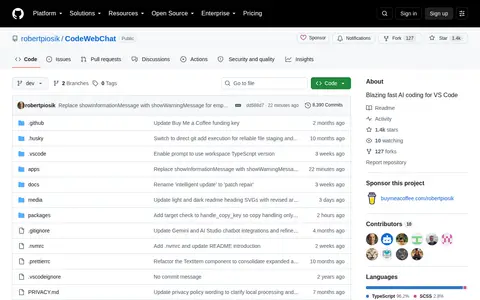
Code Web Chat is an AI coding tool for VS Code, Cursor, and Antigravity that builds lean markdown prompts from files selected on a file tree. It works with chatbots, APIs, and CLIs, and is described as free, independent, and privacy-first with 100% local operation.
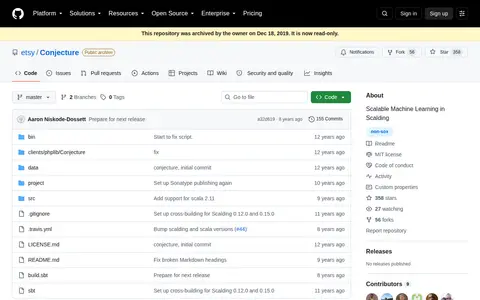
Conjecture is an open-source project hosted on GitHub that provides tools for scalable machine learning using the Scalding framework. It includes tutorials for creating training data, training classifiers, and evaluating classifiers.
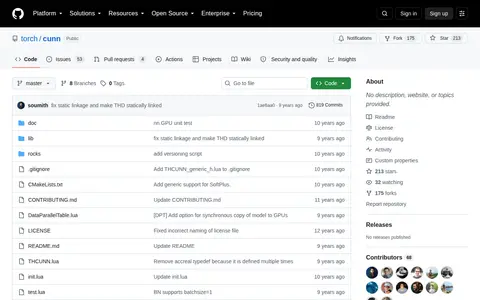
cunn is a GitHub repository under the Torch organization that provides resources for the cunn project. The repository includes documentation for installation, usage, running unit tests, and GPU training concepts.
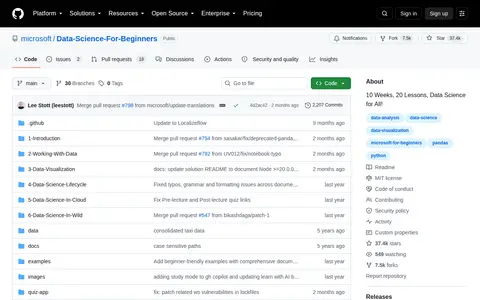
Data Science For Beginners is a public curriculum repository hosted on GitHub by Microsoft. It provides a 10-week, 20-lesson data science learning program designed for all skill levels. The repository includes documentation for getting started and offers multi-language support for learners.
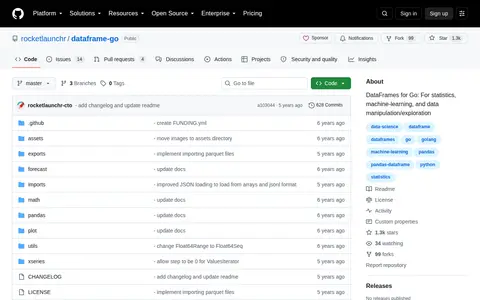
dataframe-go is a public software repository hosted on GitHub by rocketlaunchr. It provides DataFrame functionality for the Go programming language, designed to support statistics, machine learning, and data manipulation or exploration tasks.
DiamantAI is a Substack newsletter authored by Nir Diamant that covers artificial intelligence. It publishes latest techniques, breakthroughs, insights, and unique tutorials for its over 40,000 subscribers. The newsletter is described as a top 0.1% AI resource and also maintains a GitHub repository on advanced RAG techniques with thousands of stars.
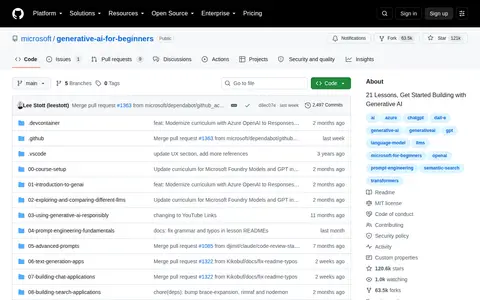
Generative AI For Beginners is a Microsoft-hosted educational resource on GitHub, structured as a 21-lesson course for learning to build generative AI applications. The resource offers multi-language support and is designed for individuals new to generative AI development.
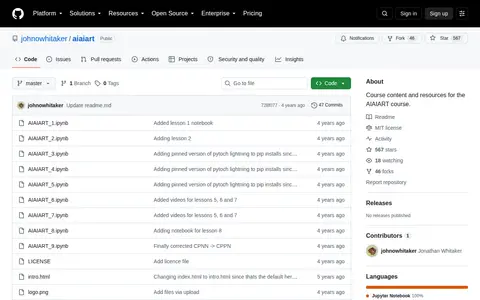
Course content and resources for the AIAIART course.
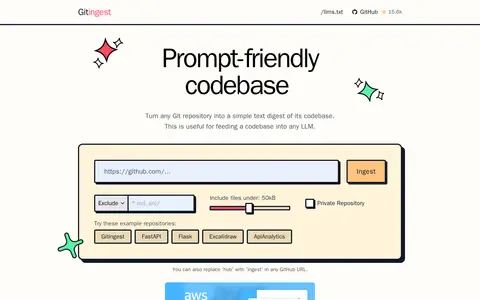
Gitingest turns a Git repository into a simple text digest of its codebase. It is intended for feeding a codebase into a large language model, and works by replacing 'hub' with 'ingest' in any GitHub URL.
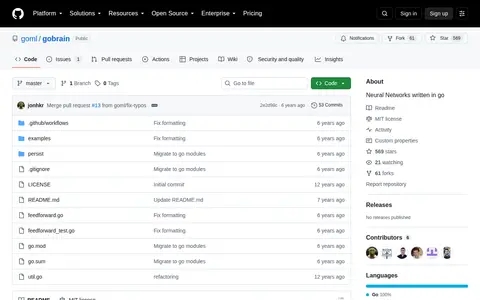
gobrain is an open-source GitHub repository maintained by the goml organization. It implements neural networks in the Go programming language. The repository includes documentation for getting started, recurrent neural network features, a changelog of updates, and project background information.
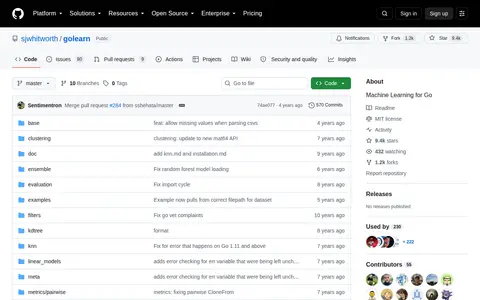
golearn is an open-source GitHub repository maintained by sjwhitworth. It provides machine learning capabilities for the Go programming language. The repository includes installation instructions, getting started guides, example use cases, and full project documentation.
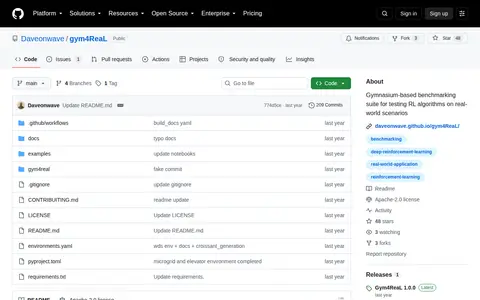
Gym4ReaL is an open-source GitHub repository maintained by Daveonwave. It is a Gymnasium-based benchmarking suite for testing reinforcement learning algorithms on real-world scenarios. The repository includes documentation on supported characteristics, reinforcement learning paradigms, folder structure, contribution guidelines, and licensing terms.
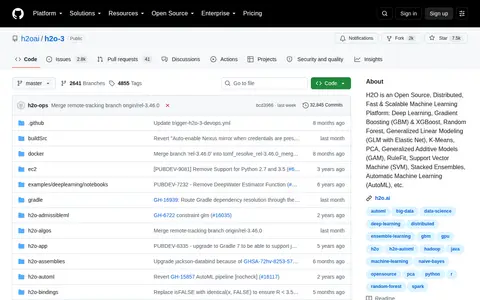
H2O is an open-source, distributed, fast, and scalable machine learning platform hosted on GitHub by the h2oai organization. It supports a wide range of machine learning methods including deep learning, gradient boosting, random forest, generalized linear modeling, clustering, dimensionality reduction, rule fitting, support vector machines, stacked ensembles, and automated machine learning.
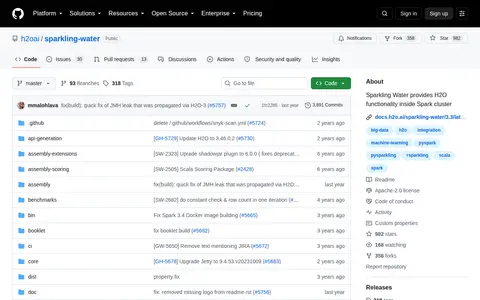
H2O Sparkling Water is an open-source GitHub repository maintained by the h2oai organization. It provides H2O machine learning functionality that can run inside Apache Spark clusters. The repository includes getting started guides, user documentation, binary download options, and resources for testing the tool.
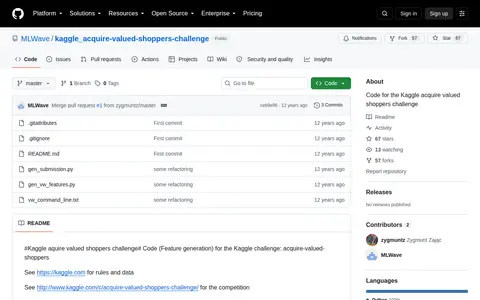
A GitHub repository holding code for the Kaggle acquire valued shoppers challenge, including feature generation scripts. The README points to Kaggle for rules and data and to a competition page and MLWave site for tutorials and discussion.
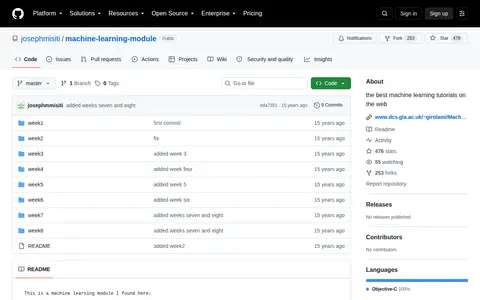
Machine Learning Module is a GitHub repository that claims to host the best machine learning tutorials on the web. It invites contributions from the community and serves as a collection of learning resources for machine learning.
MEKA is an open source implementation of methods for multi-label learning and evaluation, based on the WEKA Machine Learning Toolkit. It includes dozens of multi-label methods from the scientific literature and a wrapper to the MULAN framework. The project is distributed via SourceForge, with code hosted on GitHub.
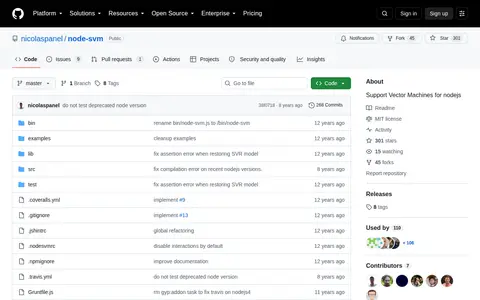
Node-SVM is a GitHub repository that provides support vector machine (SVM) implementations for Node.js. The project enables developers to use SVM algorithms within JavaScript applications. It includes installation instructions, a quick start guide, and an API reference. The repository is open source and contributed to by the community.

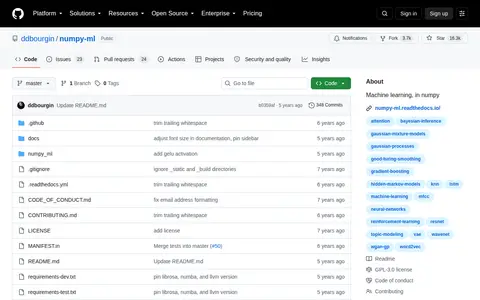
numpy-ML is a GitHub-hosted library that implements various machine learning algorithms using only NumPy. The project emphasizes rapid experimentation and can be used as a package. It covers a range of ML methods and includes documentation for users. The repository is open source and welcomes contributions.
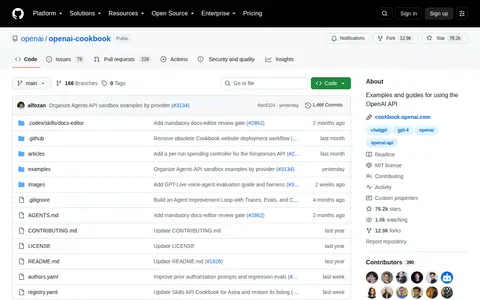
OpenAI Cookbook is a GitHub repository that provides examples and guides for using the OpenAI API. The collection helps developers integrate OpenAI models into their applications. It includes code samples, best practices, and documentation. The project is open source and accepts community contributions.
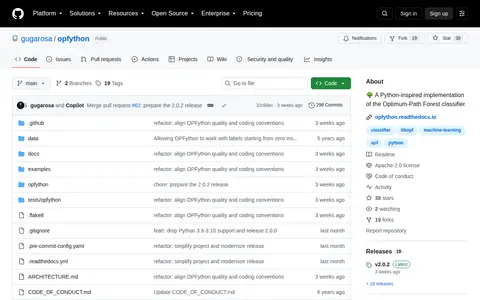
OPFython is a GitHub repository offering a Python-inspired implementation of the Optimum-Path Forest classifier. The library enables classification tasks using the optimum-path forest algorithm. It includes installation instructions, quick start guides, and classifier documentation. The project is open source and welcomes contributions from the community.
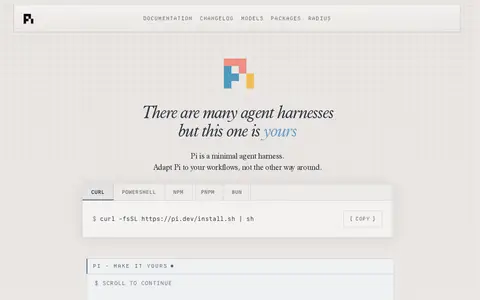
Pi is a terminal-based minimal coding agent harness built to adapt to user workflows rather than requiring users to adjust their processes. It supports 15+ providers and hundreds of models, offers tree-structured shareable interaction history, context engineering features, and four operation modes: interactive, print/JSON, RPC, and SDK. Users can customize Pi with extensions, skills, prompt templates, and themes, and share customizations as packages via npm or git. It is installable via curl, PowerShell, npm, pnpm, or bun.