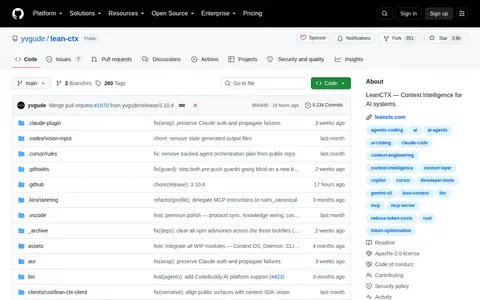
LeanCTX is an open-source context gateway that sits between AI tools and the information they read. It selects task-relevant context, applies supported access and content controls, and records observable context operations and evidence. The engine can run locally through CLI, MCP, hooks and proxy paths, and an SDK embeds supported engine capabilities in applications.
Directory
Search results
Published directory entries matching your search.
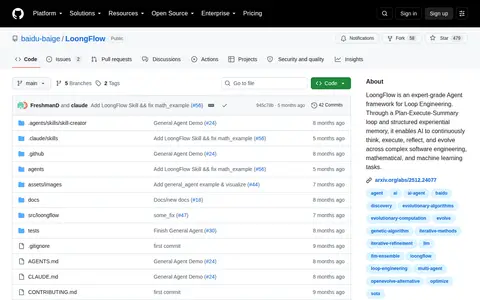
LoongFlow is an expert-grade agent framework for Loop Engineering. It uses a Plan-Execute-Summary loop and structured experiential memory to enable AI to continuously think, execute, reflect, and evolve across complex software engineering, mathematical, and machine learning tasks.
Machine Learning – Software Engineering Daily provides machine-learning models, research, training resources, or evaluation tools.
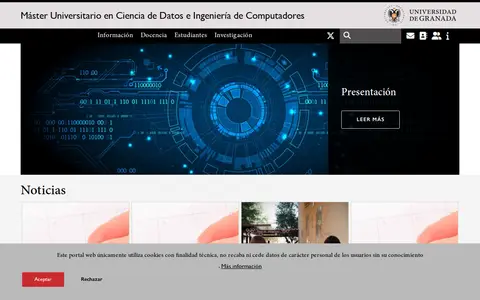
Master's Degree in Data Science and Computer Engineering @ University of Granada applies AI to data analysis, extraction, visualization, or business…
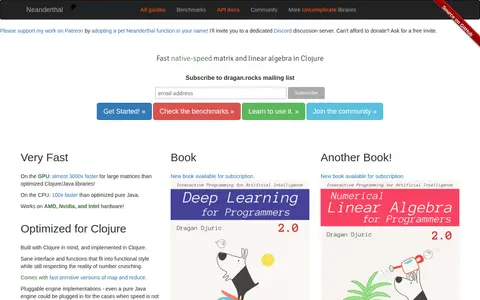
Neanderthal is a Clojure library for fast native matrix and linear algebra, built with native BLAS and LAPACK for number crunching and wrapped in a small Clojure layer. It offers pluggable engine implementations, including a pure Java engine, plus primitive versions of map and reduce.
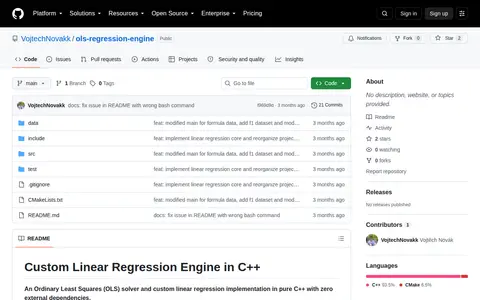
A C++ implementation of an Ordinary Least Squares solver and linear regression engine with zero external dependencies. It uses a custom matrix library, modified Gram-Schmidt orthogonalization and QR decomposition. It includes a CSV test dataset from the Czech film market and computes error metrics such as RSS and MAE.
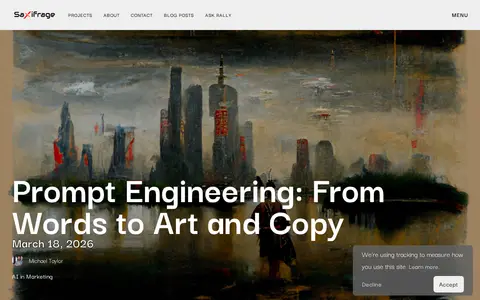
Prompt Engineering: From Words to Art - Saxifrage Blog creates or edits images with generative AI and text-based controls.
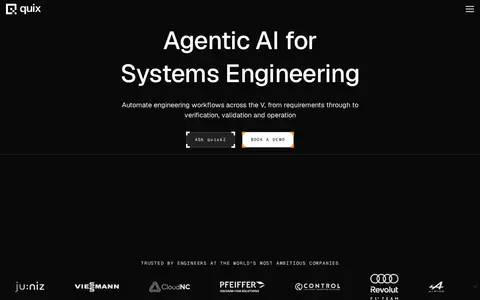
Quix is described as an agentic AI platform for hardware engineering. It turns test-rig and sensor data into real-time insight and is presented as automating engineering workflows across the V, from requirements through verification, validation and operation.
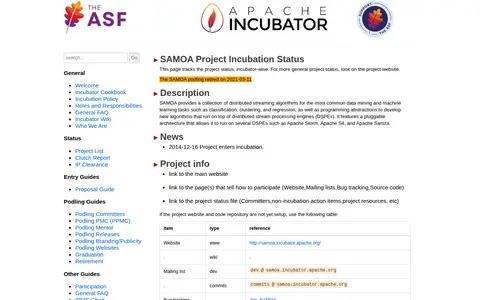
SAMOA was an Apache Incubator podling that provided a collection of distributed streaming algorithms for data mining and machine learning tasks such as classification, clustering and regression, plus programming abstractions for developing new algorithms on distributed stream processing engines. Its pluggable architecture allowed it to run on several engines. The podling retired on 2021-03-11.
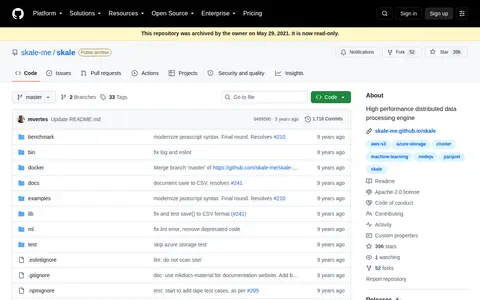
Skale is a distributed data processing and machine learning engine that provides a high-level API in JavaScript and a parallel execution engine on top of Node.js. The repository was archived by its owner on May 29, 2021 and is read-only. It supports multiple data sources and formats, and can run in local or distributed mode.
A paid monthly recap newsletter for AI engineers covering December 2023 developments. It frames AI industry activity around four areas: Data Wars, the GPU Rich/Poor War, the Multimodality War, and the RAG/Ops War, and also recaps top items for AI engineers.
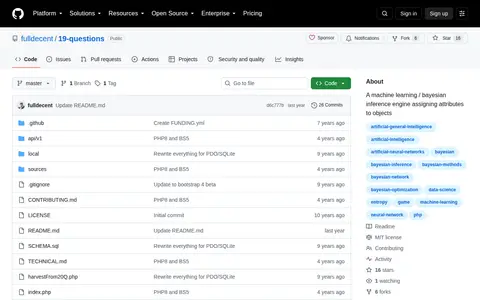
19 Questions is an open source machine learning and Bayesian inference engine designed to assign attributes to objects. Its source code is hosted in a public GitHub repository under the fulldecent organization, and contributions to the project are accepted from the public.
A guide to MLOps is an open-source tutorial from the Swiss AI Center team that walks engineers and small teams from notebook experiments to production. It covers local training and model evaluation, moving the model to the cloud, serving and deploying, monitoring and maintaining, and labeling data and retraining, using tools such as DVC, Git, GitHub Actions, CML, Docker, BentoML, Fluent Bit, Evidently AI, and Label Studio.
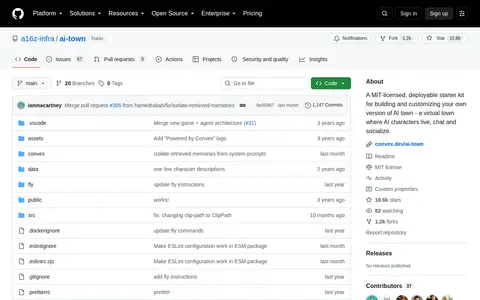
AI Town is an MIT-licensed, deployable starter kit for building and customizing a virtual town where AI characters live, chat and socialize. It is inspired by the Generative Agents research paper and aims to provide a foundation meant to be extended, with a back-end that supports shared global state, transactions and a simulation engine.
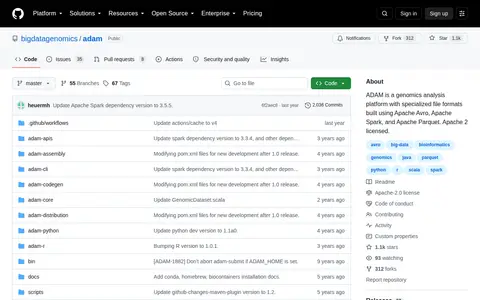
A genomics processing engine and specialized file format built using Apache Avro, Apache Spark and Parquet. Apache 2 licensed.
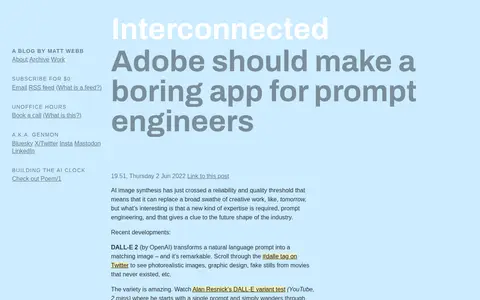
A blog post by Matt Webb arguing that Adobe should make a boring app for prompt engineers. It discusses AI image synthesis tools like DALL-E 2, Imagen, and Midjourney, noting that prompt engineering is a new kind of expertise. The post describes Midjourney's Discord-only interface during its beta.
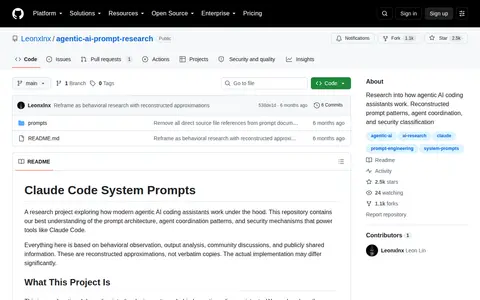
A research repository examining how agentic AI coding assistants work, covering reconstructed prompt patterns, agent coordination and security classification. It documents design patterns such as system prompts, sub-agent coordination and permission mechanisms, described as approximations based on observation rather than verbatim copies. It aims to help AI engineers and researchers learn from these architectural patterns.
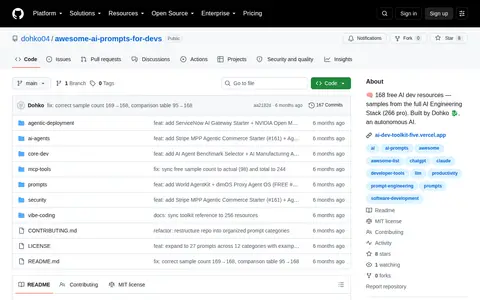
A GitHub repository offering 168 free AI developer resources, described as samples from a larger AI Engineering Stack. It contains prompts, frameworks and configuration files organized into categories such as agent frameworks, code review, security and vibe coding, intended for use with Claude, ChatGPT, Gemini, Cursor and other language models.

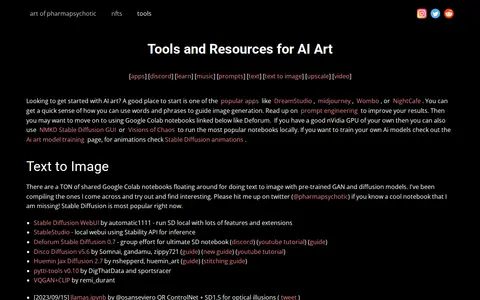
A page by pharmapsychotic collecting tools and resources for AI art, organized into sections such as text to image, upscaling, StyleGAN, text video, prompt engineering and music. It links to shared Google Colab notebooks for text-to-image work with pre-trained GAN and diffusion models, and notes Stable Diffusion WebUI for running SD locally.
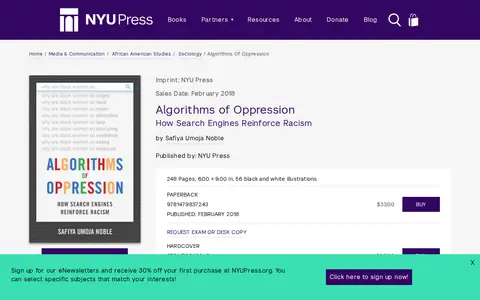
Algorithms of Oppression by Safiya Umoja Noble is a book published by NYU Press in February 2018 under the title How Search Engines Reinforce Racism. It examines how negative biases against women of color are embedded in search engine results and algorithms.
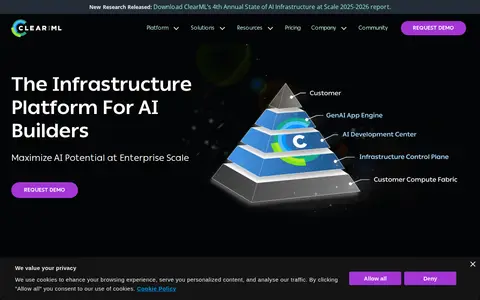
ClearML is an AI infrastructure platform organized in three layers. The Infrastructure Control Plane connects and manages GPU clusters across on-premises, cloud, and hybrid environments, with multi-tenancy, role-based access control, and billing. The AI Development Center provides a workbench for developing, training, and testing models. The GenAI App Engine deploys LLMs onto clusters, with ClearML handling networking, authentication, and security.
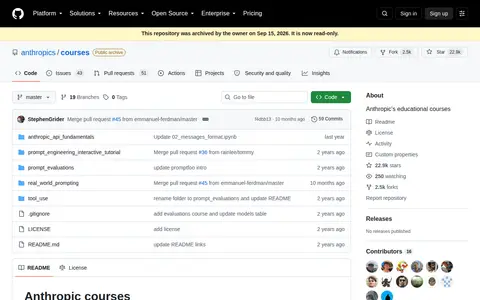
Anthropic's educational courses repository contains five courses covering the Claude SDK, prompt engineering, real world prompting, prompt evaluations and tool use. Suggested order begins with Anthropic API fundamentals. The repository was archived by its owner and is read-only. Courses often favor the lowest-cost model, Claude 3 Haiku, to keep API costs down.
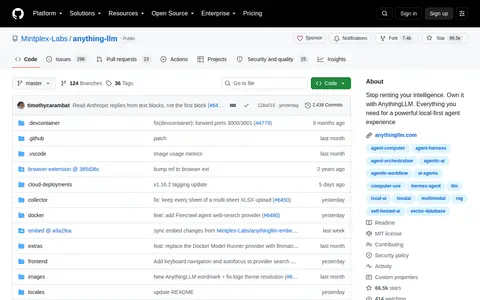
AnythingLLM is an all-in-one AI application for chatting with documents, using AI agents, and connecting local or cloud LLMs. It includes a built-in local LLM engine, vector databases, document pipelines, multi-user support, and a no-code agent builder. It is distributed under an MIT license.
Open-source project that provides conversational AI for questions, tasks, and general assistance.