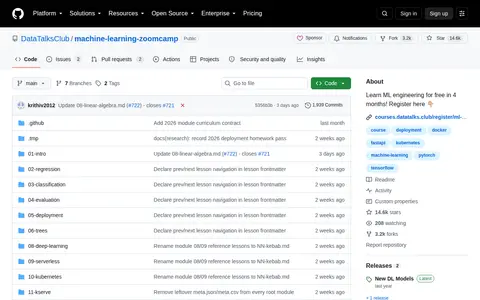

Machine Learning Zoomcamp is a free, hands-on course on building, evaluating, and deploying machine learning systems. It covers the path from framing a problem to preparing data, training and evaluating models, and deploying them, using Python, scikit-learn, TensorFlow, PyTorch, FastAPI, Docker, Kubernetes and AWS Lambda. No prior machine learning experience is required.
Directory
Search results
Published directory entries matching your search.
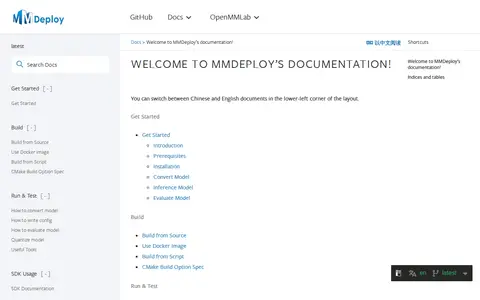
MMDeploy is documented at version 1.3.1 and covers getting started, converting, running, evaluating and quantizing models, building from source or Docker image, and SDK usage. Its backend support pages describe ncnn, ONNX Runtime, OpenVINO, PPLNN, SNPE, TensorRT, TorchScript, RKNN, TVM and Core ML, and its codebase support covers several OpenMMLab projects.
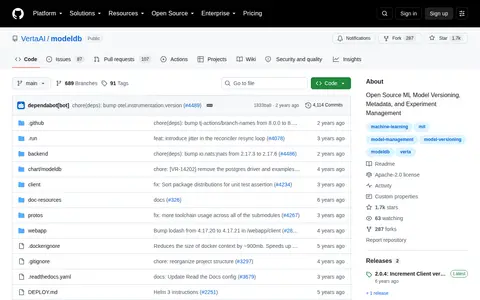
ModelDB is an open-source system for versioning machine learning models, including their code, data, config and environment, and for tracking ML metadata across the model lifecycle. It supports reproducible models, experiment management and lifecycle tracking. It runs on Docker and Kubernetes, offers Python and Scala clients, and is maintained by Verta.ai.
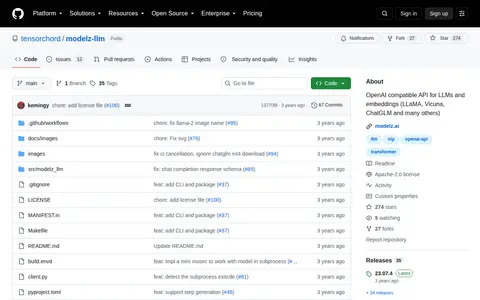
Modelz LLM is an inference server for running open source large language models such as FastChat, LLaMA and ChatGLM on local or cloud environments with an OpenAI compatible API. It supports interaction through the OpenAI python SDK or LangChain and provides docker images for deployment on Kubernetes or Modelz.
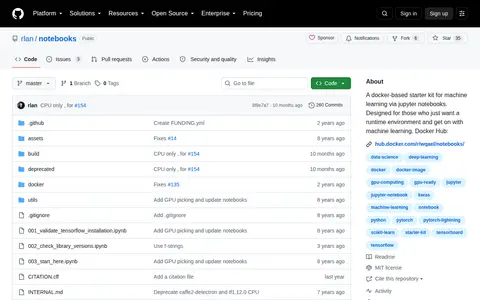
Notebooks is a Docker-based starter kit for machine learning through Jupyter notebooks, intended for users who want a ready runtime environment. Its images cover combinations of Keras, TensorFlow and PyTorch with CUDA v8 through v11, and include JupyterLab, scikit-learn, pandas and visualization, vision and NLP libraries. Python 3 only, as Python 2 is end-of-life.
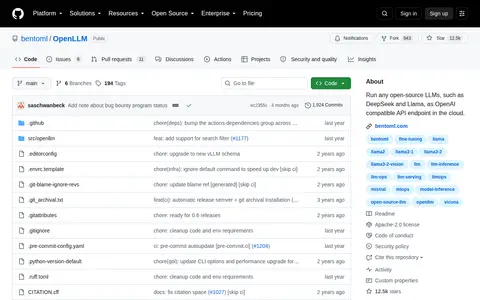
OpenLLM is a project from BentoML for running open-source LLMs or custom models as OpenAI-compatible APIs with a single command. It includes a built-in chat UI, inference backends, and a workflow for cloud deployment with Docker, Kubernetes, and BentoCloud, and it does not store model weights. A Hugging Face token is required for gated models.
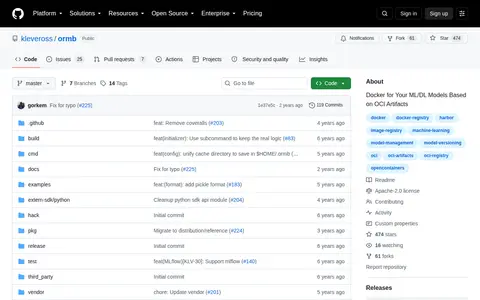
An open-source model registry that uses an image registry to distribute machine learning models. Users upload and download models with ormb pull and ormb push, and describe model information in ormbfile.yaml, similar to a Dockerfile.
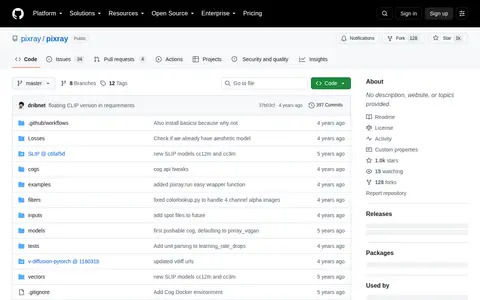
pixray is an image generation system combining perception engines, CLIP-guided GAN imagery and CLIPDraw. It is a Python library and command line utility that can also run in Google Colab notebooks or inside Docker using Cog. Installation requires a recursive git clone and a fresh Python 3.8 environment.
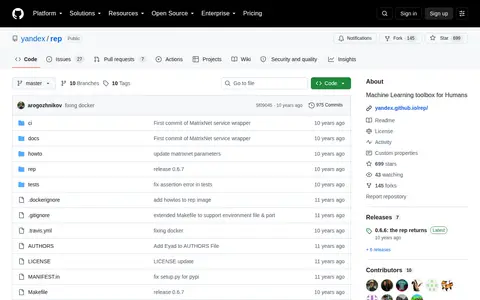
REP is a GitHub-hosted machine learning toolbox developed by Yandex, branded as a Reproducible Experiment Platform. It includes documentation for its main features, usage examples, and installation guidance for both Docker and manual setup.
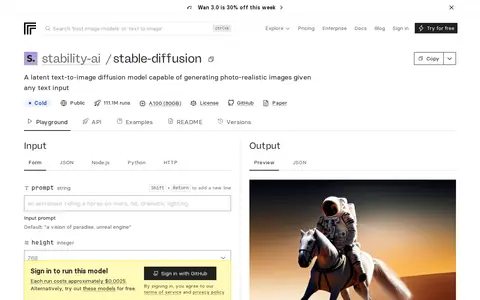
Stable Diffusion is a latent text-to-image diffusion model that generates photo-realistic images from text prompts, with support for versions 1.5 and 2.1. It is available to use via API on Replicate and can be run locally using Docker.
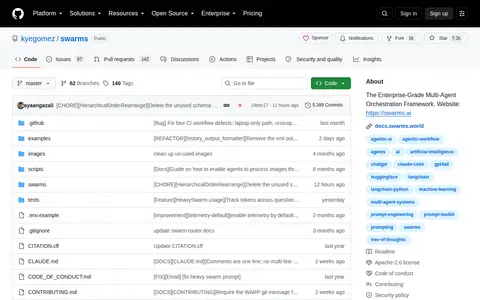
Swarms is a Python framework for building multi-agent systems, described as an enterprise-grade multi-agent orchestration framework. It provides harnesses for sequential, concurrent and hierarchical architectures, and is installed via pip, uv or Docker.
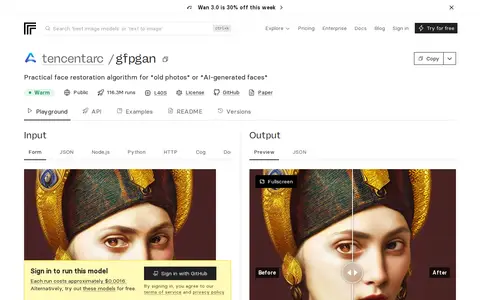
GFPGAN is a face restoration algorithm for old photos or AI-generated faces, created by tencentarc and available on Replicate. The model runs on Nvidia L40S GPU hardware and costs approximately $0.0076 to run. It is also open source and can be run on a personal computer with Docker.
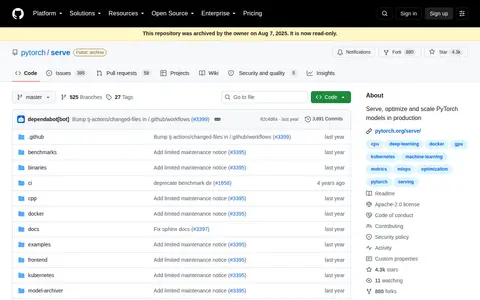
TorchServe is an open-source tool for serving, optimizing, and scaling PyTorch models in production. It offers quick start guides for TorchServe, conda, and Docker, and includes an announcement about security changes.
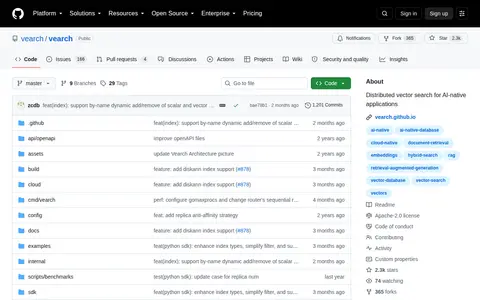
Vearch is a cloud-native distributed vector database for similarity search of embedding vectors in AI applications. It supports hybrid vector search and scalar filtering, replication, elastic scaling, RESTful APIs, and SDKs for Python, Go, Java and Rust. It integrates with frameworks including LangChain and LlamaIndex and can be deployed via Kubernetes or Docker Compose.