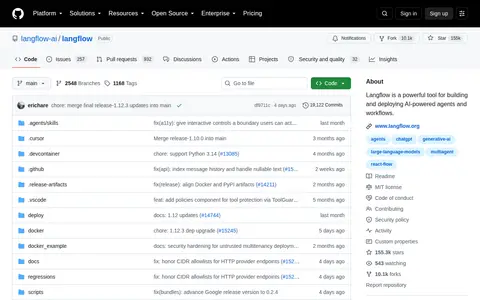

Langflow is a platform for building and deploying AI-powered agents and workflows, with a visual authoring interface and built-in API and MCP servers. It supports major LLMs, vector databases and AI tools, and allows deployment as an API, JSON export or MCP server.
Directory
Search results
Published directory entries matching your search.
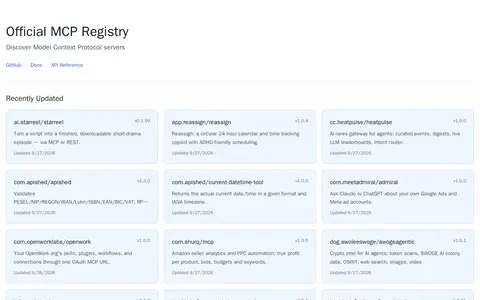
A registry for discovering Model Context Protocol servers, with links to GitHub and API reference documentation. The site lists recently updated servers and provides a base URL for API access.
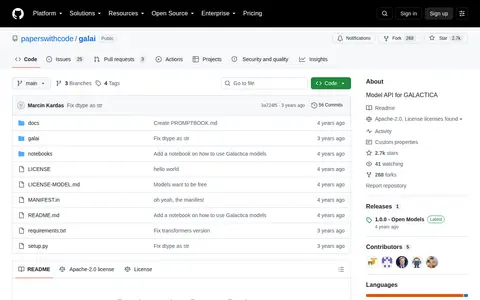
GALACTICA is a general-purpose scientific language model trained on scientific text and data. This repository provides a Model API for GALACTICA, installable from pip or the repository, with five model sizes. The models can be used with the transformers library. It is a stand-alone model that is not instruction tuned, so correct prompts are needed for good results.
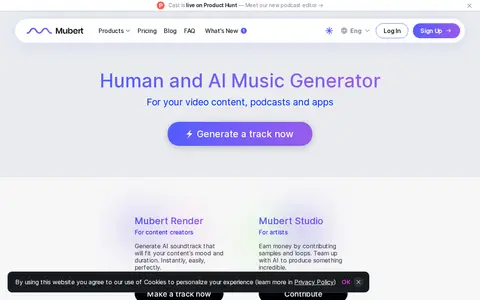
Mubert is an AI music generator offering royalty-free music from text prompts. It provides Render for content creators, Studio for contributing samples and loops, API for developers, and Play for listeners. The API supports track generation and music streaming integration.
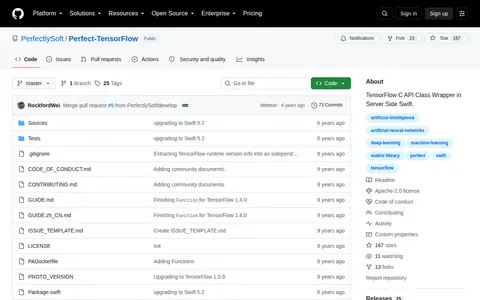
Perfect TensorFlow is an experimental wrapper of the TensorFlow C API that enables machine learning in server-side Swift. It builds with Swift Package Manager and can be used as part of the Perfect project or as an independent module. The framework conforms to TensorFlow v1.8.0 C API functionality.
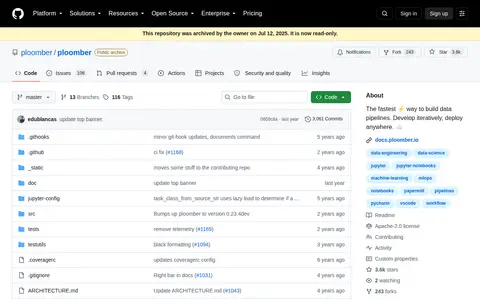
Ploomber is a tool for building data pipelines. It offers a YAML API and a Python API, and its features include caching previous pipeline results and running on Kubernetes, Airflow, AWS Batch or SLURM. It can convert monolithic notebooks into modular pipelines. The repository was archived on Jul 12, 2025 and is read-only.
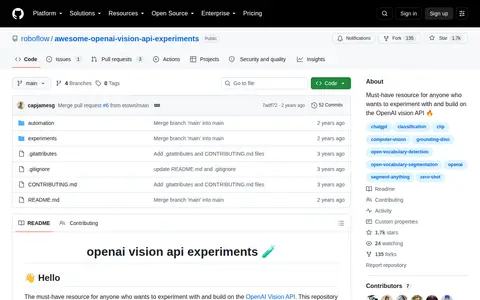
Examples showing how to use the OpenAI vision API to run inference on images, video files and webcam streams.
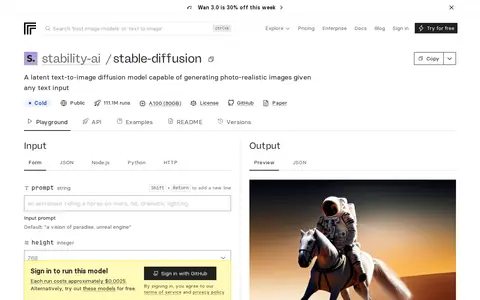
Stable Diffusion is a latent text-to-image diffusion model that generates photo-realistic images from text prompts, with support for versions 1.5 and 2.1. It is available to use via API on Replicate and can be run locally using Docker.

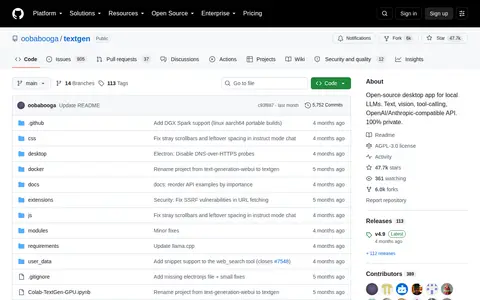
TextGen is an open-source desktop app for local LLMs, with text, vision, tool-calling and web search, plus a UI and API. It supports multiple backends including llama.cpp, Transformers, ExLlamaV3 and TensorRT-LLM, and an OpenAI/Anthropic-compatible API. It also offers LoRA training and image generation. Portable builds are provided for Linux, Windows and macOS.

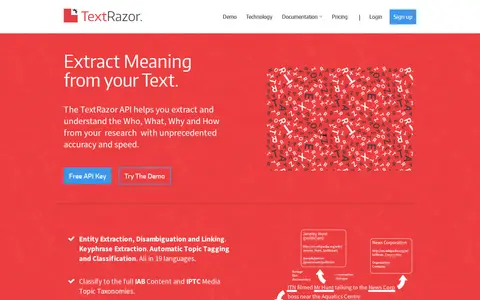
TextRazor is a natural language processing API that extracts meaning from text. It performs entity extraction, disambiguation and linking, keyphrase extraction, and automatic topic tagging and classification across 19 languages. It classifies content to the IAB Content and IPTC Media Topic taxonomies and analyzes relations and typed dependencies. Official client SDKs exist in Python, Java and PHP, with a REST API for other languages.
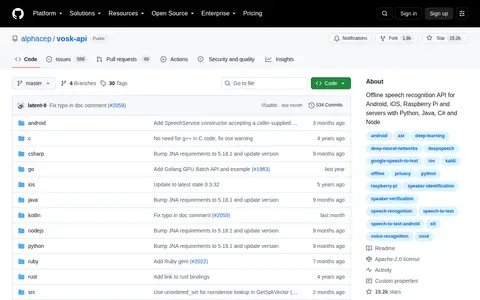
Vosk is an offline speech recognition API hosted in the alphacep/vosk-api GitHub repository. It is compatible with Android, iOS, Raspberry Pi, and server environments, and provides SDKs for Python, Java, C#, and Node.
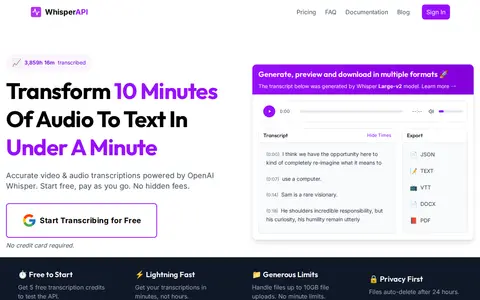
A transcription API built on OpenAI Whisper that converts audio and video files to text. It supports file uploads and remote URLs, multiple output formats, and model size selection for speed versus accuracy. A no-code dashboard offers drag-and-drop transcription. Pricing is pay-as-you-go with credit bundles, and files auto-delete after 24 hours.
Google Speech Gen helps build, test, automate, or manage AI agents, prompts, models, and API workflows.
Acapela Group is a company that develops personalized digital voices using voice AI technology. It offers text-to-speech solutions for services, applications and devices, with support for over 30 languages and more than 200 pre-made voices, plus custom voice creation options. The company provides SDKs for multiple platforms, cloud streaming APIs, and specialized solutions including voice AI for accessibility, transport and customer interaction.
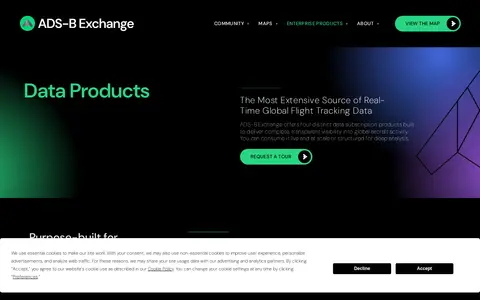
ADS-B Exchange offers live flight APIs and historical datasets of aircraft data for research, analytics and integration. Live positions refresh every 250 milliseconds, with update frequency options of 5s, 500ms or 250ms. Daily positions provide a record of global aircraft positions refreshed every 24 hours, and daily operations deliver completed flight events. Data is available via API, streaming and data feeds.
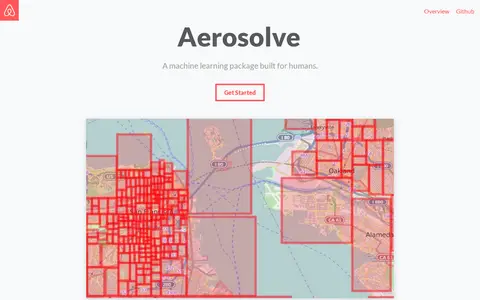
Aerosolve is a machine learning package built on the JVM. It provides features such as geo-based features, controllable quantization and feature interaction, and a feature transform language that gives developers control over features. General additive models are used. Scala handles feature training, with a lightweight Java API for run time inference.
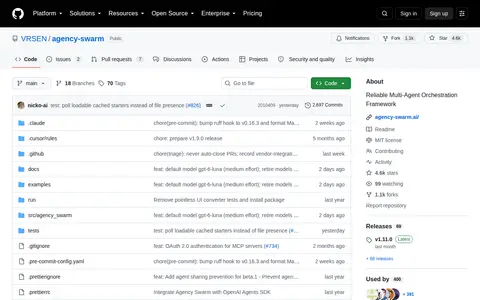
Reliable agent framework built on top of the latest OpenAI Assistants API.
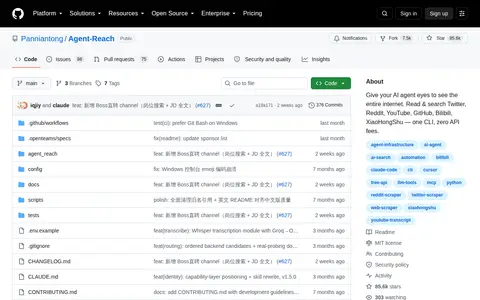
Agent Reach is a command-line tool hosted in a GitHub repository that enables AI agents to read and search content from internet platforms including Twitter, Reddit, YouTube, GitHub, Bilibili and XiaoHongShu without requiring API fees.
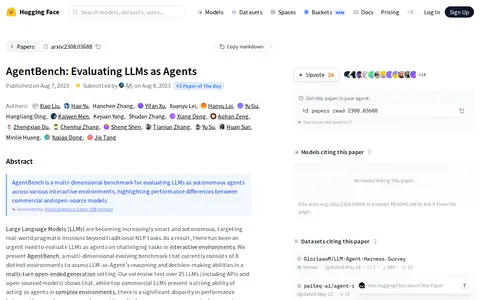
AgentBench is a multi-dimensional benchmark that consists of 8 distinct environments for evaluating LLMs as autonomous agents in interactive tasks. It assesses reasoning and decision-making abilities in multi-turn open-ended generation, and tests over 25 LLMs including APIs and open-source models.
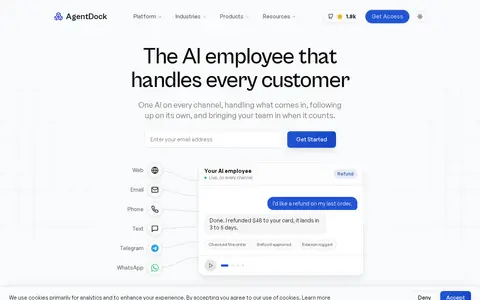
AgentDock is a writing editor, Chrome extension, open prompt library, and agent API, all stated as live. The editor supports writing, citing, and publishing documents, with citations pulled from Zotero, Mendeley, and DOIs. An AI employee for business use is described as shipping Q3 2026.
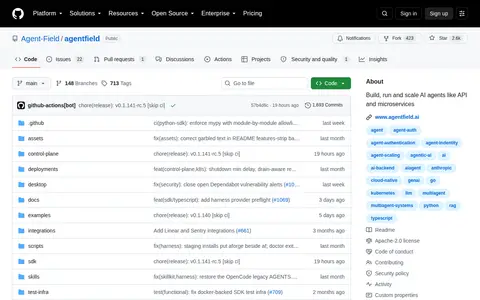
AgentField is an open source tool designed to build, run, and scale AI agents structured similarly to APIs and microservices. It supports building production agents using prompts, and its code is hosted in a public GitHub repository.
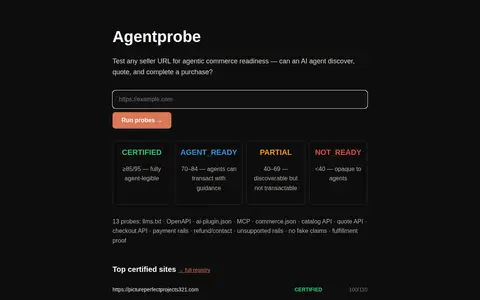
Agentprobe is a tool that tests seller URLs for agentic commerce readiness. It evaluates whether an AI agent can discover, quote, and complete a purchase using 13 probes, such as llms.txt, OpenAPI, and checkout APIs. Results are scored from NOT_READY (
Uses AI agents to complete tasks, coordinate tools or automate multi-step workflows.
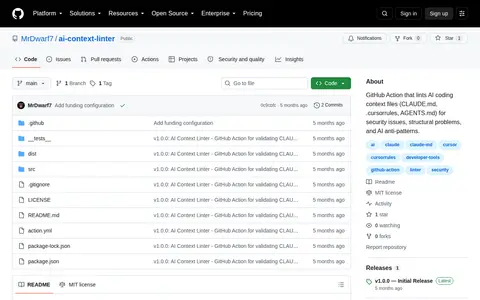
AI Context Linter is a GitHub Action that checks AI coding context files such as CLAUDE.md, .cursorrules and AGENTS.md for security issues, structural problems and AI anti-patterns. It auto-detects context files and runs 12 rules, including detection of hardcoded API keys and leaked home directory paths. Rules cover structure, vague or conflicting instructions and file-type specifics, with configurable token limits and disabled rules.