
ML/AI Interview Prep is a GitHub-hosted resource collection for machine learning and artificial intelligence technical interview preparation. It includes over 500 interview questions and answers with accompanying code, cheat sheets for NumPy, Pandas, PyTorch, and scikit-learn, and system design content targeted at candidates for roles at companies including Google, Meta, and OpenAI.
Directory
Search results
Published directory entries matching your search.
ml5.js is a JavaScript library providing access to machine learning algorithms and models in the browser, building on TensorFlow.js. It aims to make machine learning approachable for artists, creative coders and students, and is supported by code examples, tutorials and sample data sets. The project is described as currently in development.
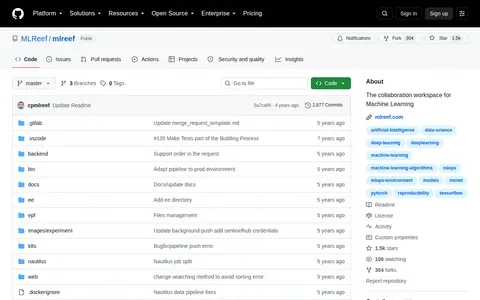
MLReef is an open source ML-Ops platform for collaborating, reproducing and sharing machine learning work. The repository notes it is no longer supported or updated there, with work continuing on GitLab. Described sections include data management with versioned data hosting, containerized code repositories, experiment tracking and ML pipelines on Kubernetes, cloud or bare metal.
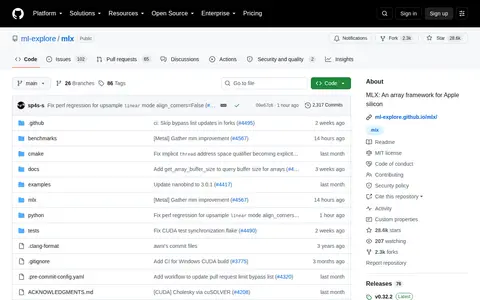
MLX is an array framework developed for use on Apple silicon hardware. The project includes example code, quickstart guides, installation instructions, and contribution guidelines. It is hosted as an open source repository on GitHub.
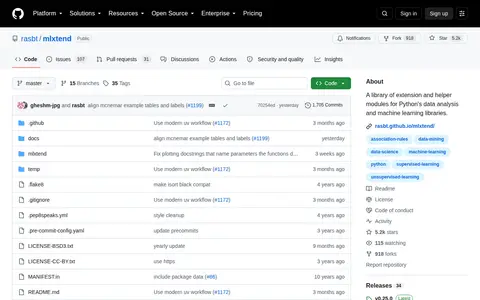
mlxtend is a library that provides extension and helper modules for Python's data analysis and machine learning libraries. The project includes installation guides, example code, license information, and contact details. It is hosted as an open source repository on GitHub.
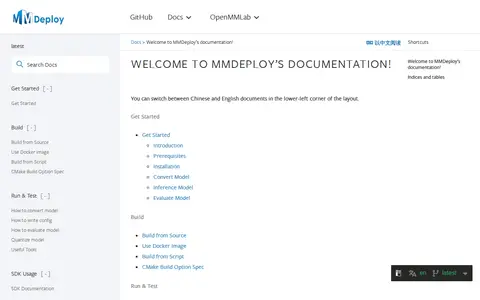
MMDeploy is documented at version 1.3.1 and covers getting started, converting, running, evaluating and quantizing models, building from source or Docker image, and SDK usage. Its backend support pages describe ncnn, ONNX Runtime, OpenVINO, PPLNN, SNPE, TensorRT, TorchScript, RKNN, TVM and Core ML, and its codebase support covers several OpenMMLab projects.
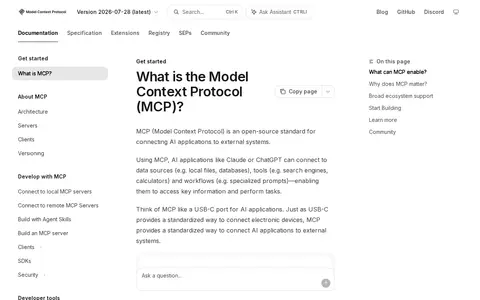
An open standard for connecting AI models to external tools and data sources. MCP Registry opensource.
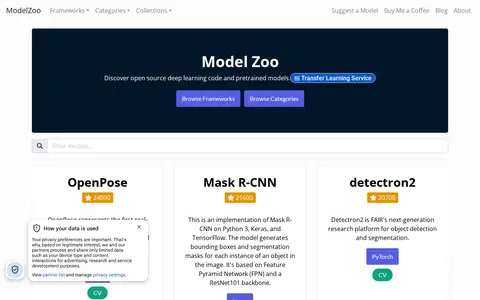
Discover open source deep learning code and pretrained models.
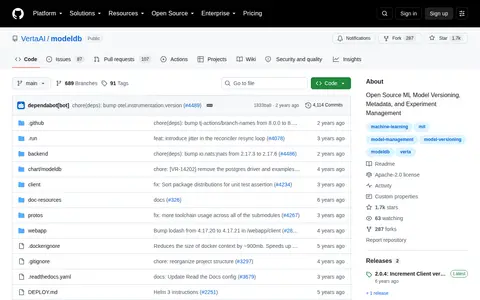
ModelDB is an open-source system for versioning machine learning models, including their code, data, config and environment, and for tracking ML metadata across the model lifecycle. It supports reproducible models, experiment management and lifecycle tracking. It runs on Docker and Kubernetes, offers Python and Scala clients, and is maintained by Verta.ai.
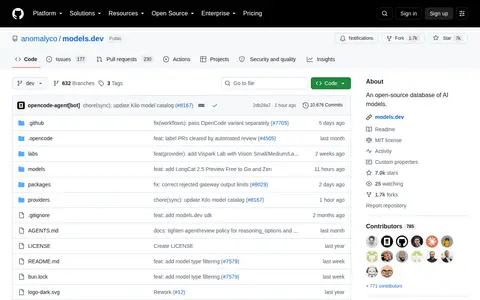
Models.dev is a GitHub repository or organization with source code, releases, documentation, or project resources.
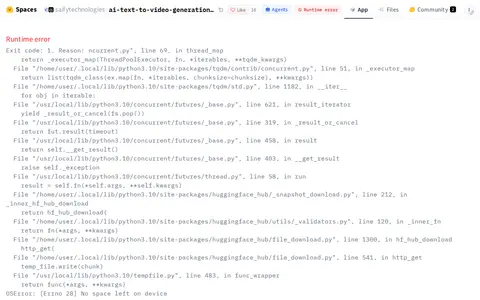
A Hugging Face Space duplicated from ali-vilab/modelscope-text-to-video-synthesis. It accepts a text prompt and an optional seed for reproducibility, and returns a video generated from the input text. The page reports a runtime error with exit code 1 and a disk space error while downloading VQGAN_autoencoder.pth.
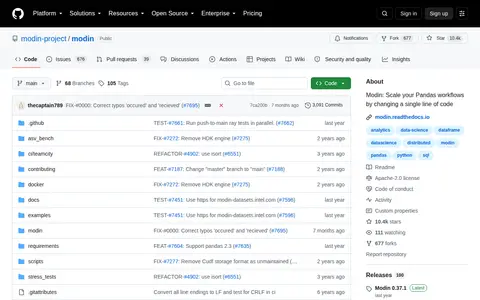
Speed up your Pandas workflows by changing a single line of code.
MongoDB is a document-oriented operational database that stores data in flexible JSON-like documents. The documentation describes built-in query capabilities including geospatial search, lexical search and vector search, and the platform page lists Atlas use cases such as vector search and stream processing.
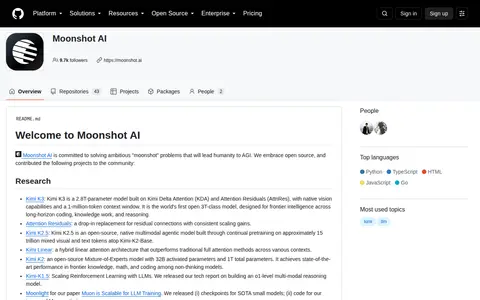
Moonshot AI is a GitHub organization focused on AI and machine learning research and development. As of the listing snapshot, it hosts 42 public repositories, with areas of work including research, benchmarks, agents, service infrastructure, and community engagement, and its code is available on GitHub.
Multi-Agent AI - Coding is a Hugging Face Space created by harry85, duplicated from the bstraehle/multi-agent-ai-autogen-coding space. It uses the Microsoft AutoGen multi-agent AI system, allowing users to input an OpenAI API key and programming task to generate formatted code solutions via a team of AI agents. The space is currently sleeping due to inactivity.
A GitHub repository with a preliminary implementation of the paper "Improving Factuality and Reasoning in Language Models through Multiagent Debate." It contains code for running arithmetic, GSM, biography and MMLU tasks through multiagent debate, with scripts to generate and evaluate answers. More tasks and settings are stated as forthcoming.
MusicGen is a single-stage auto-regressive Transformer model for music generation trained over a 32kHz EnCodec tokenizer with four codebooks, part of the AudioCraft library. It supports text-to-music and text-plus-melody-to-music models ranging from 300M to 3.3B parameters. Running it locally requires a GPU, with at least 16 GB of memory recommended for medium-sized models.
Mutahunter is an open-source, language-agnostic mutation testing tool that uses large language models. It is installed as a Python package requiring Python 3.11 or later and run against a repository with a test command, source path and test path, reporting mutation coverage and survived or killed mutants.
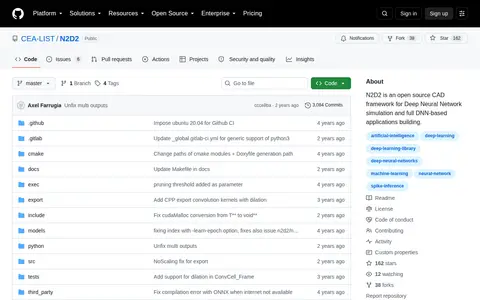
N2D2 is an open source computer-aided design (CAD) framework developed for deep neural network (DNN) simulation and the construction of full DNN-based applications. It is maintained as a public code repository by the research organization CEA-LIST.
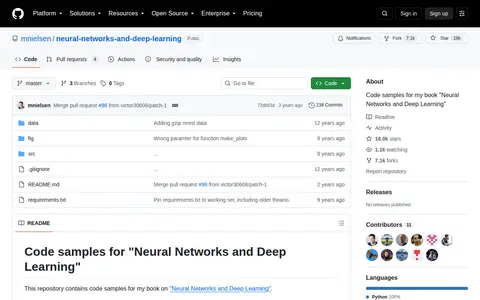
Code samples for my book "Neural Networks and Deep Learning" [DEEP LEARNING].
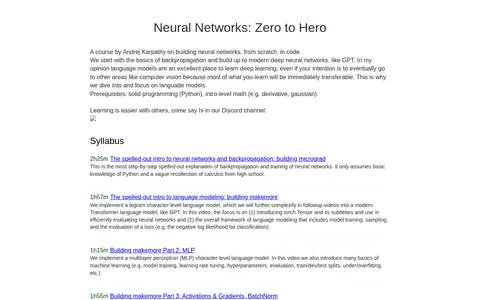
A course by Andrej Karpathy on building neural networks from scratch in code, starting with backpropagation basics and building up to modern deep neural networks like GPT. Prerequisites are solid Python programming and intro-level math such as derivatives and gaussians.
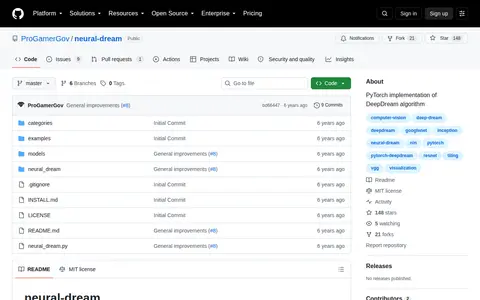
A PyTorch implementation of the DeepDream algorithm hosted on GitHub. The repository provides code for running the DeepDream algorithm using the PyTorch framework, with support for features including specific channel selection and activation strength-based channel selection.
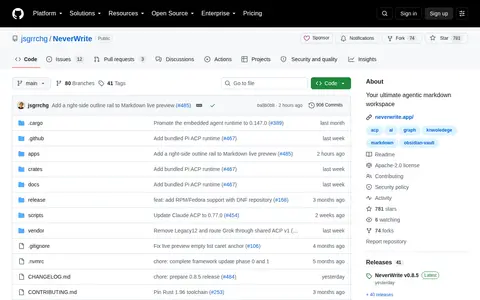
A local-first agentic markdown workspace combining a Markdown-first editor, knowledge navigation, AI agent sessions, and explicit change review in a multipane application. It runs agent sessions for providers such as Codex, Claude, Grok, Kilo, OpenCode, and Pi, and supports reviewing tracked AI edits before keeping or rejecting them.
nn_builder is a tool for building neural networks with less boilerplate code; the user specifies the network type and it builds it. It supports NN, CNN and RNN networks for PyTorch and TensorFlow 2.0, taking arguments such as layers_info, hidden_activations and dropout.