
LM Studio is a GitHub organization that provides tools for working with local large language models. As of the listing snapshot, it hosts 11 public repositories, offers functionality to discover, download, and run local LLMs, and has its code available on GitHub.
Directory
Search results
Published directory entries matching your search.
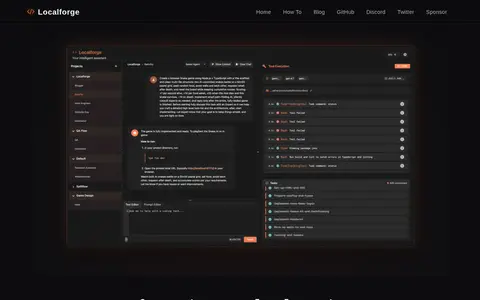
Localforge is a free, open-source desktop GUI for Codex AI, Claude and other LLMs. It runs locally and lets autonomous agent loops edit files, run tests and work on large multi-file codebase tasks. It supports swapping providers and storing prompt templates, and is distributed under the MIT license.
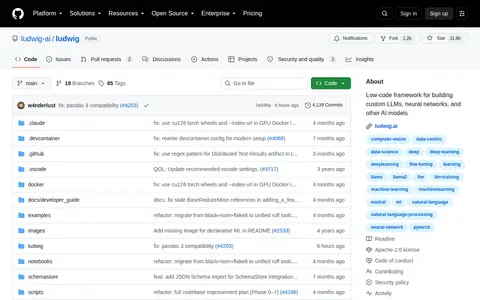
Ludwig is a low-code framework for building custom large language models, neural networks, and other AI models. The project's repository includes introductory documentation, release notes for version 0.16, installation guides, quick start materials, and resources for instruction fine-tuning of LLMs.
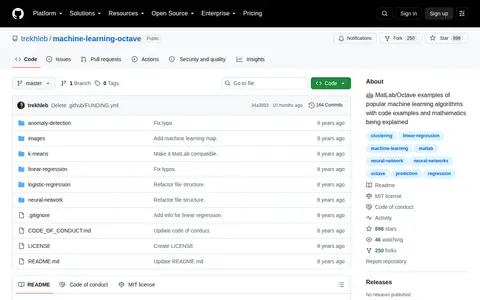
Machine Learning in MatLab/Octave is a collection of MatLab/Octave implementations of popular machine learning algorithms, including code examples and explanations of the associated mathematics. It covers supervised learning tasks such as regression and classification as well as unsupervised learning.
Magic Patterns is an AI design tool for product teams that turns prompts into production-ready UI. It can use existing components and design rules to generate prototypes, and offers an infinite canvas with collaboration. A changelog describes PDF uploads and export options.
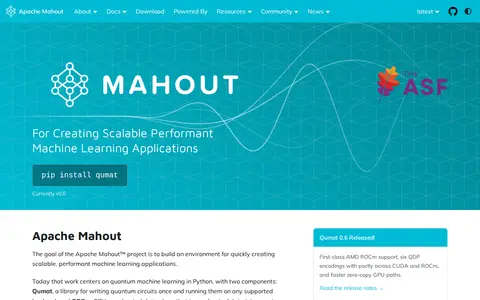
Apache Mahout builds an environment for quickly creating scalable, performant machine learning applications. Its current work centers on quantum machine learning in Python, with Qumat, a high-level library for writing quantum circuits once and running them on supported backends, and QDP, a GPU-accelerated engine that turns classical data into quantum states. The earlier Mahout Classic codebase is in maintenance mode.
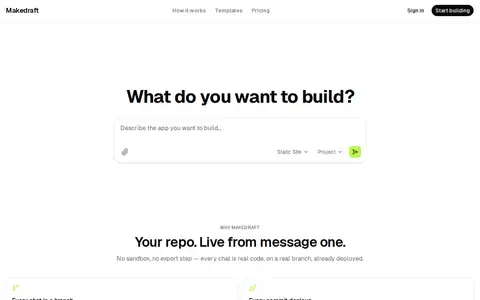
Makedraft is an AI-powered platform that builds and deploys projects from conversational instructions. It generates real code in a GitHub repository, automatically deploys each branch as a live service, and supports custom domains. It integrates with tools like Render, Supabase, and Stripe, and works with React and Next.js.
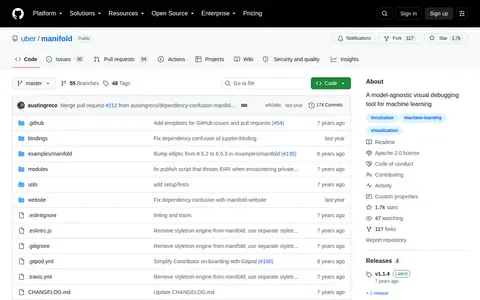
A model-agnostic visual debugging tool for machine learning.
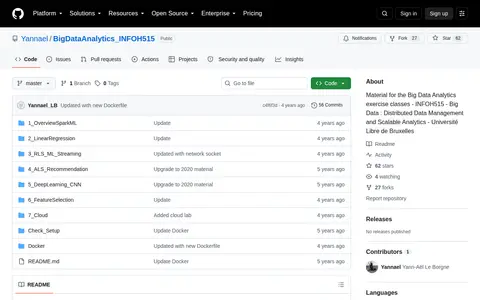
A repository of material for the exercise classes of a Big Data Analytics master course. Hands-on sessions cover Spark and its machine learning library, Map/Reduce implementations of linear regression and alternating least squares, streaming analytics with Recursive Least Squares, and image classification with convolutional neural networks. Material is provided as Jupyter notebooks.
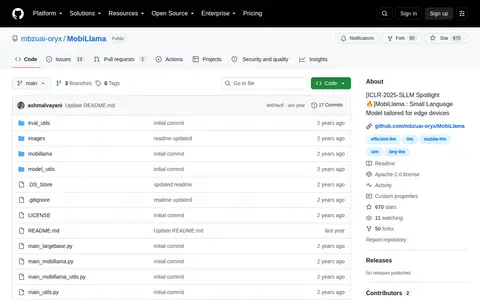
MobiLlama is a small language model tailored for edge devices. It was selected as a spotlight presentation at the ICLR 2025 SLLM Workshop, and its code is hosted on GitHub.
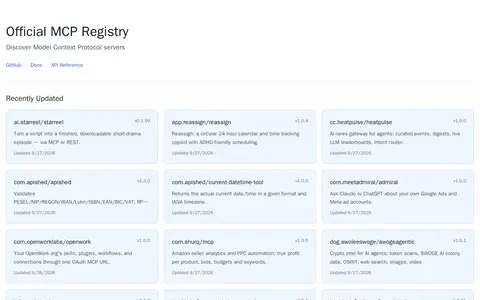
A registry for discovering Model Context Protocol servers, with links to GitHub and API reference documentation. The site lists recently updated servers and provides a base URL for API access.
MEKA is an open source implementation of methods for multi-label learning and evaluation, based on the WEKA Machine Learning Toolkit. It includes dozens of multi-label methods from the scientific literature and a wrapper to the MULAN framework. The project is distributed via SourceForge, with code hosted on GitHub.
Melies is an AI studio for filmmaking that generates images, videos, movie posters, voices, music and sound effects. It offers 30+ AI models and a library of 150+ AI actors. A CLI is available for image, video and movie poster generation from the command line. Plans include monthly credits.
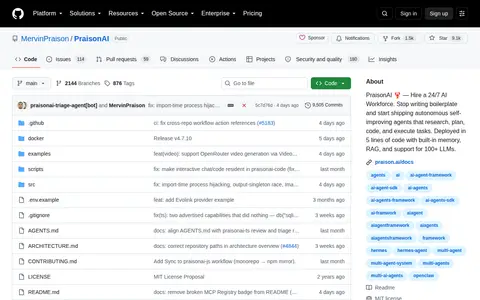
PraisonAI is an open-source project hosted on GitHub under the MervinPraison/PraisonAI repository. It enables the deployment of autonomous, self-improving AI agents capable of researching, planning, coding, and executing tasks. The tool includes built-in memory and retrieval-augmented generation (RAG) capabilities, supports over 100 large language models, and can be deployed with 5 lines of code.
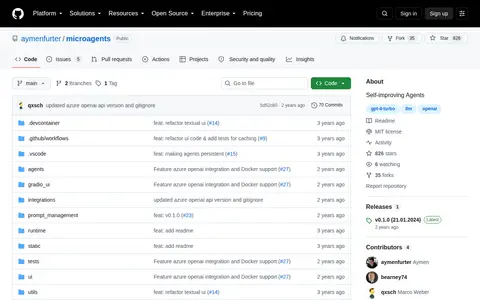
Microagents is an experimental framework for dynamically creating self-improving agents in response to user tasks. Generated agents are assessed and stored for reuse across chat sessions. It uses Python, OpenAI's GPT-4 Turbo, and Text-Embedding-Ada-002. Agents execute Python code directly and do not currently operate within a sandbox.
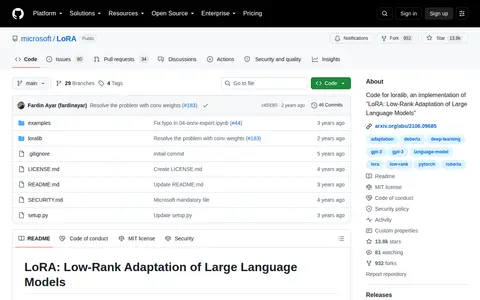
Repository containing the source code of the Python package loralib and examples of integrating it with PyTorch models, such as those in Hugging Face. LoRA learns pairs of rank-decomposition matrices while freezing the original weights, reducing the number of trainable parameters. PyTorch is the only supported framework for now.
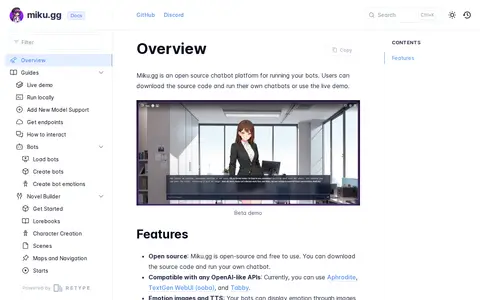
Miku.gg is an open source chatbot platform for running bots. Users can download the source code and run their own chatbots or use the live demo. It works with any OpenAI-like APIs and currently supports Aphrodite, TextGen WebUI and Tabby. Bots can show emotion through images and use TTS, with Azure TTS, NovelAI and ElevenLabs supported. A bot directory allows sharing, downloading or trying bots without local installation.
MindPal is a platform for turning documents, courses and SOPs into AI agents and multi-agent workflows. It is aimed at coaches, consultants, course creators and agencies, and users can publish agents as chatbots, embedded tools or branded portals. It offers no-code building, ready-made templates and free starting use.
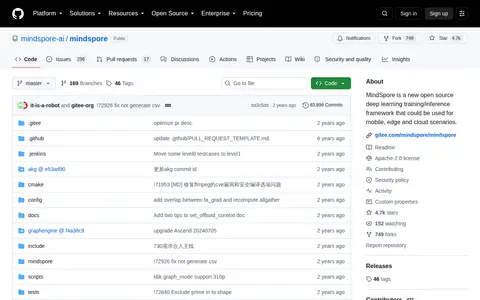
MindSpore is an open source deep learning training and inference framework that could be used for mobile, edge, and cloud computing scenarios. Its source code is hosted in the mindspore-ai/mindspore repository on GitHub.
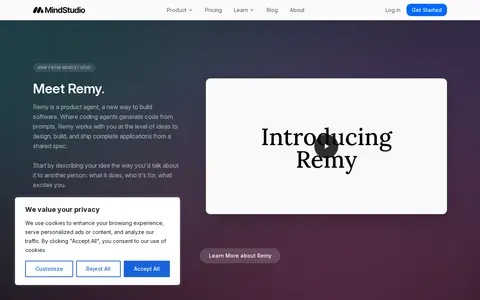
MindStudio is a visual platform for designing, building and deploying AI agents without coding, with optional code extensibility. It offers over 100 templates and connects to 200+ AI models. A product agent named Remy, in alpha, builds applications from a shared spec.
Documentation for MiniMax, covering setup, features, and practical usage.
Overview of MiniMax AI models and their capabilities.
Self-updating documentation for startups, enterprises, and agents.
ml.js is an open-source machine learning toolset implemented in JavaScript, hosted in the mljs/ml GitHub repository. It provides libraries for both supervised and unsupervised machine learning tasks, alongside usage resources and standalone example code for users.