Jupyter AI is an open source extension that connects AI agents to computational notebooks in JupyterLab. It provides a native chat UI and integrates agents through the Agent Client Protocol, with a permission system requiring approval before files are written or commands executed. It is under incubation in the JupyterLab organization.
Directory
Search results
Published directory entries matching your search.
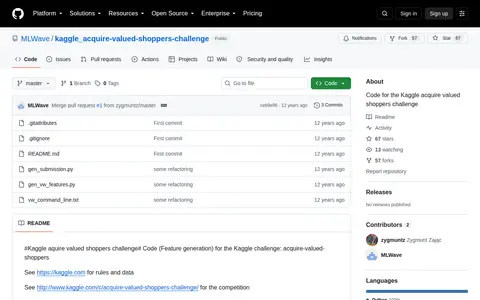
A GitHub repository holding code for the Kaggle acquire valued shoppers challenge, including feature generation scripts. The README points to Kaggle for rules and data and to a competition page and MLWave site for tutorials and discussion.
A repository holding the winning solution for the Galaxy Challenge on Kaggle. It includes code, documentation and data files, with instructions for installing dependencies such as Theano and pylearn2, downloading training data and generating the solution file.
Supports software work with AI-assisted coding, testing or application development.
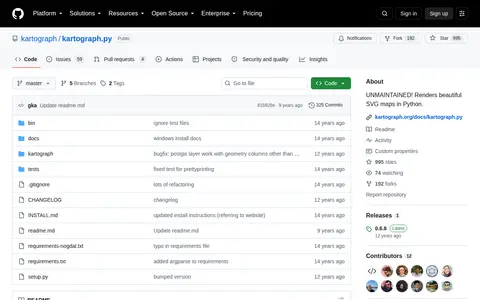
Kartograph.py is a Python library for rendering beautiful SVG maps. The project is currently unmaintained, but its source code remains available on GitHub. It allows users to create map visualizations programmatically.
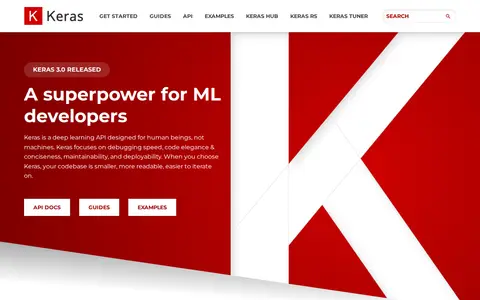
Keras is a deep learning API that focuses on debugging speed, code conciseness and maintainability. It uses a multi-backend approach that allows work with JAX, TensorFlow and PyTorch, and the KerasHub library provides Keras 3 implementations of popular model architectures with pretrained checkpoints.
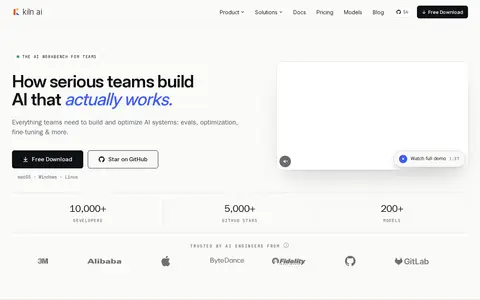
Kiln AI is a platform and open-source library for building, evaluating, and optimizing AI systems. It offers tools for working with retrieval-augmented generation, AI agents, synthetic data, model fine-tuning, and prompt optimization, with a free downloadable application available for macOS, Windows, and Linux.
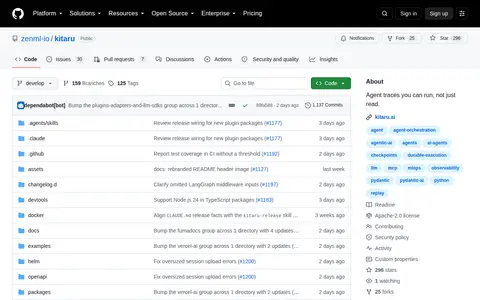
Kitaru is an open-source, self-hosted tool providing replay-based evaluations for AI agents. It records or imports production runs as sessions and replays them against a changed model, prompt, or code, with tool calls answered from the recording. It is available for Python and TypeScript and comes from the team behind ZenML.
ChatGPT, Claude, Gemini and 350+ AI models in one all-in-one AI workspace. Images, video, audio, code — one subscription, no juggling.
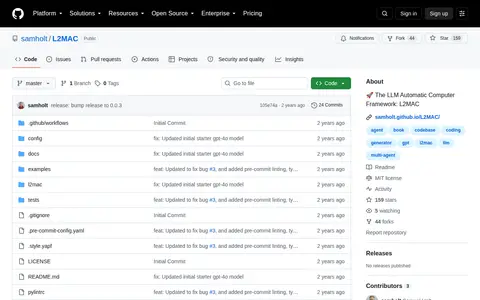
L2MAC is an open-source framework described as a Large Language Model Automatic Computer. It uses a prompt-program with instruction steps executed by agents that read and write to persistent memory, intended for generating extensive outputs such as large codebases. It is released under the MIT license.
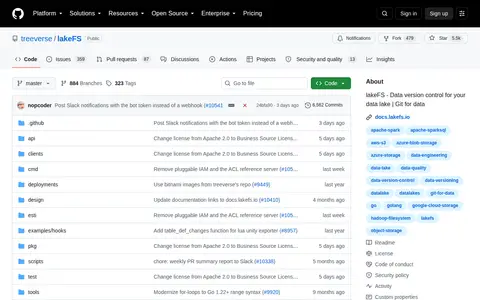
lakeFS is a source-available data version control tool that turns object storage into a Git-like repository, allowing data lakes to be managed like code. It supports AWS S3, Azure Blob Storage and Google Cloud Storage, is API compatible with S3, and works with frameworks such as Spark, Hive, AWS Athena, DuckDB and Presto.
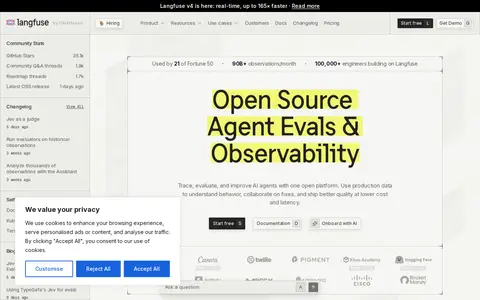
Langfuse is an open source platform for tracing, evaluating and improving AI agents. It connects tracing, monitoring, datasets, experiments and evaluation in one continuous loop, capturing every LLM call, tool invocation and retrieval step. The platform includes prompt management, a playground, experiments and human annotation, and works with any language or framework supporting OpenTelemetry instrumentation.
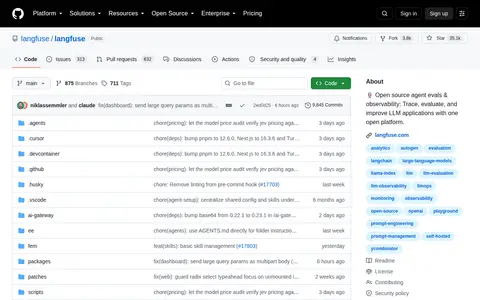
Langfuse is a GitHub repository or organization with source code, releases, documentation, or project resources.
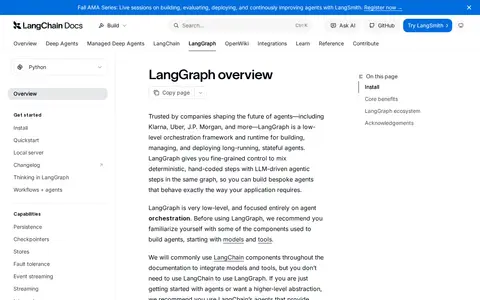
LangGraph is a low-level orchestration framework and runtime for building, managing, and deploying long-running, stateful AI agents. It provides fine-grained control to combine deterministic hand-coded steps with LLM-driven agentic steps within the same workflow graph, allowing users to build custom agents that meet specific application requirements.
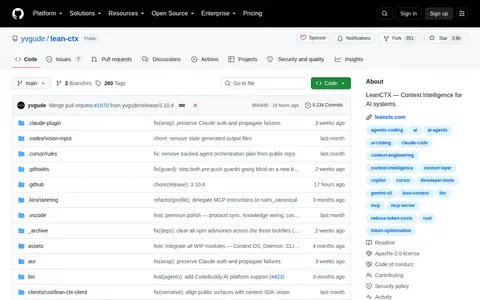
LeanCTX is an open-source context gateway that sits between AI tools and the information they read. It selects task-relevant context, applies supported access and content controls, and records observable context operations and evidence. The engine can run locally through CLI, MCP, hooks and proxy paths, and an SDK embeds supported engine capabilities in applications.
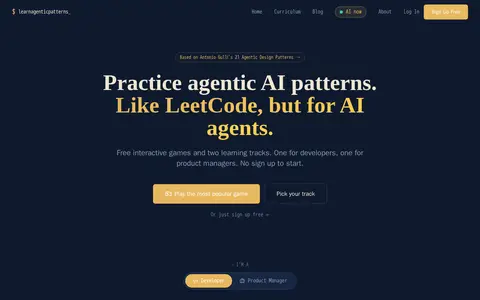
A free curriculum of six courses on agentic AI design patterns for developers and product managers. It covers code, architecture, decisions and hands-on games, with 21 patterns for developers and 15 modules for product managers. No account is needed to read the material.
Lemonade is a GitHub repository or organization with source code, releases, documentation, or project resources.
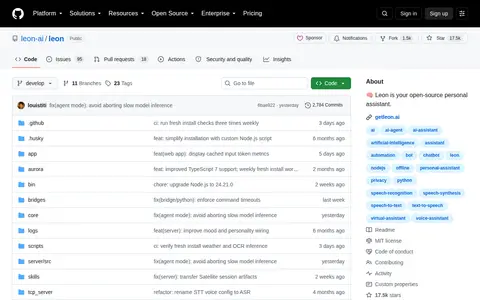
Leon is a GitHub repository or organization with source code, releases, documentation, or project resources.
LightlySSL is a Python computer vision framework for self-supervised learning on images, written in a PyTorch-like style. It exposes low-level building blocks such as loss functions and model heads, supports custom backbone models for self-supervised pre-training, and supports distributed training using PyTorch Lightning. Sample code covers models including MoCo, SimCLR, BYOL and DINO.
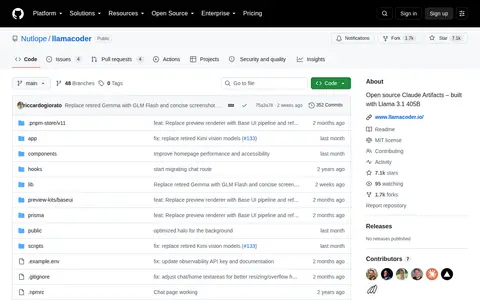
Llama Coder is an open source Claude Artifacts alternative that generates small apps with one prompt, powered by Llama 3 on Together.ai. It uses Llama 3.1 405B from Meta for the LLM and an in-browser preview renderer.
LlamaIndex is a platform focused on AI agents for document optical character recognition (OCR) and workflow automation. Its LlamaParse tool is designed to process complex documents including those with tables, charts and images, and can perform parsing, extraction, splitting, classification and indexing of document content.
This is a blog post from Confident AI that serves as a guide to LLM evaluation metrics. It covers retrieval-augmented generation (RAG) metrics such as faithfulness and answer relevancy, agent metrics, LLM-as-a-judge approaches, and includes working DeepEval code examples.
LLMStack is a no-code platform for building generative AI apps, chatbots and agents using imported data. It supports major model providers and lets users share apps publicly or restrict access with roles.