
github.com
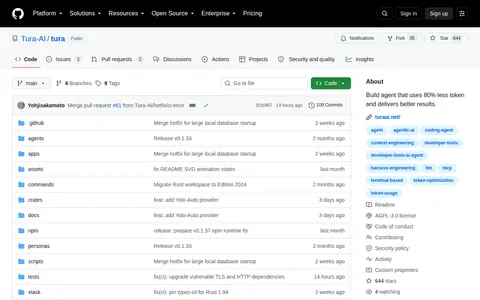
Zero-configuration MCP server that unifies multiple AI coding assistants (Claude Code, Cursor, Codex) through intelligent auto-discovery.
Directory
Published directory entries matching your search.
Zero-configuration MCP server that unifies multiple AI coding assistants (Claude Code, Cursor, Codex) through intelligent auto-discovery.

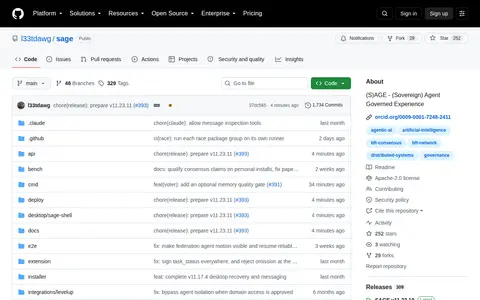
SAGE is an open-source project hosted on GitHub, with the full name (Sovereign) Agent Governed Experience. The repository is intended for collaborative development of the SAGE tool focused on agent-governed user experiences.

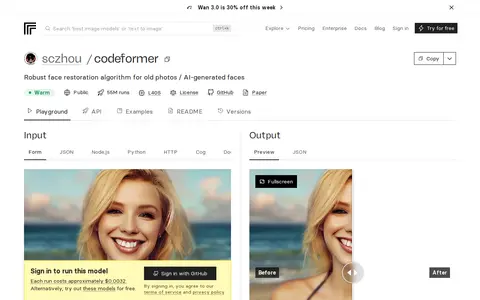
CodeFormer, developed by sczhou, is a robust open-source face restoration algorithm designed for restoring old photos and AI-generated faces. The associated web demo is intended for research purposes. It is available via the Replicate platform or for local deployment, runs on Nvidia L40S GPUs, and typically completes predictions in 3 seconds. The associated research was published at NeurIPS 2022.

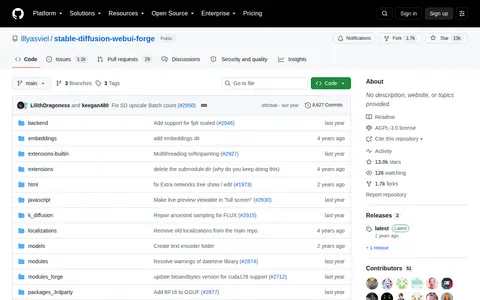
Stable Diffusion WebUI Forge is a platform built on top of Stable Diffusion WebUI (based on Gradio) that aims to ease development, optimize resource management, speed up inference and study experimental features. It is based on SD-WebUI 1.10.1 and syncs with the original WebUI periodically.

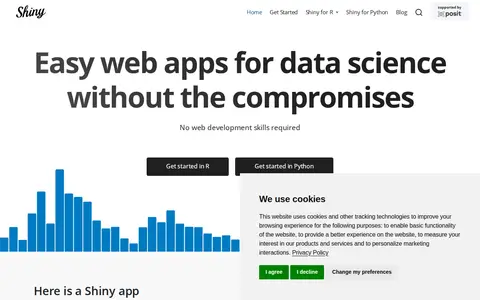
Shiny is an R and Python package for creating interactive web apps, letting users interact with data and analysis without web development skills. Apps can be written from R or Python. Questions are answered through Posit Community and Stack Overflow, with subscription support for hosting services.

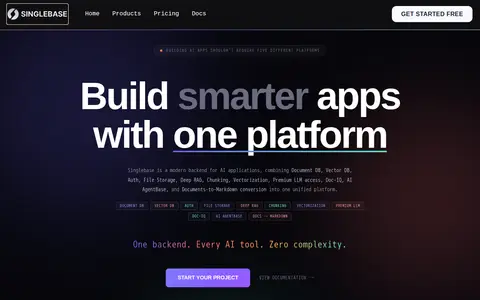
SinglebaseCloud is an AI-native backend platform and Firebase alternative that combines document and vector databases, authentication, storage, and built-in AI services to support the development and scaling of modern applications.

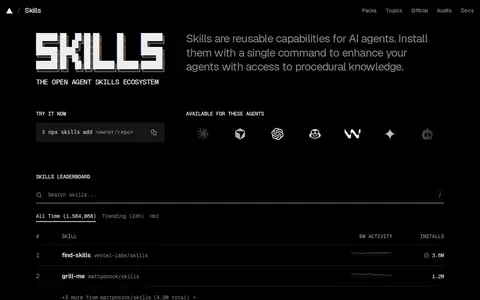
Skills is a directory for discovering and installing skills for AI agents. Skills are reusable capabilities that provide procedural knowledge helping agents accomplish specific tasks more effectively. Installation uses a skills CLI command, and the leaderboard ranks skills based on anonymous telemetry data collected from that CLI.

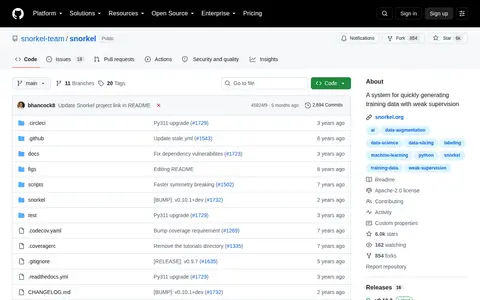
Snorkel is a system for quickly generating training data with weak supervision, released under an Apache-2.0 license and written in Python. The project started at Stanford in 2015 to programmatically label, build, and manage training data. The team now focuses on Snorkel Flow, an end-to-end AI application development platform based on the core ideas behind Snorkel.

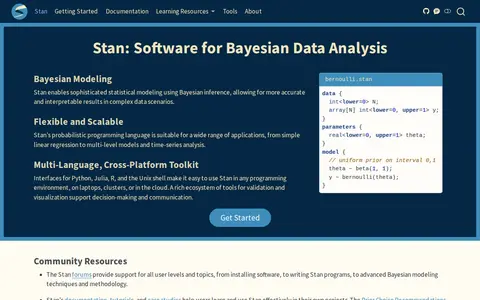
Stan is software for Bayesian data analysis that combines statistical modeling capabilities with user-friendly interfaces and open-source development. Its probabilistic programming language supports applications from simple linear regression to multi-level models and time-series analysis. Interfaces exist for Python, Julia, R, and the Unix shell, usable on laptops, clusters, or in the cloud. Official documentation covers the language, inference algorithms, and built-in functions.

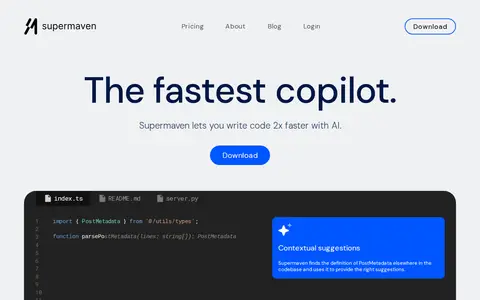
Supermaven is an AI code completion tool that uses a 1 million token context window to provide code suggestions. It is compatible with VS Code, JetBrains IDEs and Neovim, and includes a chat interface for working with models including GPT-4o and Claude 3.5 Sonnet. A free tier is offered, and Pro adds a 1 million token context window.

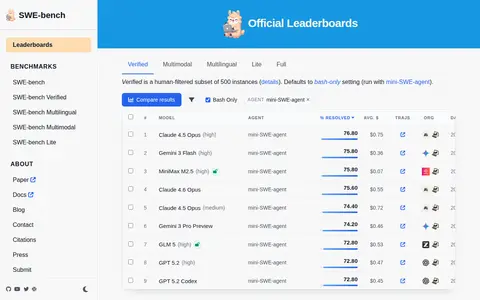
SWE-bench is a benchmark for evaluating large language models on real-world software issues collected from GitHub. Given a codebase and an issue, a language model generates a patch that resolves the described problem.

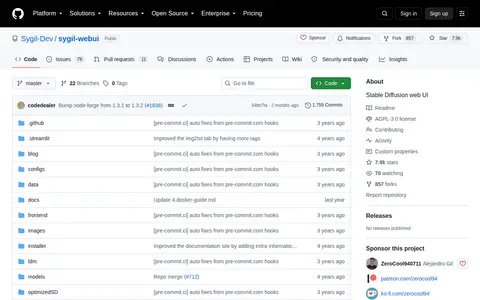
Sygil Webui is a web-based user interface for Stable Diffusion, developed by the Sygil.Dev team. Its GitHub repository provides installation instructions for the tool and links to the development team's Discord community server.

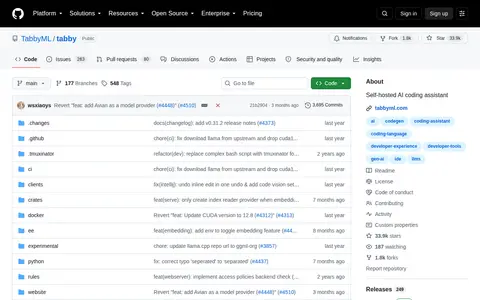
Tabby is a self-hosted AI coding assistant presented as an open-source, on-premises alternative to GitHub Copilot. The project describes itself as self-contained, requiring no DBMS or cloud service, with an OpenAPI interface for integration with existing infrastructure such as cloud IDEs, and support for consumer-grade GPUs.

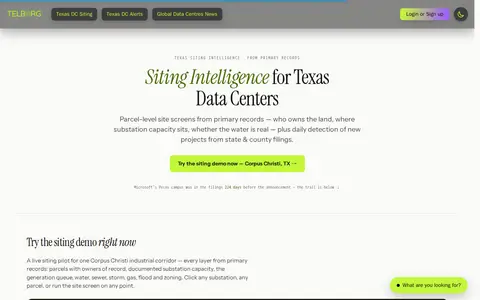
Telborg tracks construction and power developments for Texas data centers, drawing on state and county filings. It reports new campuses, power facilities and semiconductor fabs, along with the operator behind an LLC, design and construction firms, approval stage and power supplier. The site also offers a siting demo for a Corpus Christi industrial corridor.

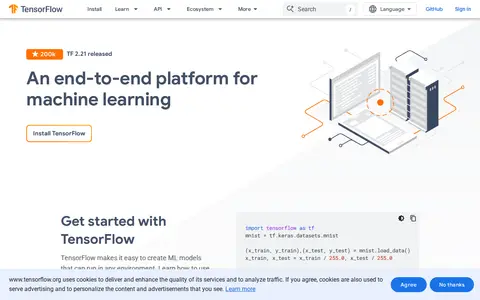
TensorFlow is an end-to-end open source machine learning platform. It provides a flexible ecosystem of tools, libraries, and community resources for machine learning development, including libraries for web, mobile, edge, and production ML pipelines, as well as pre-trained models, datasets, and educational resources for users.
Currently in development, this humanoid robot by Tesla is designed for everyday tasks and human interaction.
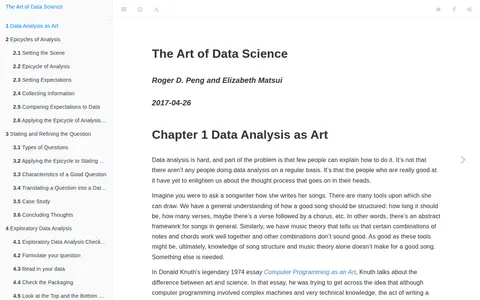
A book by Roger D. Peng and Elizabeth Matsui, dated 2017, about data analysis as an art. It discusses the thought process behind data analysis and covers R software development for building data science tools, including handling complex data, building R packages and custom data visualizations.
The copyright conundrum of AI art is an article from The Verge examining copyright issues related to generative AI. It covers image generation tools including Midjourney, Stable Diffusion, and DALL-E, discusses questions of AI art ownership, and notes that copyright concerns impact generative AI development around training data and output control.
A paid monthly recap newsletter for AI engineers covering December 2023 developments. It frames AI industry activity around four areas: Data Wars, the GPU Rich/Poor War, the Multimodality War, and the RAG/Ops War, and also recaps top items for AI engineers.

Your daily dose of AI research from AK.

The Story of AI Winters and What it Teaches Us Today is a Turing Post article that outlines five AI winter periods between 1966 and 1988. It details the causes of each collapse in AI hype, lessons learned by researchers, and how these setbacks shaped the development of modern neural networks and current AI technology.

TorchText provides models, data loaders and abstractions for language processing, powered by PyTorch. The library includes dataset iterators, basic NLP building blocks, text-processing transformations, pre-trained models and vocabulary classes. The repository was archived by its owner on Sep 10, 2025, and is now read-only; development is stopped with 0.18 the last stable release.

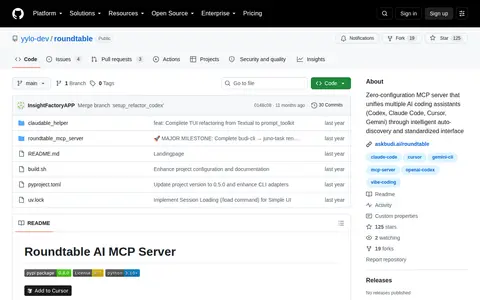
Tura is an open-source agent runtime harness that turns a task into a runtime-managed command graph, avoiding repeated model round trips in a ReAct session. The documentation describes it as a terminal-native developer tool that turns intent into verified code changes, emphasizing reading the repository first, keeping an audit trail, and proving results.

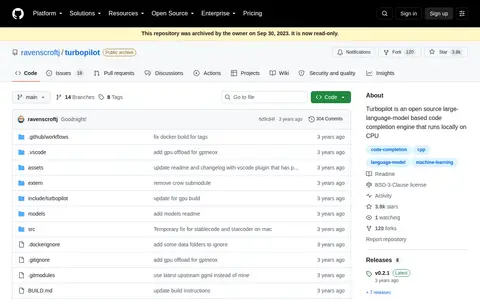
A self-hosted copilot clone that uses the library behind llama.cpp to run the 6 billion parameter Salesforce Codegen model in 4 GB of RAM.