
Floom is an open-source orchestration and execution tool for Generative AI pipelines, described as "The K8s for AI" and aimed at Developers and DevOps. Its repository is MIT licensed and the README states that Floom is now open-source and free for everyone, including commercial use.
Directory
Search results
Published directory entries matching your search.
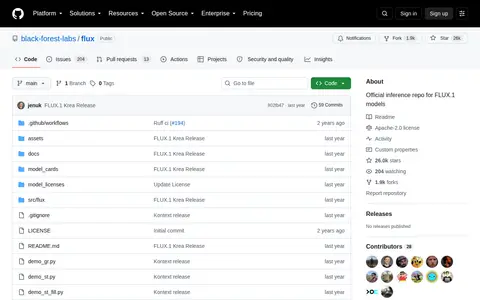
Flux is the official inference repository for FLUX.1 models from Black Forest Labs. It contains minimal inference code for running image generation and editing with the open-weight models, including text-to-image, in/out-painting, structural conditioning and image variation variants. The repository is distributed under the Apache-2.0 license.
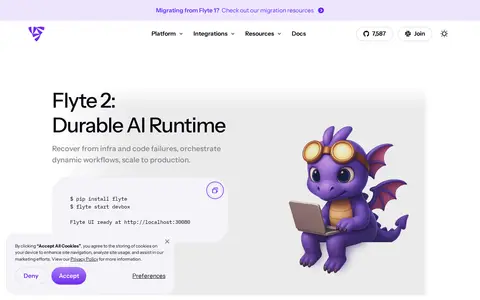
Flyte 2 is described as a durable AI runtime for running training, serving and agent workloads, with automatic recovery from infrastructure and code failures. Workflows are written in Python, and the project is distributed as Apache 2.0 open source under the Linux Foundation.
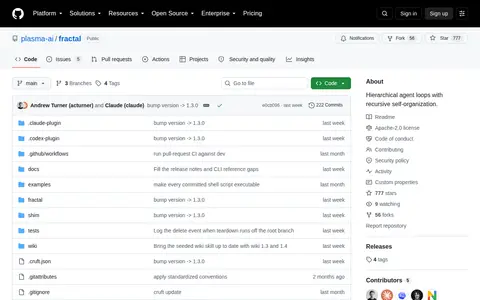
fractal is a tool for hierarchical agent loops with recursive self-organization, in which autonomous agent loops arrange themselves into a tree of git worktrees and spawn child nodes for separable subtasks. Hard caps on iterations, depth, children, cost and time bound each loop, and run metadata, including cost, is stored in a local SQLite database. Nodes run their agents without permission prompts by default.
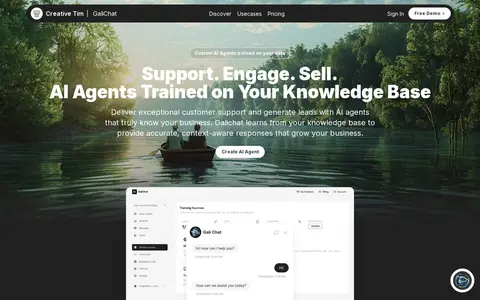
Gali Chat is a platform offering AI agents for business growth, focused on customer support, engagement and lead generation. Its agents are trained on a user's knowledge base, supporting over 50 languages, with a no-code setup process that takes approximately 3 minutes. Users can import knowledge bases from websites, PDF, Word and Excel files. The platform states its agents operate 24/7.
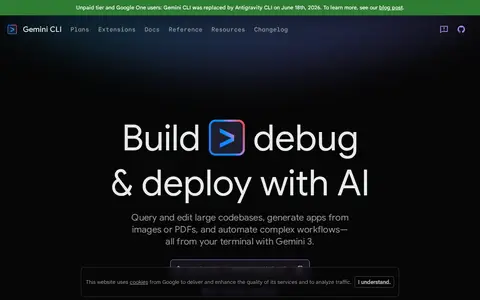
Gemini CLI is a terminal-based tool that brings Gemini models into the local development environment. It can query and edit large codebases, generate apps from images or PDFs, and automate workflows. Documentation covers configuration, extensions, agent skills, and IDE integration. Release channels include nightly, preview, and stable.
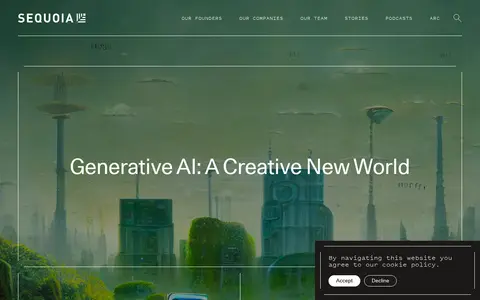
The article 'Generative AI: A Creative New World' by Sequoia Capital discusses the emergence of a powerful new class of large language models that enable machines to write, code, draw, and create with credible or superhuman results. It contrasts analytical AI with creative AI.
getdesign.md is a collection of DESIGN.md files containing independent design system analyses of popular websites. These files serve as design references for AI coding agents to ensure consistent visual styling across AI-built projects. It offers a catalog of over 550 public DESIGN.md files, private DESIGN.md creation services, and website and mobile app starter kits.
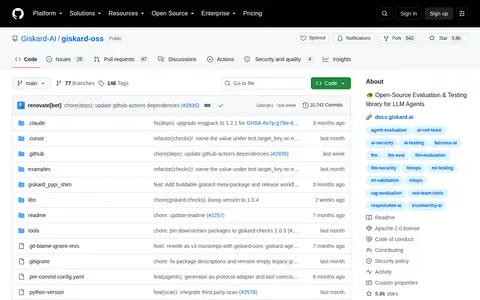
Testing framework dedicated to ML models, from tabular to LLMs. Detect risks of biases, performance issues and errors in 4 lines of code.
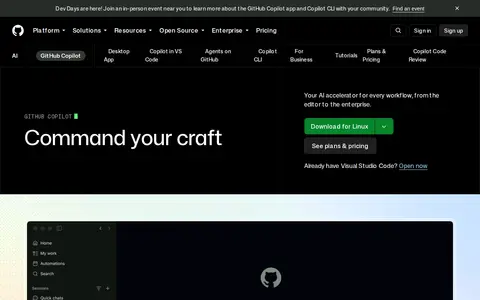
GitHub Copilot is an AI coding tool available on the GitHub platform, described as "AI that builds with you". GitHub is a software development platform used by more than 150 million people to discover, fork, and contribute to over 420 million projects.
GitHub Copilot is an AI coding agent from GitHub that assists across the workflow, from an open issue to reviewing and merging a pull request. It works in the editor, the terminal, on the desktop and on GitHub. Users can assign tasks to Copilot and third-party agents such as Claude by Anthropic and OpenAI Codex.
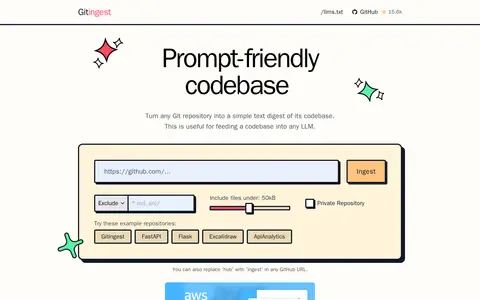
Gitingest turns a Git repository into a simple text digest of its codebase. It is intended for feeding a codebase into a large language model, and works by replacing 'hub' with 'ingest' in any GitHub URL.
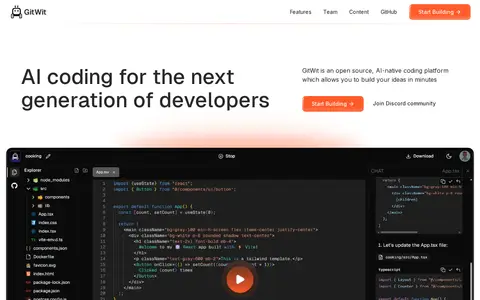
GitWit is described as an open source, AI-native coding platform intended for building ideas. The site also presents an AI Editor with AI-powered suggestions and real-time collaboration for building, testing, and deploying.
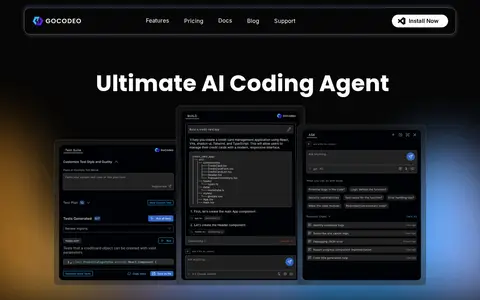
GoCodeo is an AI coding agent that integrates with IDEs to generate code and tests. Its sources describe framework support, MCP-based tool integration, Supabase integration and Vercel deployment, and automated test generation.
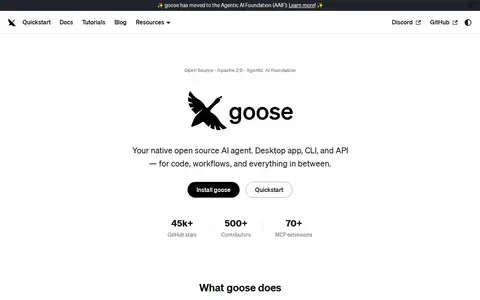
goose is an open source AI agent that runs on the user's machine. It is available as a desktop app for macOS, Linux and Windows, a CLI, and an API built in Rust. The agent is general-purpose, covering code, workflows, research, writing and automation. It connects to 70+ extensions via the Model Context Protocol and works with 15+ LLM providers, including API keys or existing subscriptions.
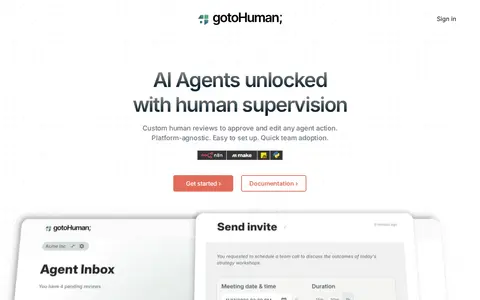
gotoHuman is a platform for supervising AI agents, letting workflows request human review of critical steps. Reviewers approve and edit AI-generated content in an Agent Inbox, with email and Slack notifications, and completed reviews return to the workflow via webhook. Review types are configured in a no-code editor and can capture text, images, markdown and JSON.
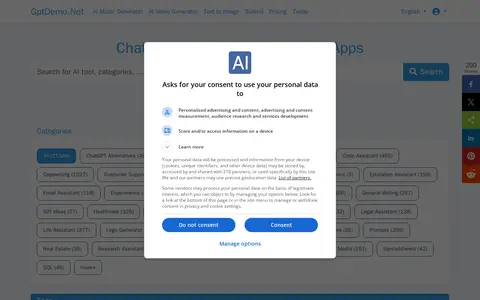
GptDemo.Net is a website that collects AI tools and displays them by category, with a catalog spanning thousands of entries. The listing shows a search or filter results page for free tools sorted by popularity, covering categories such as writing, image, video and code assistants.
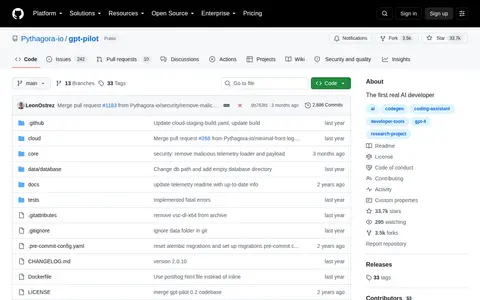
GPT Pilot is an open-source project hosted on the Pythagora-io GitHub repository, described as the first real AI developer. Unlike tools that only generate code, GPT Pilot builds full applications, and the repository includes a security notice for users.
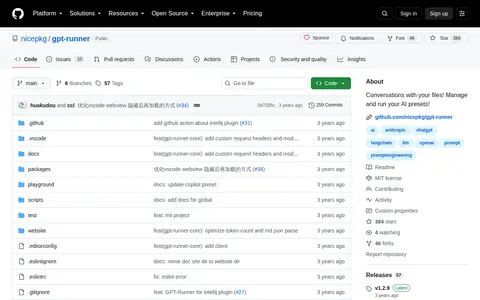
GPT Runner is a tool for managing AI presets and holding conversations with code files. It is available as a CLI, web page and VSCode extension, supports third-party LLMs, and stores data locally.
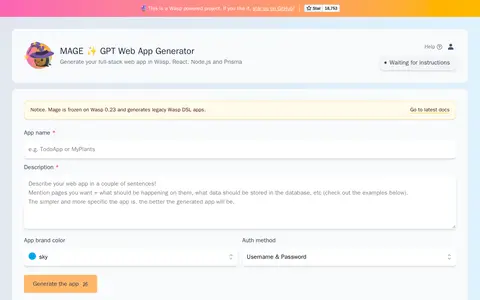
GPT Web App Generator, also referred to as MAGE, is a tool that generates full-stack web applications built with React, Node.js, and Prisma, using GPT and the Wasp full-stack framework. It is hosted at usemage.ai.
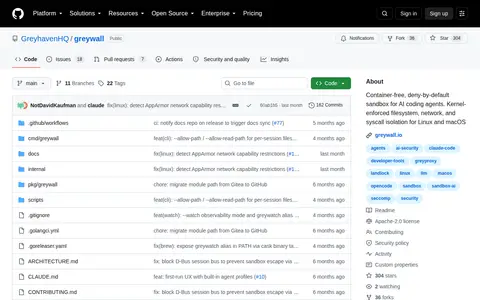
Greywall is a container-free, deny-by-default sandbox designed for AI coding agents. It provides kernel-enforced filesystem, network, and syscall isolation for Linux and macOS operating systems, and is hosted as a public repository on GitHub.
Some experiments with the coordinate descent algorithm used in the (Sparse) Group Lasso model.
Guild AI is the source repository for an open source toolkit that automates and optimizes machine learning experiments. It runs unmodified training scripts, captures each run result as a unique experiment, and automates trials using grid search, random search and Bayesian optimization.
PandasAI is an open-source library that enables conversational data analysis using large language models and retrieval-augmented generation. It allows users to interact with databases or datalakes supporting SQL, CSV, and parquet file formats.