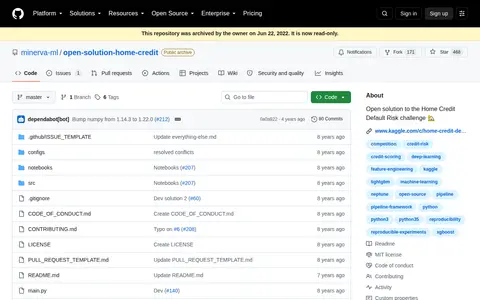
An archived, read-only GitHub repository holding an open solution to the Home Credit Default Risk challenge. It provides code, configs and notebooks plus documented solutions using LightGBM, sklearn and XGBoost with engineered features; the README lists cross-validation and leaderboard scores for each. References to Neptune are optional and the solution can run as a plain Python script.
Directory
Search results
Published directory entries matching your search.
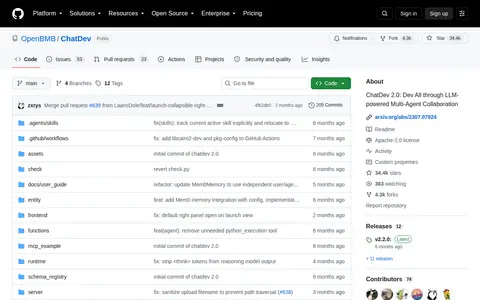
Create customized software using natural language idea (through llm-powered multi-agent collaboration).
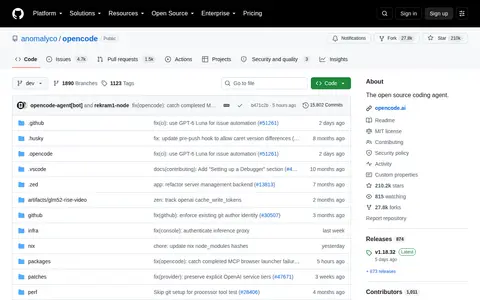
The AI coding agent built for the terminal.
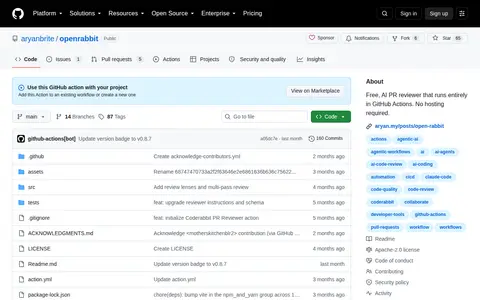
OpenRabbit is a free, open-source, self-hosted GitHub pull request reviewer. It analyzes PR diffs, consults a pluggable LLM provider such as Groq or OpenRouter, and posts a summary with inline comments. It runs entirely in GitHub Actions, so no server or hosting subscription is required, and code stays in the user's runner.
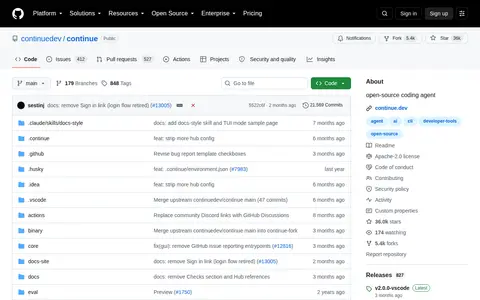
Continue is an open source coding agent. It is hosted on the GitHub repository continuedev/continue, which includes project documentation and notes a final 2.0.0 release. Contributors can engage with the project by creating a GitHub account.
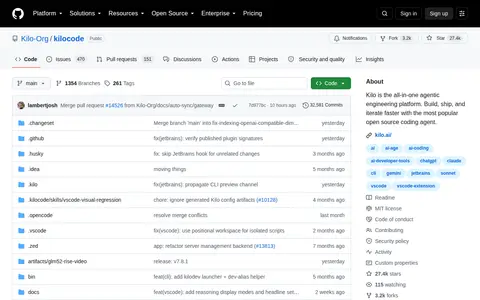
Kilo - Open-source AI coding assistant for VS Code, JetBrains, and the CLI.
Model Context Protocol - An open standard for connecting AI models to external tools and data sources. MCP Registry.
Vanna is an open source tool that enables users to interact with SQL databases via natural language. It uses large language models and agentic retrieval to generate accurate text-to-SQL queries.
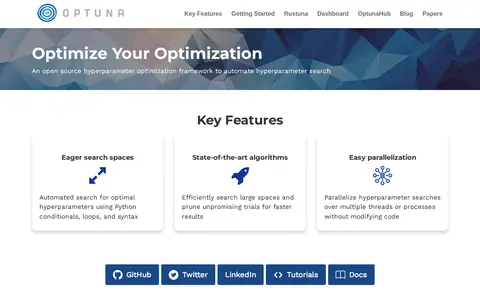
Optuna is an open source automatic hyperparameter optimization software framework designed for machine learning. It provides an imperative, define-by-run style user API with eager search spaces, algorithms that prune unpromising trials, and parallelization of searches over multiple threads or processes without modifying code. It is framework agnostic and can be installed with pip on Python 3.10 or newer.
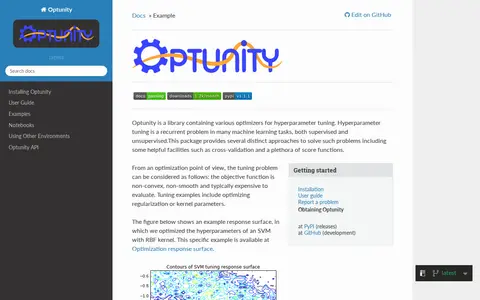
Optunity is a Python library containing various optimizers for hyperparameter tuning. It provides several approaches to solving tuning problems, including cross-validation facilities and score functions. The documentation states it is supported in R, MATLAB, GNU Octave and Java through Jython, and is free software under a BSD-style license.
Paper2Galgame is proprietary software that turns academic papers into interactive visual novels using AI. Users upload PDFs to generate story-driven explanations and can study with anime partners or custom characters. It also offers document parsing, chapter-by-chapter reading, voice, and blackboard notes. Its source code is not publicly available.
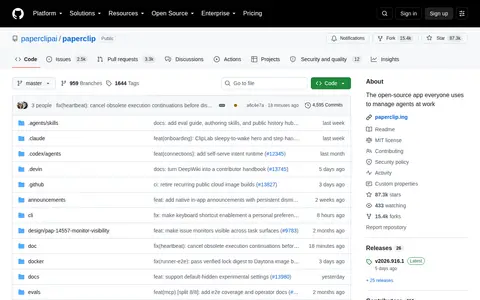
Open-source platform to run coding agents as managed workers with tasks, approvals, budgets, and workspaces.
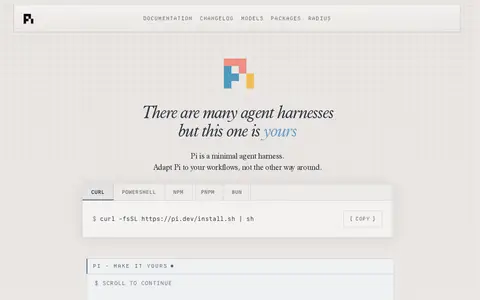
Pi is a terminal-based minimal coding agent harness built to adapt to user workflows rather than requiring users to adjust their processes. It supports 15+ providers and hundreds of models, offers tree-structured shareable interaction history, context engineering features, and four operation modes: interactive, print/JSON, RPC, and SDK. Users can customize Pi with extensions, skills, prompt templates, and themes, and share customizations as packages via npm or git. It is installable via curl, PowerShell, npm, pnpm, or bun.
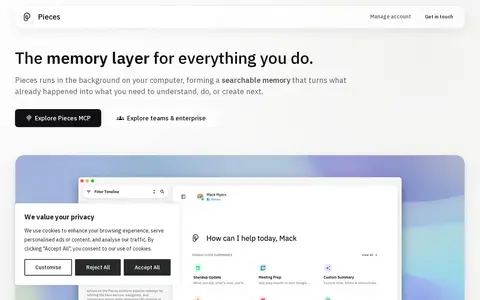
Pieces is a memory layer that runs in the background on a computer, forming a searchable record of work from apps the user already uses. It captures activity chronologically so users can search, filter and revisit moments, and carry context into AI tools. Memories are saved on-device by default, and capture from copy and paste is opt-in.
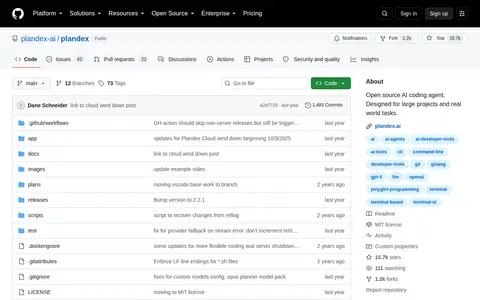
Plandex is an open source AI coding agent built for large projects and real-world tasks. It includes smart context management for large codebases, configurable autonomy levels, and tools to support producing production-ready results.
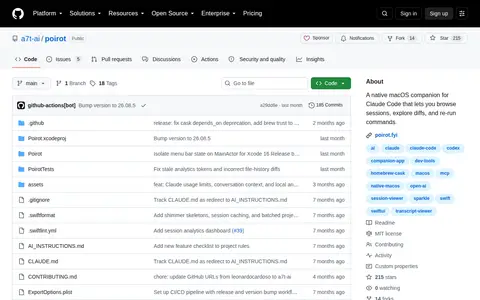
Poirot is a native macOS companion app for Claude Code. Built with SwiftUI, it lets users browse sessions, explore diffs, and re-run commands. It also provides session analytics, usage limit gauges, conversation views, and search across sessions. The app requires no login and no analytics and works offline.
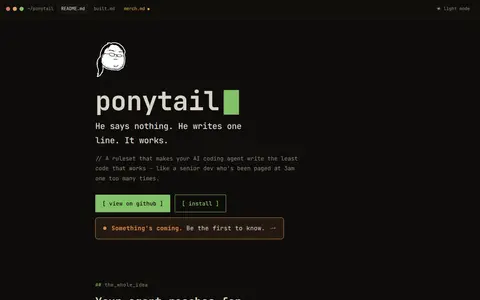
Ponytail 5 is a ruleset for AI coding agents intended to make them write the least code that works. It provides a review command and an audit command, and states tests accompany risky logic. The project reports benchmark comparisons against running without it.
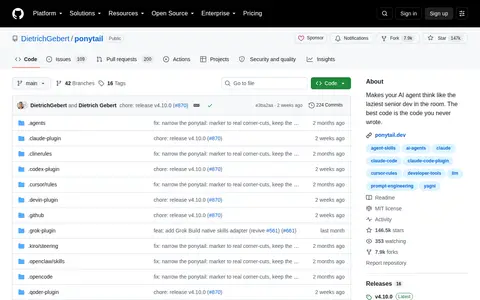
Ponytail is a GitHub repository or organization with source code, releases, documentation, or project resources.
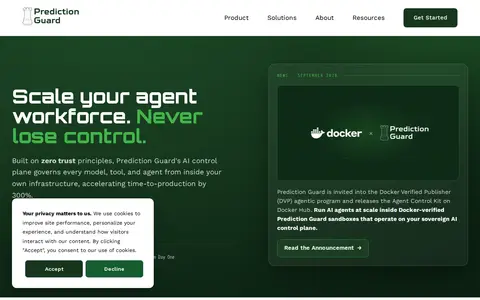
Prediction Guard is a self-hosted AI control plane described as enforcing NIST and OWASP-aligned runtime controls inside an organization's security boundary. It offers Agent Forge for creating interactive and autonomous agents, and an OpenAI, Anthropic and MCP compatible API. The site lists a Docker Verified Publisher agentic program entry and a verified Agent Control Kit on Docker Hub.
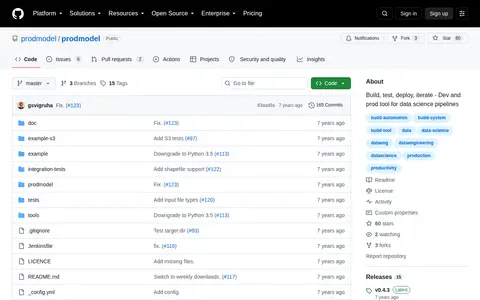
Build tool for data science pipelines.
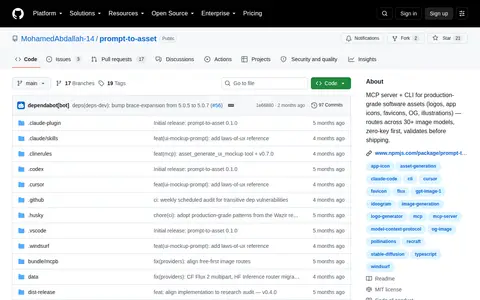
prompt-to-asset is a GitHub repository containing an MCP server and command-line interface tool for generating production-grade software assets including logos, app icons, favicons, Open Graph images and illustrations. The tool routes requests across more than 30 image models, supports zero-key initial usage, and includes validation functionality to review assets before they are shipped.
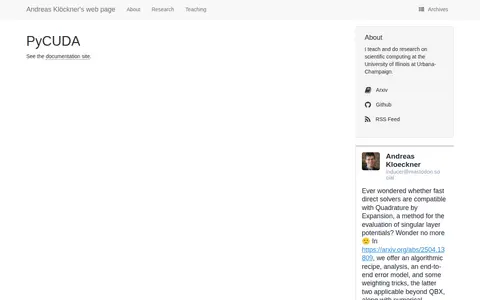
PyCUDA is a software project associated with Andreas Klöckner, who teaches and conducts research in scientific computing at the University of Illinois at Urbana-Champaign. The project has a dedicated documentation site.
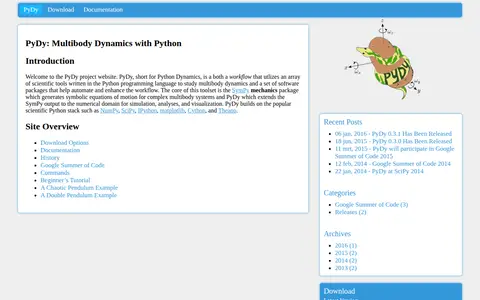
PyDy, short for Python Dynamics, is a workflow and set of software packages for studying multibody dynamics in Python. Its core is the SymPy mechanics package, which generates symbolic equations of motion for multibody systems, and PyDy extends that output to simulation, analyses, and visualization. It builds on NumPy, SciPy, IPython, matplotlib, Cython, and Theano.
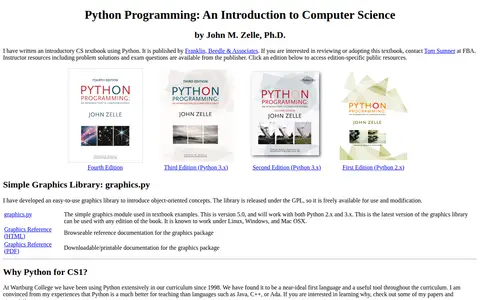
Teaching page by John M. Zelle, Ph.D., for an introductory computer science textbook written in Python and published by Franklin, Beedle & Associates. It links edition-specific public resources for four editions and offers graphics.py, a simple graphics library released under the GPL for introducing object-oriented concepts. Instructor resources including problem solutions and exam questions are available from the publisher.