




gotoHuman is a platform for supervising AI agents, letting workflows request human review of critical steps. Reviewers approve and edit AI-generated content in an Agent Inbox, with email and Slack notifications, and completed reviews return to the workflow via webhook. Review types are configured in a no-code editor and can capture text, images, markdown and JSON.

TensorForce
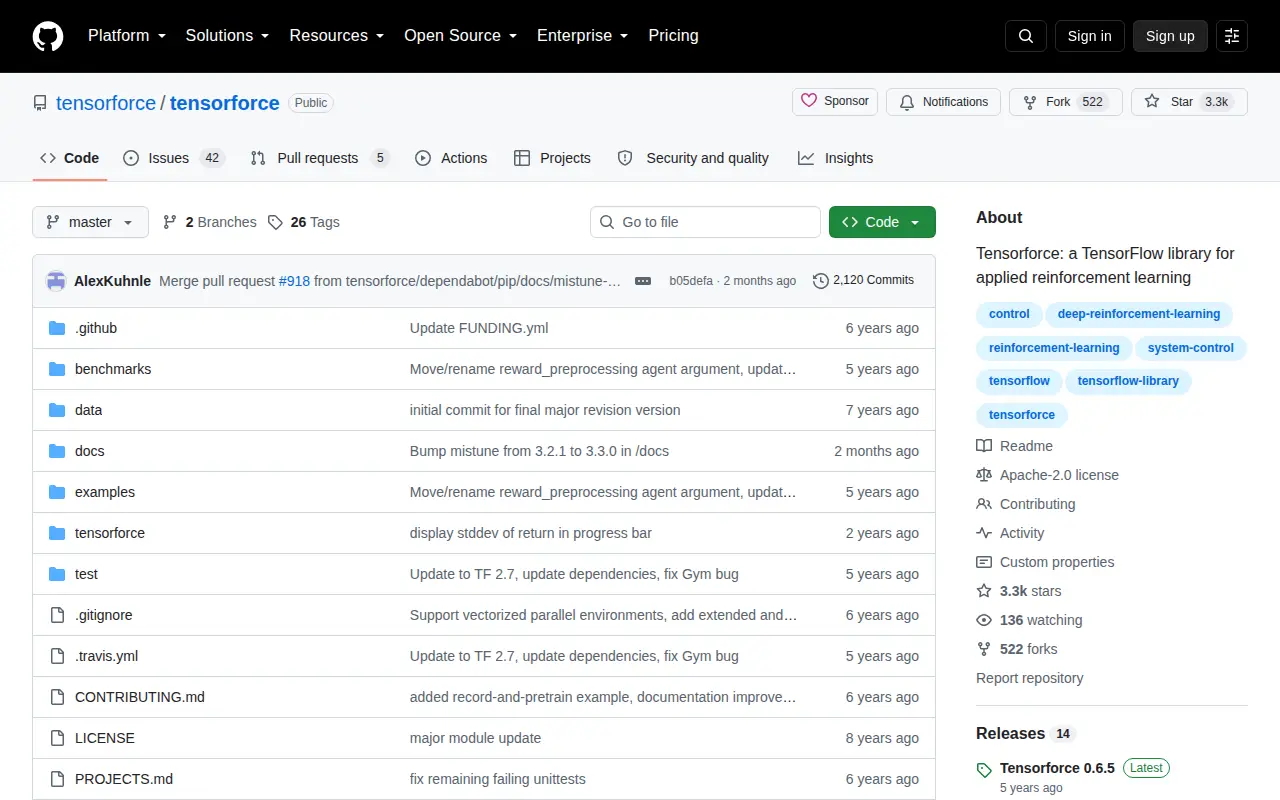
TensorForce is an open-source library built on TensorFlow for applied reinforcement learning. Hosted on GitHub, the project provides installation guidance, quickstart example code, and command line usage documentation for users.
Links
Tags
-
0gotoHuman is a platform for supervising AI agents, letting workflows request human review of critical steps. Reviewers approve and edit AI-generated content in an Agent Inbox, with email and Slack notifications, and completed reviews return to the workflow via webhook. Review types are configured in a no-code editor and can capture text, images, markdown and JSON.
-
0An index page from LabLab for discovering AI technologies and related topics. Each technology page is described as offering tutorials, upcoming hackathons, frameworks and boilerplates. Listed technologies include GPT-4, ChatGPT, BERT, AI21 Labs, Anthropic, AWS, Cohere, Hugging Face and DeepSeek.
-
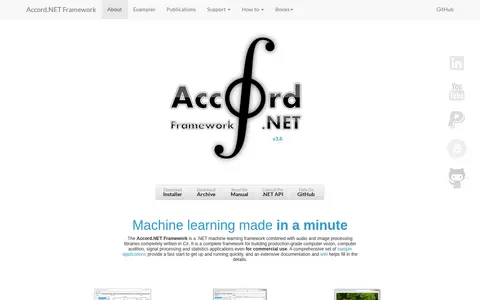
0Accord.NET is a .NET machine learning framework combined with audio and image processing libraries written in C#. It covers classification, regression, clustering, distributions, hypothesis tests and kernel methods, with imaging and signal processing components. The framework is intended for building computer vision, audition, signal processing and statistics applications, including commercial use. It offers sample applications, documentation and a wiki.
-
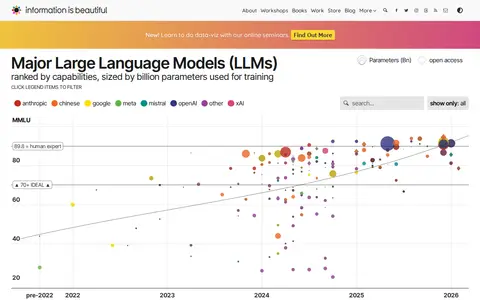
0A visualisation of major large-language models ranked by performance using the MMLU benchmark, which consists of 16,000 multiple-choice questions across 57 academic subjects. It also presents selected lawsuits filed against AI companies and notes that MMLU has some critiques.
-
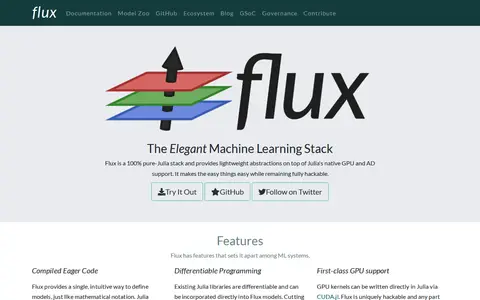
0Flux is a machine learning library built as a pure-Julia stack, offering lightweight abstractions over Julia's native GPU and automatic differentiation support. It is compiled and eager, and existing Julia libraries can be incorporated into Flux models. Its ecosystem includes probabilistic programming, graph neural networks, computer vision and natural language processing packages, and it is maintained by a community team.
-
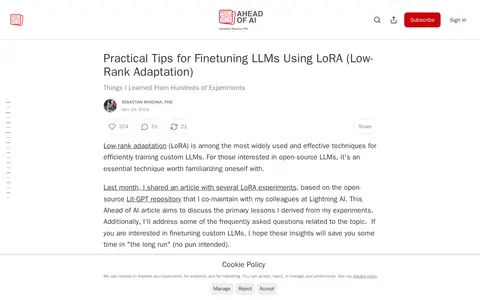
0An Ahead of AI article by Sebastian Raschka sharing lessons from hundreds of experiments on finetuning LLMs with low-rank adaptation (LoRA), billed as an essential technique for efficiently training custom open-source LLMs. It covers LoRA consistency, QLoRA compute-memory trade-offs, learning rate schedulers, Adam versus SGD, multiple epochs, enabling LoRA for more layers, and balancing rank and alpha.
Community notes
Reviews and discussion
No reviews yet
Be the first to share how this project worked for you.
Join the discussion
Sign in with a verified account to leave a review or join the discussion.
Sign in to review