


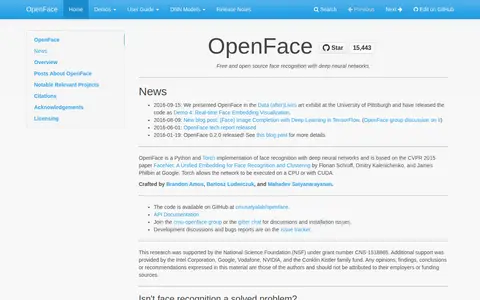
OpenFace is a free and open source face recognition implementation with deep neural networks, written in Python and Torch and based on the CVPR 2015 FaceNet paper. It detects faces, aligns them, and embeds faces on a 128-dimensional unit hypersphere.
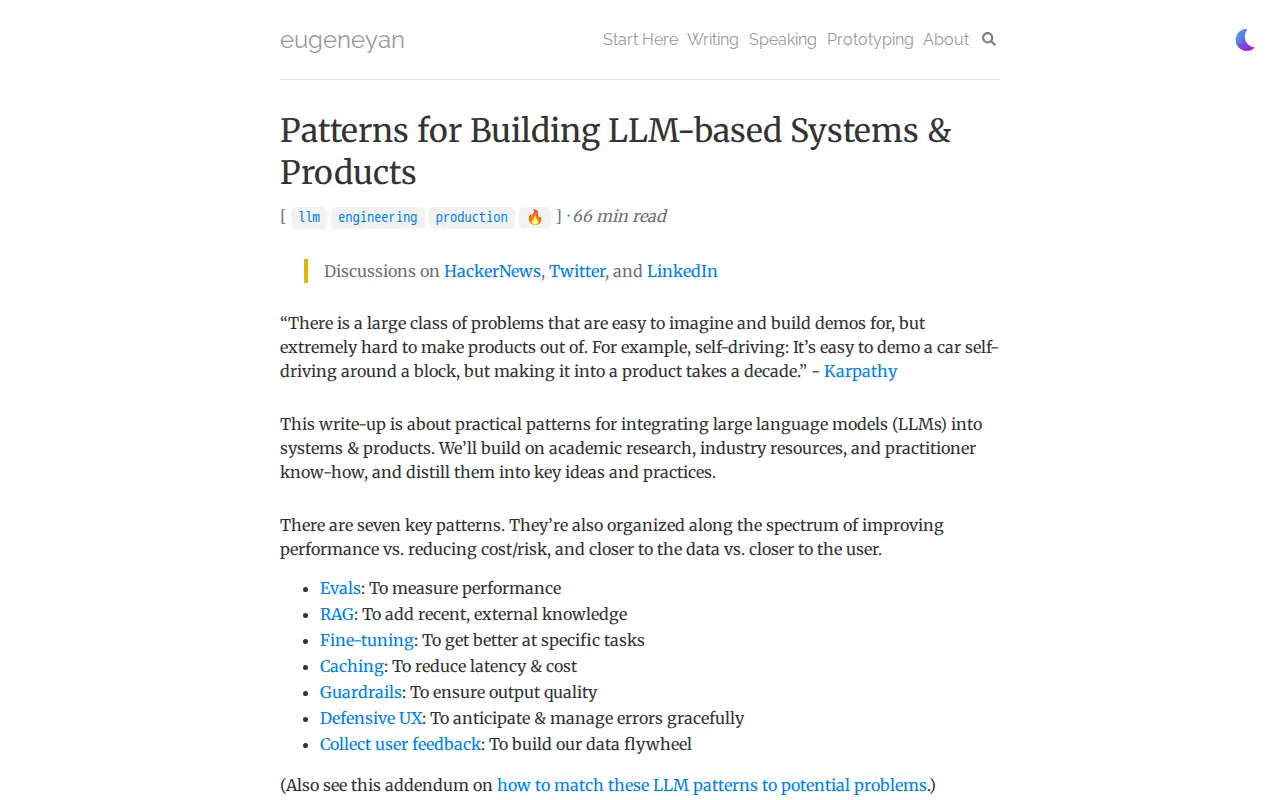
Patterns for Building LLM-based Systems & Products
A write-up on practical patterns for integrating large language models into systems and products, drawing on academic research, industry resources and practitioner know-how. It covers seven key patterns, including evals, RAG, fine-tuning, caching, guardrails, defensive UX and collecting user feedback.
Features
- There are seven key patterns. Source: eugeneyan.com
Links
Tags
-
0OpenFace is a free and open source face recognition implementation with deep neural networks, written in Python and Torch and based on the CVPR 2015 FaceNet paper. It detects faces, aligns them, and embeds faces on a 128-dimensional unit hypersphere.
-
0Licensing is neither feasible nor effective for addressing AI risks provides machine-learning models, research, training resources, or evaluation…
-
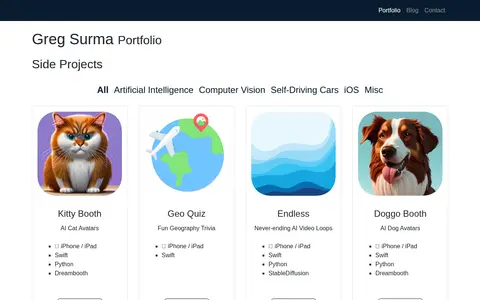
0A portfolio page for Greg (Grzegorz) Surma that lists side projects related to machine learning, computer vision, self-driving cars and iOS development. It indexes apps and experiments, including AI avatars, image filters, depth estimators, a CNN explainer and games, with the tools and platforms used for each.
-
0Apache Spark is a multi-language engine for executing data engineering, data science, and machine learning on single-node machines or clusters. It provides high-level APIs in Java, Scala, Python and R, and supports Spark SQL, pandas API on Spark, MLlib, GraphX and Structured Streaming. The documentation covers downloads, the shell and client applications.
-
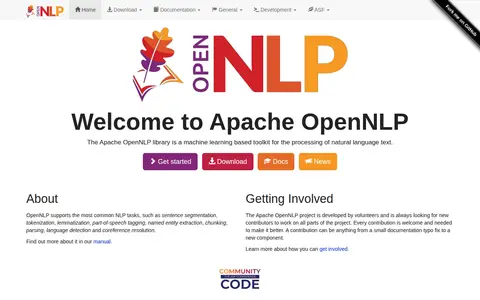
0Apache OpenNLP is a machine learning based toolkit for the processing of natural language text. It supports tasks such as sentence segmentation, tokenization, lemmatization, part-of-speech tagging, named entity extraction, chunking, parsing, language detection and coreference resolution. The project is developed by volunteers and welcomes contributions, from small documentation fixes to new components.
-
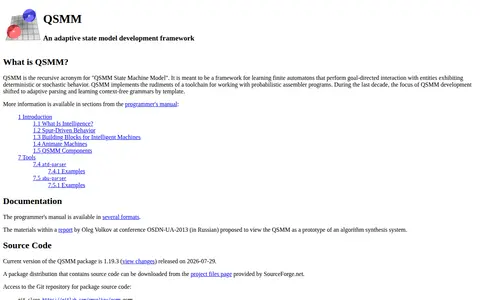
0QSMM is a framework for learning finite automatons that perform goal-directed interaction with entities exhibiting deterministic or stochastic behavior. It implements the rudiments of a toolchain for working with probabilistic assembler programs, and development focus shifted to adaptive parsing and learning context-free grammars by template. It includes atd-parser and abu-parser tools.
Community notes
Reviews and discussion
No reviews yet
Be the first to share how this project worked for you.
Join the discussion
Sign in with a verified account to leave a review or join the discussion.
Sign in to review