Creates or edits images with generative models and visual controls.
https://www.topazlabs.com/
Topaz Labs: AI Image Quality Software: "professional grade workflow, with many features" (this is an affiliate link by nejcsusec.beehiiv.com).
Website Directory import
Preview unavailable
Screenshot unavailable. The listing stays available while a preview is prepared.
Links
Tags
-
 0
Creates or edits images with generative models and visual controls.
-
 0
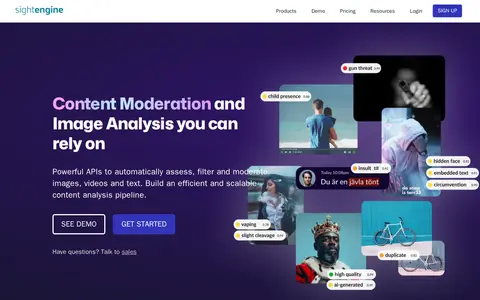
Sightengine provides APIs for assessing, filtering and moderating images, videos, text and audio. It detects nudity, violence and offensive content, and flags AI-generated media such as images, video, speech and music. Additional models cover face liveness, near-duplicate and spam detection, and OCR, returning JSON detection results from a single API call.
-
 0
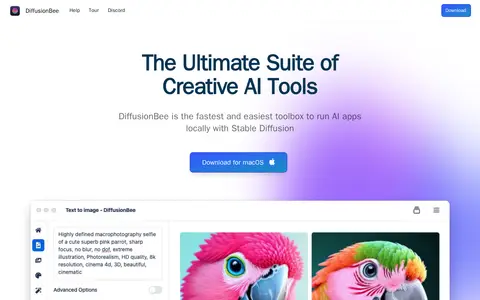
DiffusionBee is a Stable Diffusion application for generating AI art locally on a computer. It is free of charge and runs offline, so prompts, models and generated images stay on the device. The package includes text to image, image to image, generative fill, an image upscaler, video tools, control images and local model training. A macOS download is provided.
-
0
Libraire is a personal AI library that produces book summaries in five styles, plus video insights, audiobooks and podcasts. Users supply a book, choose a summary style, and can read, export or revisit the result. The site mentions a 7-day free trial with 2 summaries, no credit card, and cancellation anytime on paid plans.
-
 0
TokenVerse is a method for multi-concept personalization that uses a pre-trained text-to-image diffusion model. It can disentangle complex visual elements and attributes from a single image and combine concepts extracted from multiple images, supporting objects, accessories, materials, pose and lighting. It uses a DiT-based text-to-image model and learns modulation-space directions for each word.
-
 0
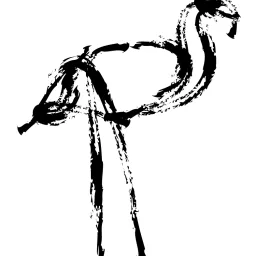
CLIPasso is a method for converting an object image into a sketch with adjustable abstraction levels while preserving key visual features. It optimizes Bézier curves using a differentiable rasterizer and a CLIP-based perceptual loss, without requiring an explicit sketch dataset. Abstraction is controlled by varying the number of strokes.
Community notes
Reviews and discussion
No reviews yet
Be the first to share how this project worked for you.
Join the discussion
Sign in with a verified account to leave a review or join the discussion.
Sign in to reviewKeep exploring
More in AI Image Generation
sightengine.com
Sightengine provides APIs for assessing, filtering and moderating images, videos, text and audio. It detects nudity, violence and offensive content, and flags AI-generated media such as images, video, speech and music. Additional models cover face liveness, near-duplicate and spam detection, and OCR, returning JSON detection results from a single API call.
diffusionbee.com
DiffusionBee is a Stable Diffusion application for generating AI art locally on a computer. It is free of charge and runs offline, so prompts, models and generated images stay on the device. The package includes text to image, image to image, generative fill, an image upscaler, video tools, control images and local model training. A macOS download is provided.
libraire.ai
Libraire is a personal AI library that produces book summaries in five styles, plus video insights, audiobooks and podcasts. Users supply a book, choose a summary style, and can read, export or revisit the result. The site mentions a 7-day free trial with 2 summaries, no credit card, and cancellation anytime on paid plans.
token-verse.github.io
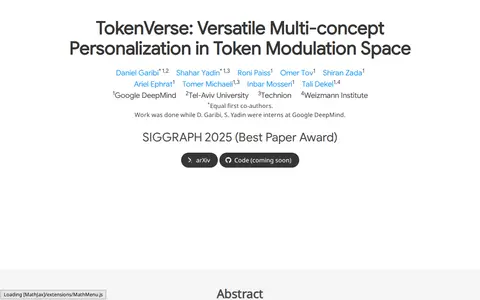
TokenVerse is a method for multi-concept personalization that uses a pre-trained text-to-image diffusion model. It can disentangle complex visual elements and attributes from a single image and combine concepts extracted from multiple images, supporting objects, accessories, materials, pose and lighting. It uses a DiT-based text-to-image model and learns modulation-space directions for each word.
clipasso.github.io
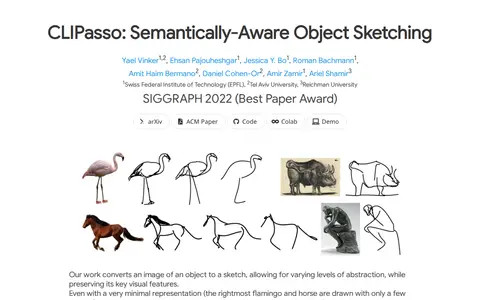
CLIPasso is a method for converting an object image into a sketch with adjustable abstraction levels while preserving key visual features. It optimizes Bézier curves using a differentiable rasterizer and a CLIP-based perceptual loss, without requiring an explicit sketch dataset. Abstraction is controlled by varying the number of strokes.