


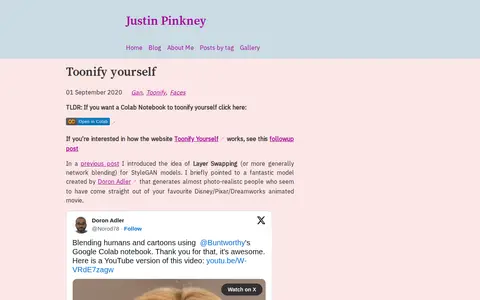
A blog post by Justin Pinkney explaining how to toonify yourself, making a photo-realistic cartoon model using StyleGAN model blending. It describes transfer learning by fine-tuning a faces model on animated film characters, then swapping layers so low resolution layers give a cartoon face structure while high resolution layers keep photo-realistic rendering.
Artificial Intelligence at the Service of Collective Intelligence
Artificial Intelligence at the Service of Collective Intelligence creates or edits images with generative AI and text-based controls.
Links
Tags
-
0
A blog post by Justin Pinkney explaining how to toonify yourself, making a photo-realistic cartoon model using StyleGAN model blending. It describes transfer learning by fine-tuning a faces model on animated film characters, then swapping layers so low resolution layers give a cartoon face structure while high resolution layers keep photo-realistic rendering.
-
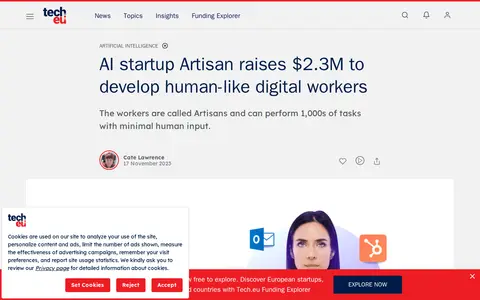
0The workers are called Artisans and can perform 1,000s of tasks with minimal human input.
-
0
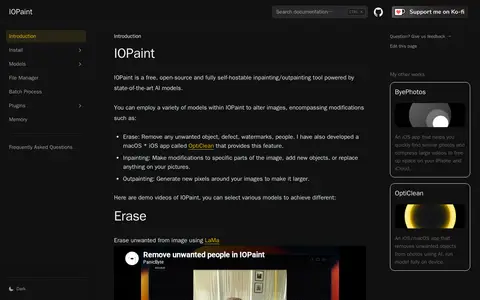
IOPaint is a free, open-source and fully self-hostable image inpainting and outpainting tool powered by AI models. It can erase unwanted objects, add or replace elements in images, generate text, and generate new pixels around images to enlarge them, with various models available for different tasks.
-
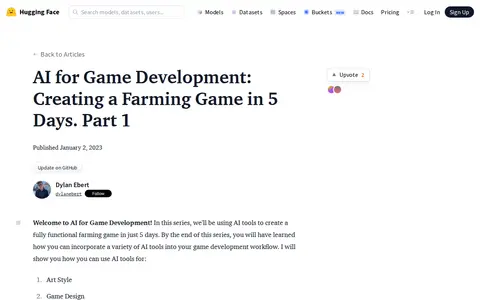
0A tutorial series by Dylan Ebert showing how AI tools can be incorporated into a game development workflow. It describes creating a fully functional farming game in five days, covering art style, game design, 3D assets, 2D assets and story. The first part covers choosing an art style with Stable Diffusion, generating concept art and bringing it into Unity; readers are assumed to know Unity and C#.
-
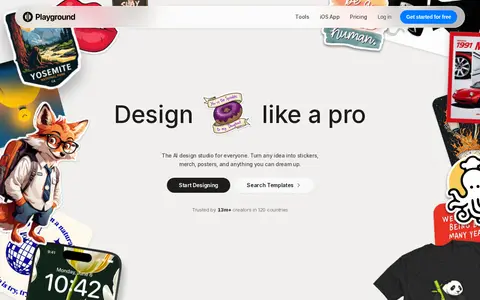
0Playground is an AI design tool for creating logos, stickers, merch, posters, social media graphics and other designs without experience. It provides templates across 24 categories and uses image models including GPT Image 2, Nano Banana Pro and Seedream. Paid plans add faster generation, credits, upscaling, background removal and commercial use licensing.
-
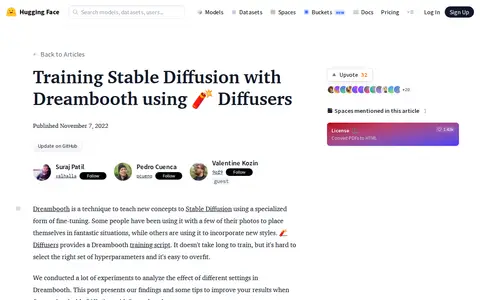
0A blog post presenting findings and tips on fine-tuning Stable Diffusion with the Dreambooth technique using Diffusers. It describes experiments with hyperparameters and settings, recommending a low learning rate and progressively more training steps, and notes that faces need more steps and prior preservation.
Community notes
Reviews and discussion
No reviews yet
Be the first to share how this project worked for you.
Join the discussion
Sign in with a verified account to leave a review or join the discussion.
Sign in to review