
data.aad.gov.au
Research data portal for exploring biology records, including image.
Recently added
Browse dated community launches and imported or editorial directory additions.
Research data portal for exploring biology records, including image.

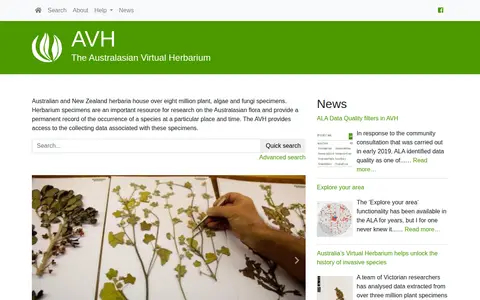
The Australasian Virtual Herbarium provides access to the collecting data associated with plant, algae and fungi specimens held in Australian and New Zealand herbaria. Search results can be filtered with data quality profiles, which are disabled by default in AVH. An 'Explore your area' page allows searching by location, address, postcode or coordinates.
Browse public datasets, metadata and downloadable records in an open catalog.

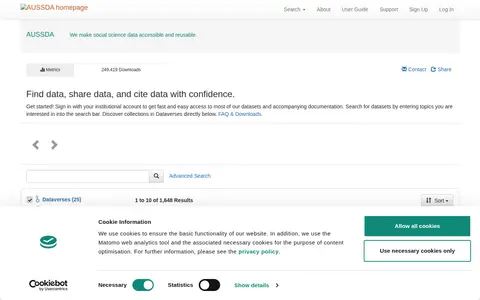
The Austrian Social Science Data Archive (AUSSDA) makes social science data accessible and reusable for researchers. It hosts a wide range of datasets, including collections focused on AUTNES, Statistik Austria, qualitative data, COVID-19 pandemic research, and teaching and learning. Users can search for datasets by topic, and institutional account sign-in provides access to most datasets and accompanying documentation. The archive operates on the Dataverse platform.

Dataset repository covering geology and palaeontology, with searchable datasets.

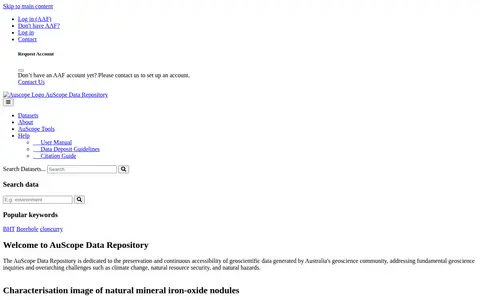
The AuScope Data Repository preserves and provides continuous access to geoscientific data generated by Australia's geoscience community. It addresses fundamental geoscience questions and challenges such as climate change, natural resource security, and natural hazards. The site lists collections including iron-oxide nodule characterisation images, Victorian multi-element geochemistry samples, and Calperum ground temperature data.
Open data portal of Auckland Council in New Zealand.

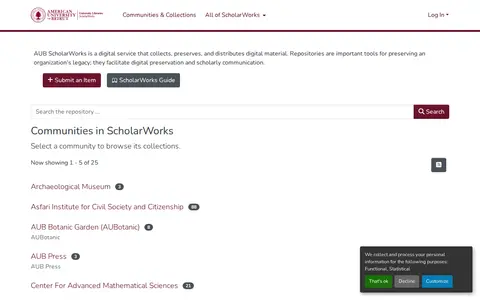
AUBScholarWorks is a digital service from the American University of Beirut that collects, preserves, and distributes digital scholarly material. It supports digital preservation and scholarly communication, organizes content into communities and collections, and includes recent submissions such as a dataset for AI-based calorie and macronutrient estimation for Lebanese dishes.
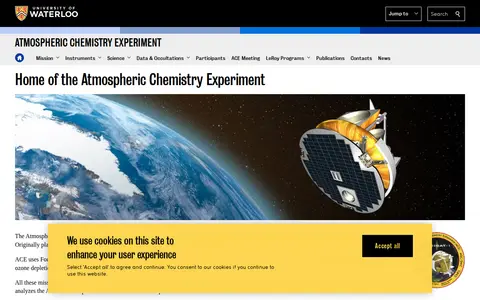
Research data portal for exploring atmospheric records, including observational data.

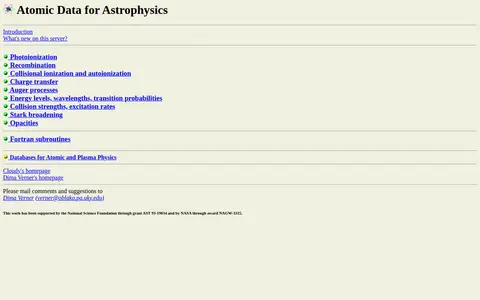
Atomic Data for Astrophysics is a resource that provides atomic data for astrophysics research. It covers topics including photoionization, recombination, collisional ionization and autoionization, charge transfer, Auger processes, energy levels, transition probabilities, collision strengths, and Stark broadening. It also offers related Fortran subroutines and links to other atomic and plasma physics databases.
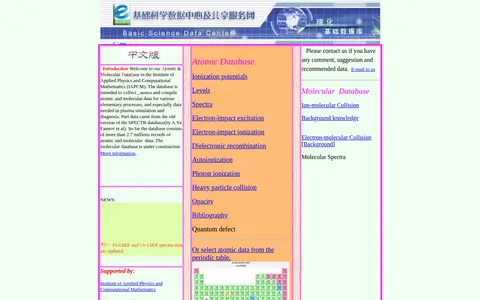
The Atomic & Molecular Database at the Institute of Applied Physics and Computational Mathematics collects, assesses and compiles atomic and molecular data for elementary processes, particularly data used in plasma simulation and diagnosis. It holds more than 2.7 million records and includes an ionization potentials and levels index and a periodic table selector. The molecular database is under construction.
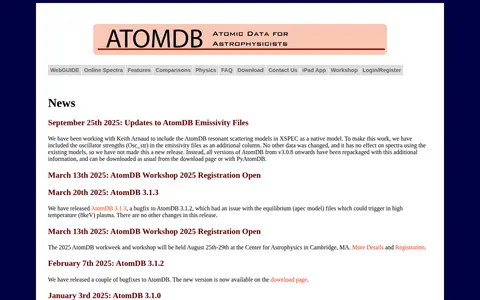
AtomDB is an astrophysical plasma emission database providing atomic data for modeling X-ray spectra. It includes ionization and recombination rates, energy levels, wavelength and Einstein A values, electron and proton collision data, and density-sensitive line diagnostics for plasma modeling.

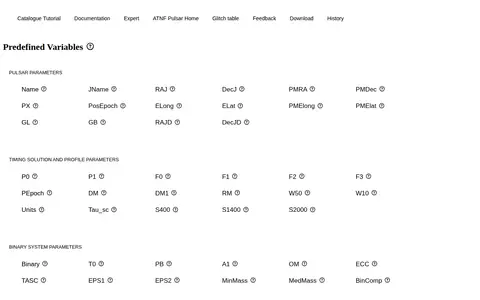
The ATNF Pulsar Catalogue is version 2.8.1 of a searchable resource for pulsar data. Users can select predefined pulsar parameters including name, position, proper motion, parallax, timing, binary system, distance, association, and derived parameters, or define custom variables for queries.
Research data portal for exploring atmospheric records, including compiled data.

Dataset repository covering atmospheric, with searchable datasets.

Browse research datasets and datasets related to acoustics.

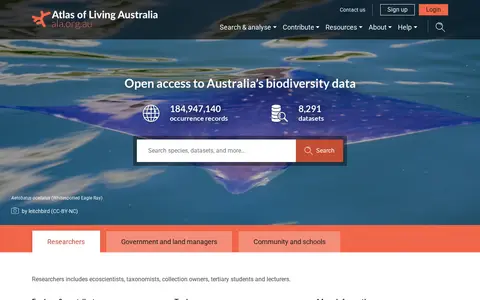
The Atlas of Living Australia is a biodiversity data platform offering open access to Australian biodiversity data. It holds occurrence records and datasets and lets users search and download records by species, taxon, dataset, region, date or location. It provides tools including an R and Python package, a spatial portal and BioCollect for surveys and field data.

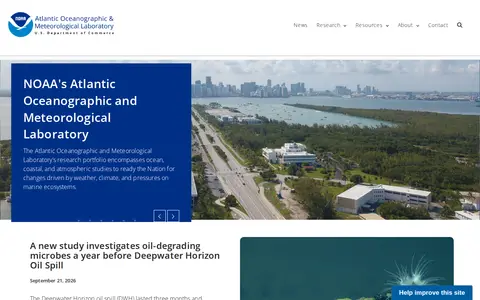
The Atlantic Oceanographic and Meteorological Laboratory (AOML) is a U.S. National Oceanic and Atmospheric Administration (NOAA) laboratory. Its research portfolio covers ocean, coastal, and atmospheric studies to prepare the nation for changes driven by weather, climate, and pressures on marine ecosystems. The lab is organized into divisions including Hurricane Research, Ocean Chemistry & Ecosystems, and Physical Oceanography, and its work supports improved hurricane forecasting and coastal ecosystem management.

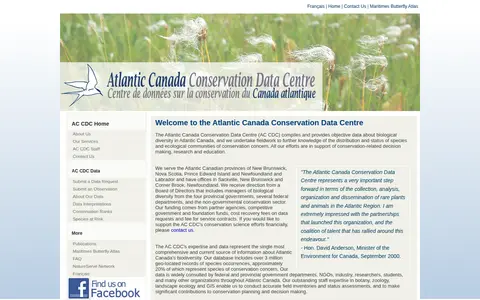
The Atlantic Canada Conservation Data Centre compiles and provides data about biological diversity in Atlantic Canada and conducts fieldwork on the distribution and status of species and ecological communities of conservation concern. It serves New Brunswick, Nova Scotia, Prince Edward Island and Newfoundland and Labrador, with offices in Sackville, New Brunswick and Corner Brook, Newfoundland.

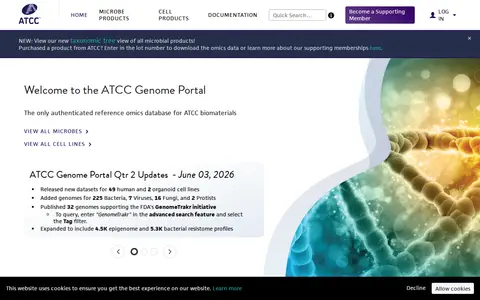
The ATCC Genome Portal is a repository of authenticated microbial reference genomes. It also offers a taxonomic tree view of microbial products, and customers who purchased an ATCC product can enter a lot number to download omics data.

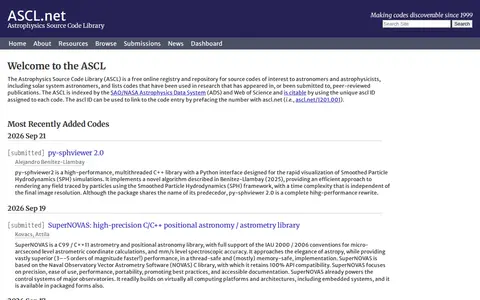
The Astrophysics Source Code Library is a free online registry and repository for source codes of interest to astronomers and astrophysicists. It lists codes used in peer-reviewed publications and is indexed by ADS and Web of Science. Each code receives a unique ascl ID that can be used to link to its entry.
The Astronomical Data Archives Center is part of the National Astronomical Observatory of Japan and provides services including an online catalog service and a VizieR catalogue service mirror. The information it provides is intended only for academic research and educational activities, and use for commercial products, services, or activities is prohibited.

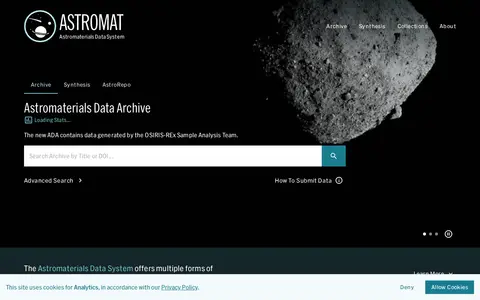
The Astromaterials Data System (Astromat) is a data infrastructure that curates, archives, and provides access to analytical data generated from astromaterials samples. It is NASA’s designated archive for laboratory analytical data acquired on samples from past, present, and future NASA missions curated by NASA’s Astromaterials Acquisition and Curation Office. The system supports end-to-end data curation and synthesis for advanced analysis and AI/ML use, and features machine- and human-actionable interfaces for the astromaterials research community.

Aston Data Explorer is Aston University's research data repository. It offers advanced search and recent items, and links to Aston Publications Explorer for open access publications and Aston Research Explorer for information on research staff, activities and awards. The site also provides support, policy and OAI 2.0 access information.