NetNewsWire vs Capy Reader
NetNewsWire vs Capy Reader: compare free Apple and Android RSS apps, sync services, OPML transfers and full-content limits before moving subscriptions.
On this page
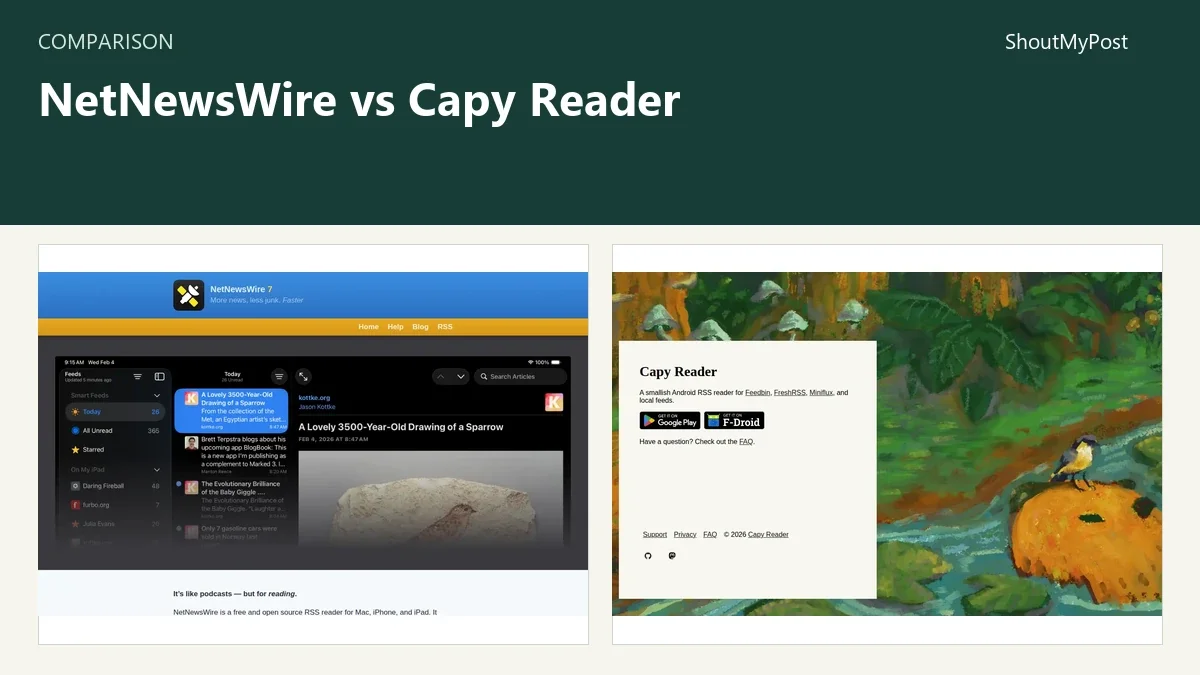
NetNewsWire wins for an Apple-device reading setup; Capy Reader wins for Android. Both are free RSS clients, so the NetNewsWire vs Capy Reader decision starts with your devices and sync service. A mixed-device household may use both rather than replace one with the other.
Capy Reader's current FAQ requires Android 11 or later. NetNewsWire's current homepage lists macOS 15 or later and iOS 26 or later for its latest apps. Check that device detail before deciding on a reader because of its screenshots.
NetNewsWire vs Capy Reader at a glance
| Factor | NetNewsWire | Capy Reader | Official source; checked |
|---|---|---|---|
| App price | Free | Free, no ads or in-app purchases | NetNewsWire homepage; Capy Reader FAQ; Oct 9, 2026 |
| Platforms | Mac, iPhone, iPad | Android 11+ | Official download information; Oct 9, 2026 |
| Local reading | Direct feed account | Local-only feeds | Official product descriptions; Oct 9, 2026 |
| Sync | iCloud and supported third-party services | Feedbin, FreshRSS, Miniflux and compatible Google Reader API services | Official features and Capy FAQ; Oct 9, 2026 |
| Reading tools | Folders, starred articles, reader view and search | Feed subscriptions and full-content mode | Official descriptions; Oct 9, 2026 |
| Import/export | OPML subscription import/export documented | Repository and account controls document feed-list handling | NetNewsWire homepage; Capy repository; Oct 9, 2026 |
| Open source | Yes | Yes | Official source repositories; Oct 9, 2026 |
| Updates | Current app download and public development resources | Stable releases and separately labeled nightly builds | Official download pages and repository; Oct 9, 2026 |
| Privacy/data location | Depends on direct reading versus selected sync account | Local account or chosen server determines where feed data sits | Official account descriptions; Oct 9, 2026 |
| Paid service costs | Optional sync provider costs are separate | Optional sync provider costs are separate | Official supported-account lists; Oct 9, 2026 |
Start with the NetNewsWire project page and Capy Reader project page. Both are reading clients. The provider behind an optional account is a separate part of the setup.
Device support settles the first choice
NetNewsWire is built around Mac, iPhone and iPad. If those are the devices where you read, native apps across the set are the strongest reason to choose it. You can organize a publication list without introducing an unrelated browser service simply to reach your phone.
Capy Reader is the Android answer. Its free app is available through the distributions named in the official FAQ, including Google Play and F-Droid. That makes it a better candidate for someone whose daily reading happens on an Android phone and who wants a dedicated client.
The weakness on both sides is platform reach. NetNewsWire doesn't supply an Android app in its official platform list. Capy Reader doesn't supply a Mac or iPhone app. Neither is the obvious single-client choice for a person moving among Windows, Android and an iPad.
A web reader, such as KrISS feed, answers a different device problem by placing the interface in a browser. That comes with server operation. Native apps avoid installing a reader server merely to begin with a local subscription list.
For a mixed Apple-and-Android setup, pick the common sync service before picking a favorite interface. A service supported by both apps is what can join the reading state. Installing each app with unrelated local feeds won't make them one shared inbox.
Winner: NetNewsWire for Apple devices; Capy Reader for Android.
Local reading avoids an unnecessary account
Both apps offer a route that doesn't begin with a paid RSS account. NetNewsWire can fetch feeds directly, and Capy Reader supports local-only feeds. That is my preferred start when one device is enough for the reading habit.
A local client stores its own reading state and checks publication feeds. It doesn't become a hosted browser reader you can open on a borrowed computer. This matters if “no account” is attractive but you also expect all unread counts to appear on every device.
Once you need synchronization, choose a supported account. NetNewsWire's Apple-oriented iCloud option is one route; Capy Reader lists Feedbin, FreshRSS and Miniflux, plus services supporting the Google Reader API. These are different ways to arrange the connection.
An existing server can make Capy Reader a straightforward Android front end. The app isn't the server itself. Someone must still run a self-hosted account, or pay the hosted provider if its plan requires payment. The $0 app price doesn't describe the complete cost of every possible setup.
My verdict is a tie for beginning with feeds on one device. For multi-device use, the winner is whichever app supports the account you already trust and maintain. Moving to a different account purely for a favorite color scheme makes a small reading decision larger than it needs to be.
Winner: tie for local reading; compare the supported service for synchronization.
A reader view is different from the publisher's feed
Many feeds provide an excerpt, while some provide the full article. A reader's full-content feature works on the webpage behind the item when it needs more text. That distinction explains why one publication can look complete and another can show only a summary.
Capy Reader's FAQ explicitly warns that full-content mode won't work perfectly for every site. Its documented route is a site-specific full-content request on GitHub. The app also names Cloudflare and other bot-detection systems as reasons a feed may refuse its requests.
NetNewsWire lists a reader view among its features. Its troubleshooting material provides a way to investigate failed feeds and accounts. The attraction is a dedicated reading environment with diagnostics, while the limitation is still the publisher's content and whether the app can obtain it.
Don't make the purchase decision around an assumption that a reader changes publisher access. An RSS title linking to a subscriber article isn't itself a subscription to that publication. The feed, reader parser and publisher access are separate pieces of what eventually appears in the article pane.
If a publication is essential, check how it exposes its feed and how the reader handles that source. A clean app can still display an untidy feed supplied by a publisher. That isn't a reason to rewrite the entire subscription list or blame the syncing account before checking the source.
Winner: neither promises perfect full-text extraction; Capy Reader documents a direct site-specific reporting route.
Feed management matters after the first import
The first day with a reader is mostly about adding subscriptions. Later, the job includes handling quiet publications, renamed feeds, duplicates and broken addresses. A reader that shows these details can be easier to keep tidy than a visually appealing list that hides the cause of missing articles.
NetNewsWire's Dinosaurs feature, introduced in version 7.1, lists stale feeds using the last stored article and response details. Its Error Log records recent download and syncing failures. These controls give an Apple reader a specific route into cleanup.
Capy Reader's official support material directs feed and content problems to its public development resources. It describes concrete reasons a feed may fail, including nonstandard content and request blocking. That is a clearer starting point than treating every empty subscription as an abandoned publication.
For a phone-focused workflow, fewer panels can be an advantage. For a large archive, desktop inspection and feed-management tools may matter more. The best reading screen and the best place to repair fifty subscriptions don't have to be the same device.
Winner: NetNewsWire for documented stale-feed inspection; Capy Reader for an Android-first reading workflow.
What users say
A September 2026 NetNewsWire switching thread praises its simpler reading experience and iCloud syncing. Replies immediately ask about Android and web access. The praise and limitation point to the same conclusion: it can fit an Apple setup very well without being the right client for every device.
In an RSS app discussion, readers suggest Capy Reader and NetNewsWire for different platforms. That kind of recommendation makes more sense than declaring one interface universally better. Capy's own FAQ gives the firmer downside for daily use: full-content extraction and feed access can fail on individual sites.
Choose one
Choose NetNewsWire if…
- Your main reading devices are a Mac, iPhone or iPad.
- You want iCloud or one of its supported service accounts.
- Desktop feed cleanup is part of managing your subscriptions.
Choose Capy Reader if…
- Your reading phone runs Android 11 or later.
- You already use Feedbin, FreshRSS, Miniflux or a compatible service.
- A free local-only Android account is enough to begin.
Other options
Feedreader is worth identifying carefully because its site describes multiple products. Makagiga combines desktop feeds with notes and tasks; Gnus fits an existing Emacs workflow. Browse the news search category for the remaining choices.
FAQ
Is Capy Reader free?
Yes, Capy Reader's official FAQ says the app is free with no ads or in-app purchases. It requires Android 11 or later and can use local-only feeds. A separate hosted sync provider may still charge for an account, while self-hosting brings server costs. Those costs belong to the chosen account, not the app download.
Can I use both apps with the same subscriptions?
Yes, both can read the same publication feeds, and a compatible sync account can connect a mixed-device setup. Check that the chosen service is supported by each app before building that workflow. Independent local accounts don't synchronize just because their feed URLs match; they keep their own reading state and refresh history.
Does NetNewsWire work on Android?
No Android edition appears in NetNewsWire's current official platform list. Its latest apps target Mac, iPhone and iPad. Capy Reader is the Android option in this comparison. If you read on both device families, look for a shared supported sync service so the two different clients can use the same subscription account.
Sources
NetNewsWire official features and help; Capy Reader FAQ and repository, checked October 9, 2026. Reader feedback is linked in its section.
Related articles
Current evidence
Verified facts
Each value shows its source and when it was checked.
No shared facts have current source and check-date evidence yet. Facts without that evidence are left out.