(Non-)Human is an art installation by Yuguang Zhang that explores the semi-human, semi-object territory. It conjures the hidden human-ness in objects and imagines a speculative world where a human exists in non-human forms. The initial piece is a bedsheet that tweaks and bends in the form of its owner. It uses tools including Arduino, webcam, PoseNet, Node.js, and a custom GAN.
Directory
AI & Machine Learning
AI and Machine Learning covers the tools, models, and services built around machine learning. Models and machine learning holds model hubs, playgrounds, and training resources. AI image generation collects text-to-image tools, editors, and prompt libraries, while audio and speech covers transcription, voice, and music generation. AI coding and development lists assistants, code review tools, and developer utilities, and AI agents and automation brings together workflow builders and task tools. AI data and analytics holds platforms for labelling, monitoring, and evaluating models. Many listings are open source projects rather than hosted services, so check what you get and what it costs before you depend on one. We do not independently test each tool, and a Shout shows member support rather than a quality score. Imported listings do not start with an assigned owner or price.
](https://emu-video.metademolab.com/demo /demo): state-of-the-art text-to-video generation.
Prompt Refinery - Text to Image Gradio is a Hugging Face Space created by user awacke1 that expands short user-provided image generation prompts into more detailed versions using MagicPrompt, then generates images from the expanded prompts. The Space has received 44 likes on the Hugging Face platform.
Helps find, analyze or synthesize information for research and knowledge discovery.
GPTeam is an open-source multi-agent simulation project hosted in the 101dotxyz GitHub repository. It focuses on collaborative AI agents. The repository includes documentation for getting started, understanding the simulation's operation, and viewing agent activity.
Mcp-server-track demo video at https://youtu.be/EpV YnR4fjk.
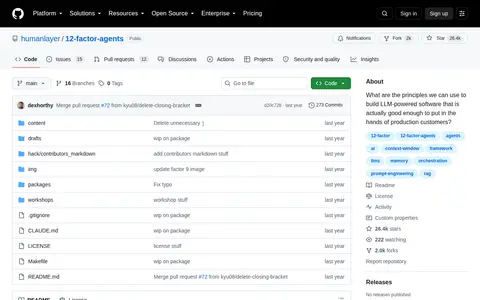
12-Factor Agents is a GitHub repository that outlines principles for building large language model (LLM) powered software that is reliable enough for production customer use. It documents a set of 12 core factors for developing such applications, and contributions to the project are accepted from the public.
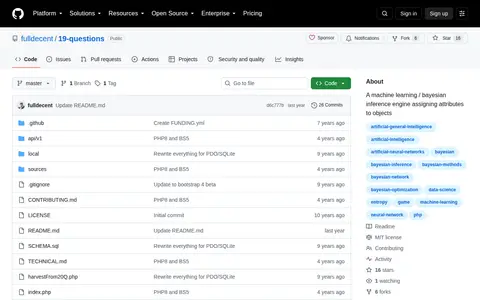
19 Questions is an open source machine learning and Bayesian inference engine designed to assign attributes to objects. Its source code is hosted in a public GitHub repository under the fulldecent organization, and contributions to the project are accepted from the public.
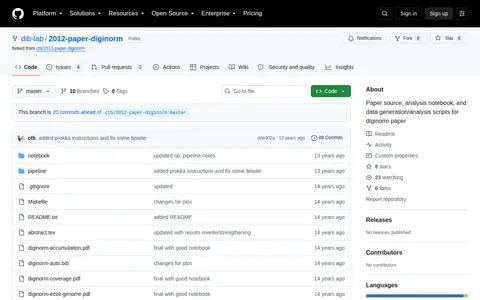
A repository holding the paper source, analysis notebook, and data generation and analysis scripts for the diginorm paper. It is forked from another repository and includes LaTeX sources, bibliography files, figures and a pipeline folder.
Creates, rewrites or summarizes written content with language models.
Post by Travis Tang from DataDrivenInvestor.
Creates or edits images with generative models and visual controls.
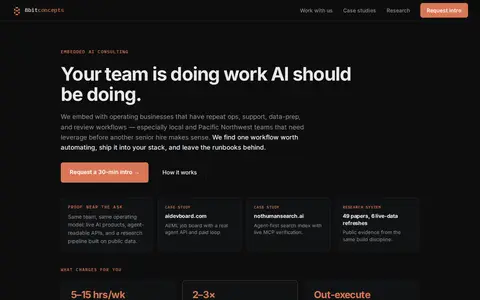
8bitconcepts is an embedded AI consulting practice that works inside operating businesses to ship AI workflow and process systems. It targets repetitive operations, support, data-preparation and review workflows, and publishes research papers and data snapshots alongside live AI products.
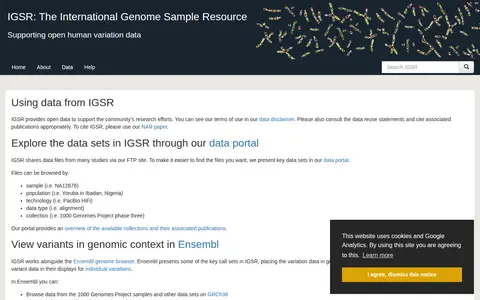
IGSR, the International Genome Sample Resource, provides open human variation data. Data files from many studies are shared via FTP, with key data sets presented in a data portal browsable by sample, population, technology, data type and collection. Ensembl presents some key call sets in genomic context. Bulk downloads are recommended via Globus, with FTP and Aspera also available.
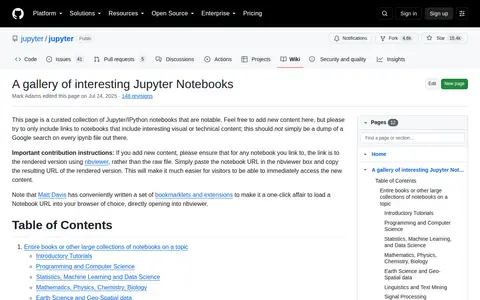
This is a curated gallery of interesting Jupyter Notebooks, organized by topic categories including introductory tutorials, programming and computer science, statistics and machine learning, data science, mathematics, physics, chemistry, biology, earth science, geo-spatial data, linguistics, and text mining.
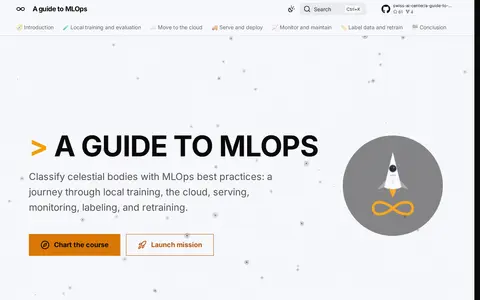
A guide to MLOps is an open-source tutorial from the Swiss AI Center team that walks engineers and small teams from notebook experiments to production. It covers local training and model evaluation, moving the model to the cloud, serving and deploying, monitoring and maintaining, and labeling data and retraining, using tools such as DVC, Git, GitHub Actions, CML, Docker, BentoML, Fluent Bit, Evidently AI, and Label Studio.
Paper by Dipankar Dasgupta, Deepak Venugopal and Kishor Datta Gupta.
A simple guide to fine-tuning Llama 2 Brev docs provides machine-learning models, research, training resources, or evaluation tools.
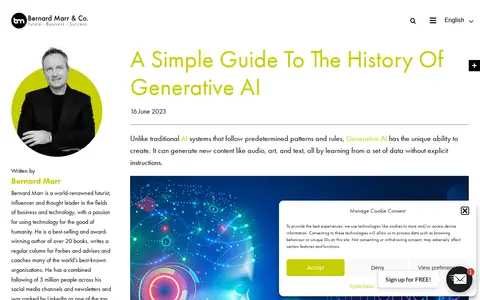
A Simple Guide To The History Of Generative AI is an article on Bernard Marr's website that explains the history of generative AI. It covers sections including the birth of generative AI, key milestones, its impact, and its evolving narrative, and notes that generative AI differs from traditional rule-based AI systems by its ability to create content.
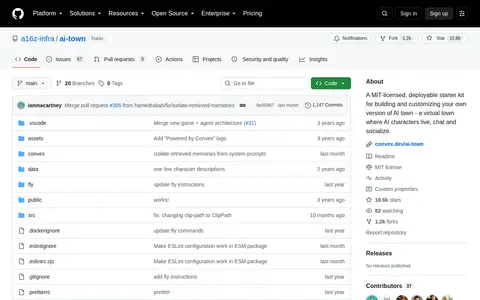
AI Town is an MIT-licensed, deployable starter kit for building and customizing a virtual town where AI characters live, chat and socialize. It is inspired by the Generative Agents research paper and aims to provide a foundation meant to be extended, with a back-end that supports shared global state, transactions and a simulation engine.
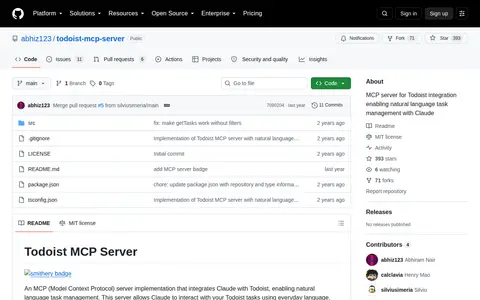
An MCP server implementation that integrates Claude with Todoist to enable natural language task management. It provides tools to create, retrieve, update, complete, and delete tasks, with filtering by due date, priority, and partial name matches.
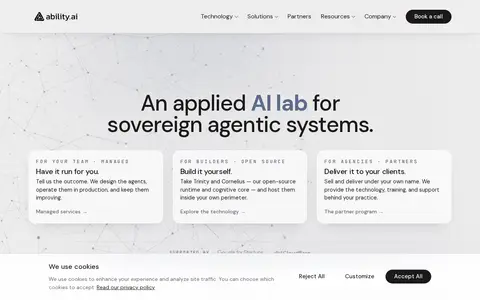
Ability AI provides machine-learning models, research, training resources, or evaluation tools.
Acapela Group is a company that develops personalized digital voices using voice AI technology. It offers text-to-speech solutions for services, applications and devices, with support for over 30 languages and more than 200 pre-made voices, plus custom voice creation options. The company provides SDKs for multiple platforms, cloud streaming APIs, and specialized solutions including voice AI for accessibility, transport and customer interaction.
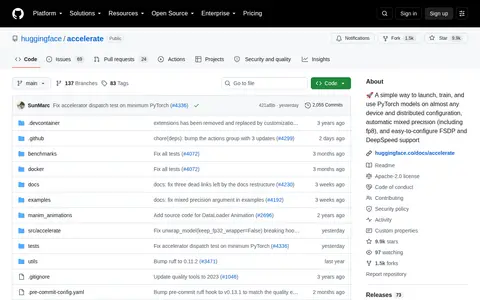
A library created for PyTorch users to launch, train, and use PyTorch models on almost any device and distributed configuration. It abstracts the boilerplate code related to multi-GPUs, TPUs, and fp16 while leaving the rest of the code unchanged, and supports automatic mixed precision and FSDP and DeepSpeed.