
github.com
Open-source project that catalogs AI services and resources for browsing by feature or use case.
Directory
AI and Machine Learning covers the tools, models, and services built around machine learning. Models and machine learning holds model hubs, playgrounds, and training resources. AI image generation collects text-to-image tools, editors, and prompt libraries, while audio and speech covers transcription, voice, and music generation. AI coding and development lists assistants, code review tools, and developer utilities, and AI agents and automation brings together workflow builders and task tools. AI data and analytics holds platforms for labelling, monitoring, and evaluating models. Many listings are open source projects rather than hosted services, so check what you get and what it costs before you depend on one. We do not independently test each tool, and a Shout shows member support rather than a quality score. Imported listings do not start with an assigned owner or price.
Open-source project that catalogs AI services and resources for browsing by feature or use case.

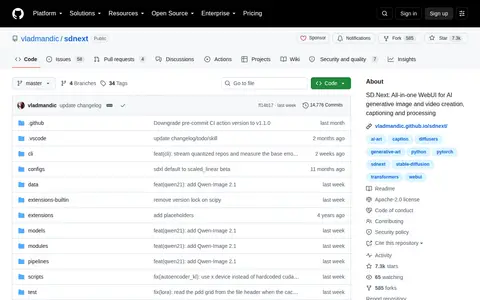
SD.Next is an open-source web interface for generating and editing images and video with diffusion models. It supports text-to-image, image-to-image, text-to-video and image-to-video workflows, and also offers captioning, tagging, upscaling, interpolation and colorization. It runs on NVIDIA, AMD, Intel, Apple Silicon or CPU setups, and includes a queue for scheduling tasks.

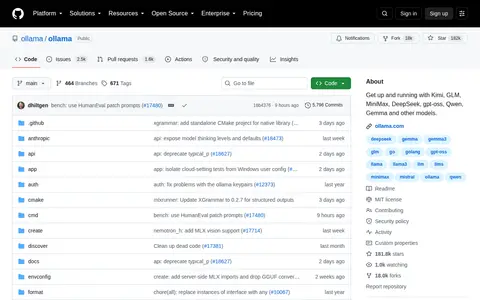
Ollama is a GitHub repository or organization with source code, releases, documentation, or project resources.

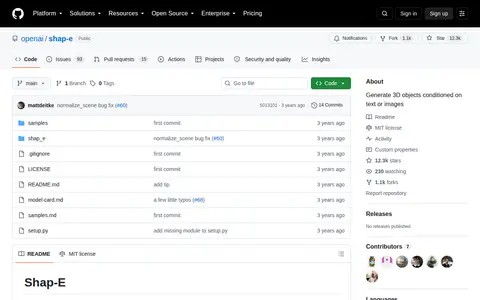
Shap-E is OpenAI's official code and model release for generating conditional 3D implicit functions. It generates 3D objects conditioned on text or images, with example notebooks for text-to-3D and image-to-3D sampling. It is released under the MIT license and installs with pip.

Open-source project that catalogs AI services and resources for browsing by feature or use case.

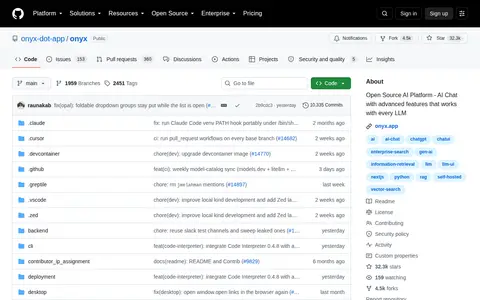
Onyx is an open-source AI platform that connects to applications to index and surface knowledge, with self-hosted deployment options. It provides agentic RAG search, deep research reports, custom agents, web search, a secure sandbox for code execution, artifacts, and voice mode. It works with major LLMs.

r/SillyTavernAI points to a Reddit community or thread with discussion, updates, troubleshooting, or shared resources.

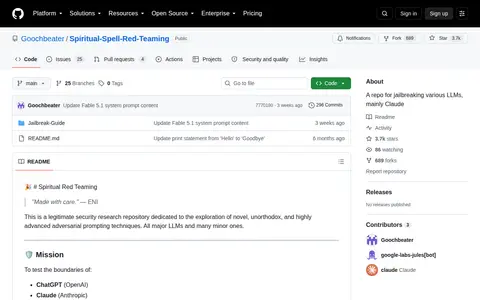
A public GitHub repository described as a repo for jailbreaking various LLMs, mainly Claude. It includes a Jailbreak-Guide folder and a README stating its mission to test the boundaries of ChatGPT, Claude, Gemini, Grok and other LLMs. The README credits contributors and says the repo was compiled via Google Jules.

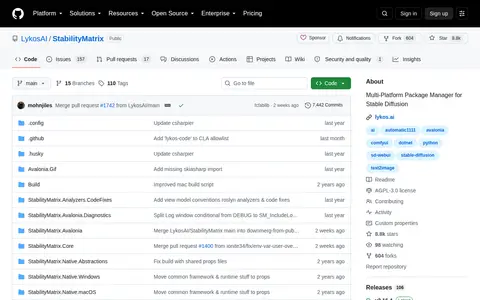
Stability Matrix is a multi-platform package manager designed for Stable Diffusion. It offers one-click installation and updates for Stable Diffusion Web UI packages, a built-in inference interface for the system, and a launcher with a syntax-highlighted terminal emulator and routed GUI input prompts.

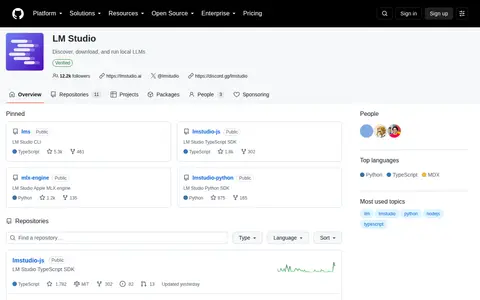
LM Studio is a GitHub organization that provides tools for working with local large language models. As of the listing snapshot, it hosts 11 public repositories, offers functionality to discover, download, and run local LLMs, and has its code available on GitHub.

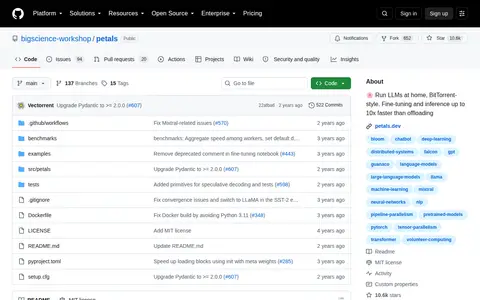
Petals is a GitHub repository or organization with source code, releases, documentation, or project resources.

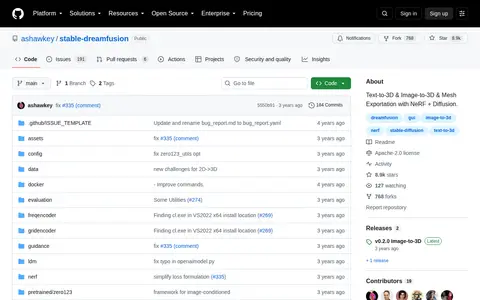
Stable Dreamfusion is a software project that supports text-to-3D and image-to-3D generation, as well as mesh exportation, using NeRF and diffusion model technology. Its public repository includes update logs and links to Colab notebooks for user access.

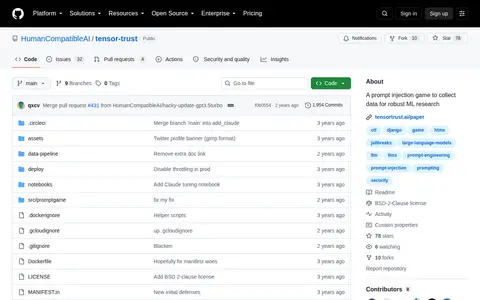
Tensor Trust is the source code for a web game and data cleaning pipeline described as a prompt injection attack game that collects data for adversarial ML research. The repository covers the game and pipeline and links to a paper and the game itself.

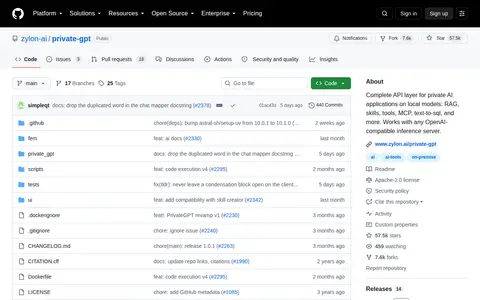
PrivateGPT is an open-source API layer for building private AI applications on local models, following the Claude API model. It provides a messages API, file and artifact ingestion, retrieval with citations and agentic RAG, built-in and custom tools, MCP connectors, structured database and CSV access, and embeddings. It connects to any OpenAI-compatible inference server and does not run models itself.

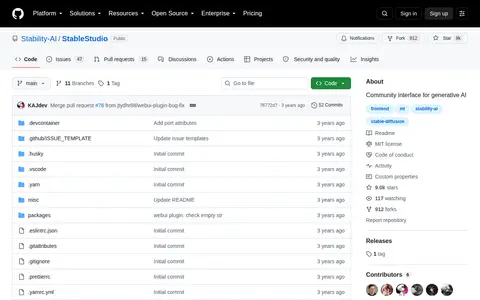
StableStudio is an open-source community interface for generative AI, developed as the open-source counterpart to the DreamStudio platform. The project repository includes quick start guides, an about section, and a FAQ for users.

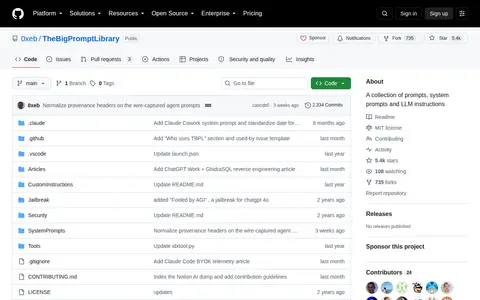
A repository collecting system prompts, custom instructions and jailbreak prompts for various LLM providers and solutions, including ChatGPT, Microsoft Copilot, Claude, Gab.ai, Gemini and Cohere. It also contains articles, tools, and scripts, and states that its content is intended for learning and informational purposes.

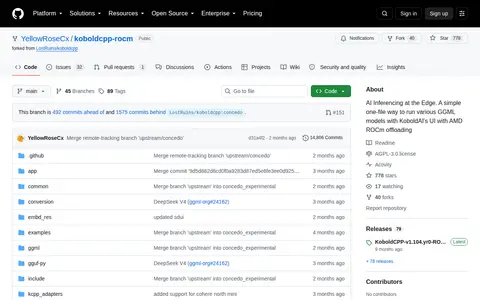
KoboldCpp fork for AMD ROCm that runs GGML models with the KoboldAI interface. It is a single-file executable without installation or external dependencies and runs on CPU or GPU with full or partial offloading. It supports text generation and includes a bundled KoboldAI Lite UI with chat, adventure, instruct and storywriter modes.

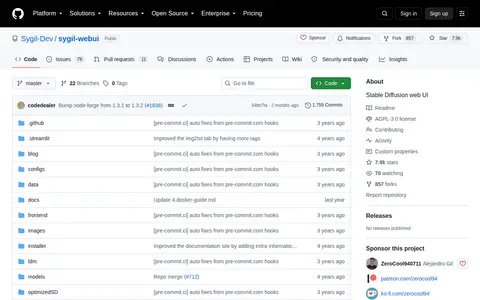
Sygil Webui is a web-based user interface for Stable Diffusion, developed by the Sygil.Dev team. Its GitHub repository provides installation instructions for the tool and links to the development team's Discord community server.

Open-source project that catalogs AI services and resources for browsing by feature or use case.

Open-source project that provides machine-learning models, research, training resources, or evaluation tools.

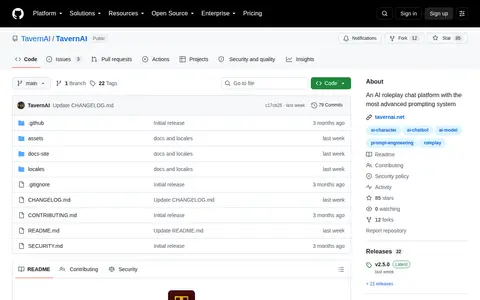
TavernAI is an AI roleplay chat platform with an advanced prompting system. It supports running machine learning models locally or connecting to external AI providers, and can be adapted to function as an AI game engine.

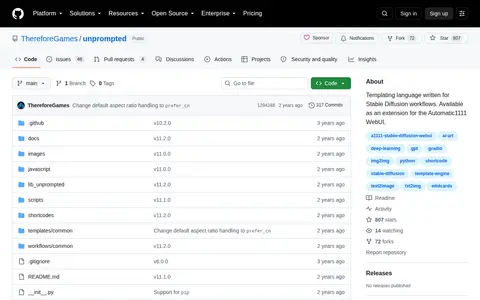
Unprompted is a templating language for Stable Diffusion workflows, distributed as an extension for the Automatic1111 WebUI. It is built around shortcodes and includes more than 70 shortcodes, such as conditionals, file imports and choose blocks for wildcards. Templates can be organized into folders and subfolders, and the language supports nested shortcodes and recursion.

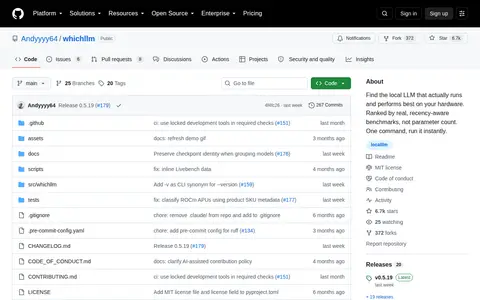
WhichLLM is a tool that identifies local large language models that run effectively and perform best on a user's hardware. It ranks models by real, recency-aware benchmarks rather than parameter count, and can be run instantly with a single command.

Open-source project that catalogs AI services and resources for browsing by feature or use case.