
Authors A.I. is an analytical AI tool for fiction authors that provides manuscript review services. Its AI tool Marlowe analyzes novels in minutes to deliver developmental feedback on plot arcs, pacing, character development, and other craft elements, comparing works to bestsellers. It does not generate or rewrite text, and is used by more than 40,000 authors.
Directory
Models & Machine Learning
Models and machine learning covers model hubs, research papers, training guides and evaluation tools. The topic mixes practical resources with reference material, so you will find repositories that host downloadable models next to sites that explain how a technique works. Some entries are collections of papers or benchmarks, and others are tutorials that walk through fine-tuning or deployment. It pays to compare the model licence, the training data, the hardware needed and the date of the last update. The field moves quickly, so verify version notes on the source before you build on anything listed here.
Open-source project that provides machine-learning models, research, training resources, or evaluation tools.
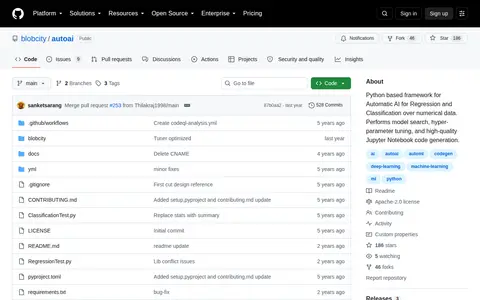
autoai is an open-source Python framework for automatic artificial intelligence focused on regression and classification tasks over numerical data. It automates model search, hyper-parameter tuning, and generates high-quality Jupyter Notebook code for resulting models.
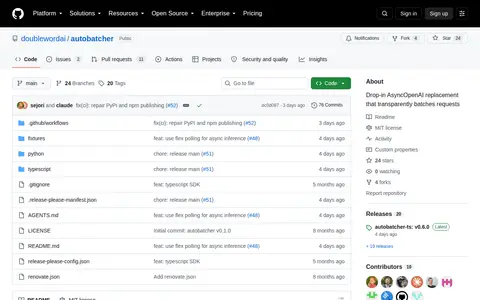
Drop-in AsyncOpenAI replacement that transparently batches requests via the Batch API for cheaper LLM inference.
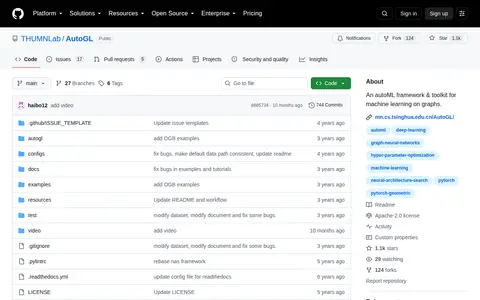
AutoML framework & toolkit for machine learning on graphs.
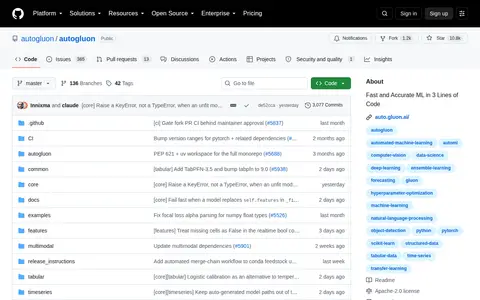
Automated machine learning for image, text, tabular, time-series, and multi-modal data.
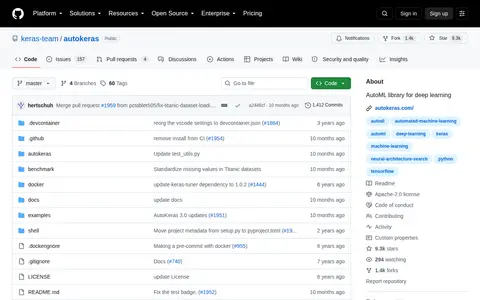
AutoKeras is an AutoML library for deep learning built on Keras, developed by DATA Lab at Texas A&M University. The project describes its goal as making machine learning accessible to everyone. It can be installed with pip, and the documentation states it is currently only compatible with Python 3.7 or later and TensorFlow 2.8.0 or later.
Open-source project that provides machine-learning models, research, training resources, or evaluation tools.
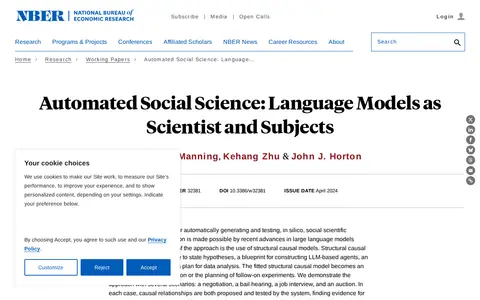
An NBER working paper presenting an approach for automatically generating and testing social scientific hypotheses in silico, using large language models with structural causal models. The approach is demonstrated in a negotiation, a bail hearing, a job interview, and an auction.
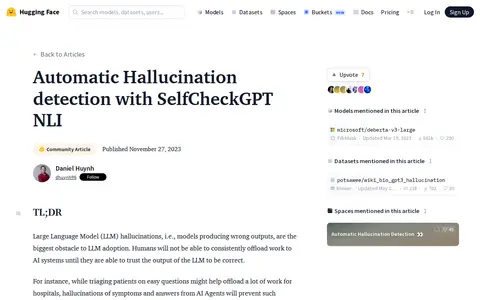
A Hugging Face blog post by Daniel Huynh describing an experiment assessing SelfCheckGPT NLI as a measure of LLM inconsistencies for predicting hallucinated outputs. It reports that scores were highly precise after a threshold and that a score of 0.8 corresponded to close to 80% of hallucinations being identified.
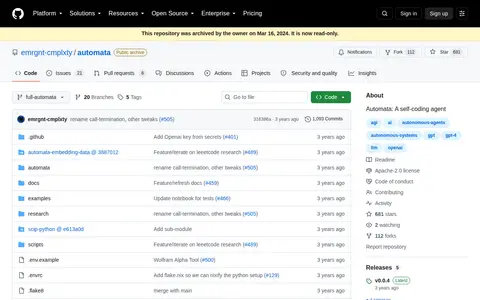
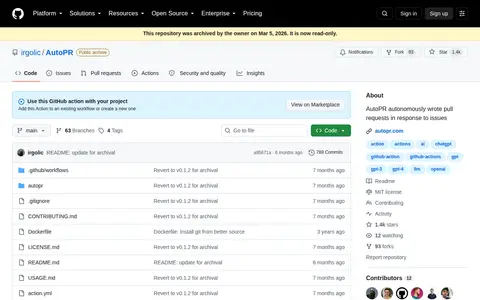
AutoPR was a GitHub Action that autonomously generated pull requests in response to issues, triggered by adding a label containing AutoPR. It planned a fix, wrote code, pushed a branch and opened a pull request. The alpha-release action had limitations including incorrect references to code in other files, duplicated lines and calls to functions that don't exist, and worked only on GitHub. The repository was archived by the owner on Mar 5, 2026 and is now read-only.
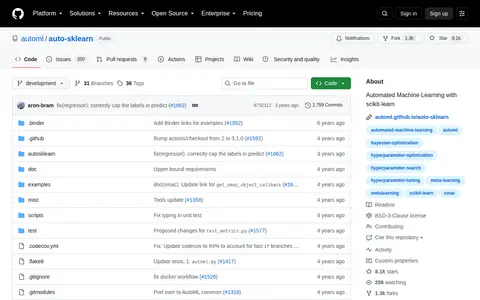
Automated machine learning toolkit and a drop-in replacement for a scikit-learn estimator.
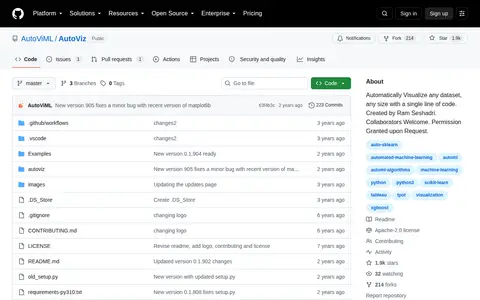
AutoViz is a Python library that automatically visualizes any dataset, any size, with a single line of code. It also offers the FixDQ() function for a quick assessment of dataset quality and fixing data quality issues. The project aims to provide an automated approach to exploratory data analysis through quick and easy data visualization plus data quality, abstracting away the complexities of various plotting libraries and techniques.
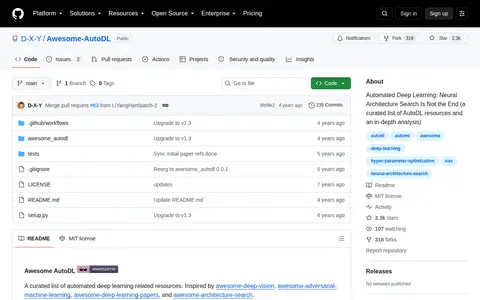
Awesome AutoDL is a curated list of automated deep learning resources and an in-depth analysis, subtitled that neural architecture search is not the end. It collects papers, libraries and benchmarks covering neural architecture search and hyper-parameter optimization.
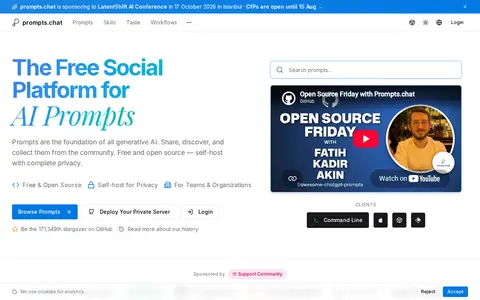
prompts.chat is a community platform for discovering, collecting and sharing AI prompts for ChatGPT, Claude, Gemini and other models. It is free and open source, and can be self-hosted for private deployments. An MCP-first API supports searching and discovering prompts programmatically.
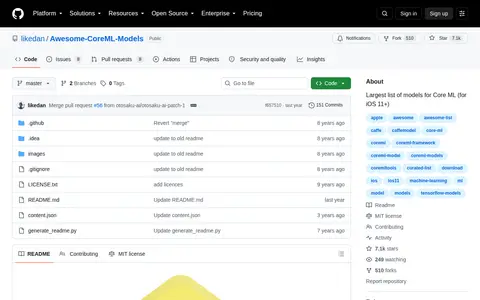
Awesome Core ML Models is a GitHub repository that hosts the largest collection of Core ML models for iOS 11 and newer versions. It allows users to contribute new models to the list via GitHub.
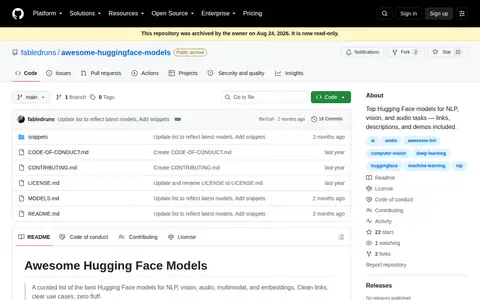
Curated list of top Hugging Face models for NLP, vision, and audio tasks with demos and benchmarks.
Open-source project that provides machine-learning models, research, training resources, or evaluation tools.
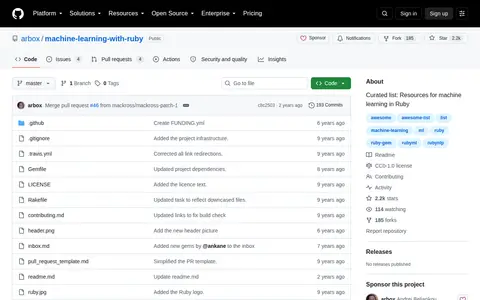
Awesome Machine Learning with Ruby is a GitHub-hosted curated list of resources for machine learning development using the Ruby programming language. It includes tutorials and machine learning libraries for Ruby users.
Curated list of awesome open source libraries to deploy, monitor, version and scale your machine learning.
List of awesome compiler projects and papers for tensor computation and deep learning.
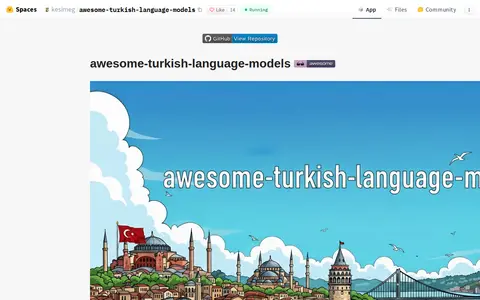
Awesome Turkish Language Models is a Hugging Face Space that hosts a curated list of Turkish AI models, datasets, and papers. It also functions as an application that fetches Markdown content from user-provided URLs and converts it to formatted HTML for reading.

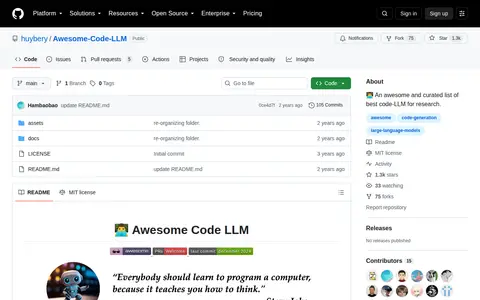
Awesome-Code-LLM is a curated list of code large language models for research, covering top code LLMs, evaluation toolkits, leaderboards and related papers. It also lists evaluation frameworks for autoregressive code generation models and a secure sandbox for judging generated code.
BabyCommandAGI is a Python script system based on BabyAGI that is designed to test combining CLI and LLM interfaces, with the thinking part of BabyAGI greatly simplified to execute commands efficiently. The README warns that it may unintentionally destroy the environment, recommends running it in a virtual environment such as Docker, and recommends Claude 3.7 Sonnet or higher.