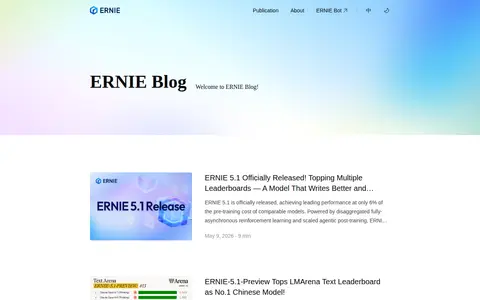

ERNIE is Baidu's blog covering its model releases. Posts describe ERNIE 5.1, a model trained with disaggregated fully-asynchronous reinforcement learning and scaled agentic post-training, and ERNIE 5.0, a 2.4 trillion-parameter unified multimodal model trained from scratch that integrates text, image, video and audio in a single autoregressive framework. ERNIE-Image is a text-to-image generation model built on a single-stream Diffusion Transformer.
Directory
Models & Machine Learning
Models and machine learning covers model hubs, research papers, training guides and evaluation tools. The topic mixes practical resources with reference material, so you will find repositories that host downloadable models next to sites that explain how a technique works. Some entries are collections of papers or benchmarks, and others are tutorials that walk through fine-tuning or deployment. It pays to compare the model licence, the training data, the hardware needed and the date of the last update. The field moves quickly, so verify version notes on the source before you build on anything listed here.
Open-source project that provides machine-learning models, research, training resources, or evaluation tools.
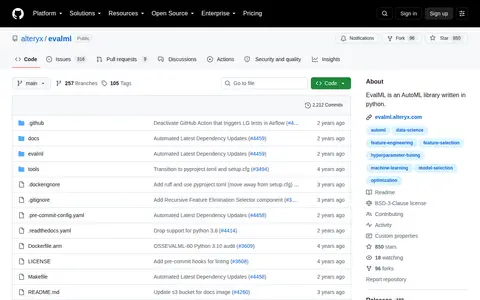
EvalML is an AutoML library written in Python that builds, optimizes, and evaluates machine learning pipelines using domain-specific objective functions. It includes data quality checks, cross-validation, preprocessing, feature engineering, feature selection, and model understanding tools. Install from PyPI or conda-forge.
Uncover LLM evaluation's importance and explore methods for assessing its performance and impact across industries.
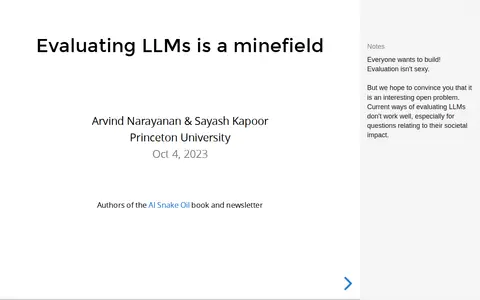
Annotated talk slides by Arvind Narayanan and Sayash Kapoor of Princeton University, dated October 4, 2023, on evaluating large language models. The slides discuss three hard problems in LLM evaluation: prompt sensitivity, construct validity and contamination, and examine questions about ChatGPT's behavior over time and its political bias.
AITV is the world's first AI streamer factory - built for creators, brands, and communities.
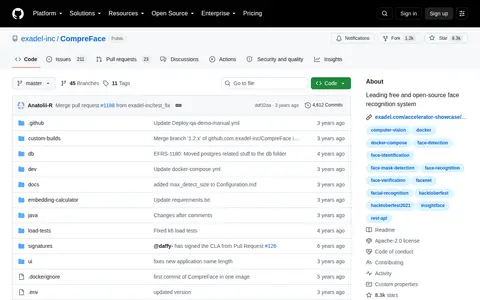
Exadel CompreFace is a free and open-source face recognition system hosted on a GitHub repository maintained by Exadel Inc. Its repository description positions it as a leading face recognition solution.
Exam Samurai provides machine-learning models, research, training resources, or evaluation tools.
Explore Clinical & Biomedical Language Models provides machine-learning models, research, training resources, or evaluation tools.
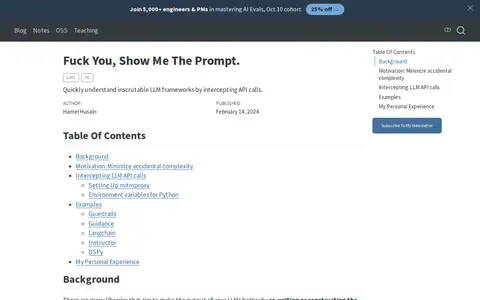
A blog post by Hamel Husain, published February 14, 2024, describing how to intercept LLM API calls with mitmproxy to see the prompts sent by frameworks such as Guardrails, Guidance and Langchain. The post argues that these prompts are the fastest way to understand how such tools work.
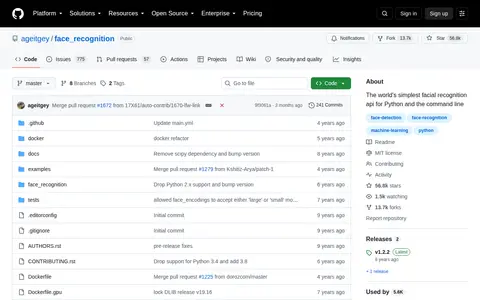
face_recognition is a GitHub repository maintained by ageitgey that provides what is described as the world's simplest facial recognition API for Python and the command line. The repository includes documentation, installation requirements, and online demos for the tool.
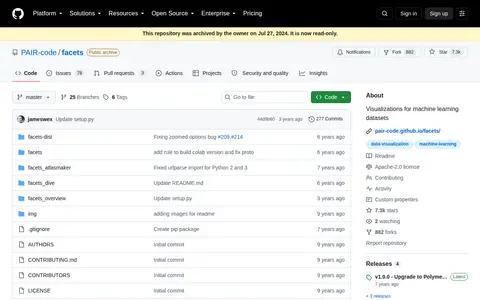
Facets is a project containing two visualizations, Facets Overview and Facets Dive, for understanding and analyzing machine learning datasets. The visualizations are Polymer web components backed by TypeScript that can be embedded in Jupyter notebooks or webpages. Overview produces feature-by-feature statistical analysis and compares statistics across datasets. The repository was archived on Jul 27, 2024 and is now read-only.
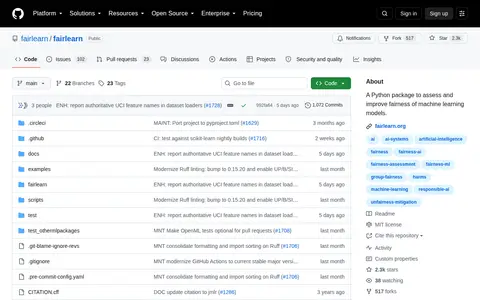
Fairlearn is a Python package hosted on a GitHub repository maintained by the Fairlearn project, designed to assess and improve the fairness of machine learning models. The repository includes documentation covering fairness definitions and a getting started guide for the tool.
Falcon LLM is described as a generative large language model that supports applications and use cases. The site presents models in the Falcon LLM family, including Falcon-H1 and Falcon-E, and lists Falcon-H1 model insights. It also references Falcon Arabic for Modern Standard Arabic and dialects, and names Falcon-Emirati, Falcon-ASR and Falcon-OCR-Arabic.
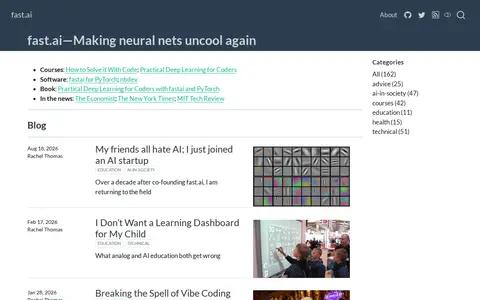
fast.ai is a project that publishes courses and software for deep learning, including Practical Deep Learning for Coders and the fastai library for PyTorch. The site also hosts blog posts on education, AI in society, and technical topics.
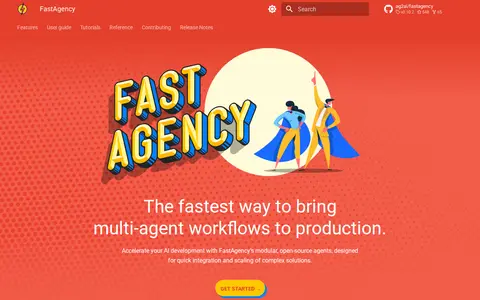
FastAgency is an open-source AI development tool designed to build and scale multi-agent workflows for production use. It provides modular, integrable agents to accelerate the development of complex AI solutions.
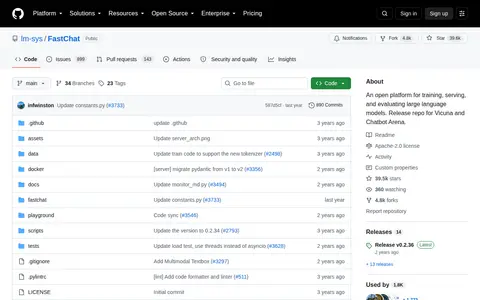
FastChat is an open platform for training, serving, and evaluating large language model based chatbots. Its core features include training and evaluation code for models such as Vicuna and MT-Bench, and a distributed multi-model serving system with a web UI and OpenAI-compatible RESTful APIs.
Open-source project that provides machine-learning models, research, training resources, or evaluation tools.
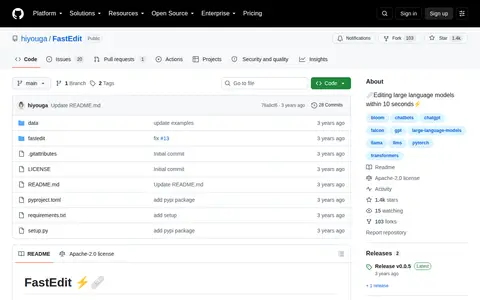
FastEdit is a repository intended to help developers inject fresh and customized knowledge into large language models using one command. It supports models including GPT-J, LLaMA, LLaMA-2, BLOOM, Falcon, Baichuan, and InternLM. The implemented algorithm is Rank-One Model Editing (ROME). It requires Python 3.8+ and PyTorch 1.13.1+.
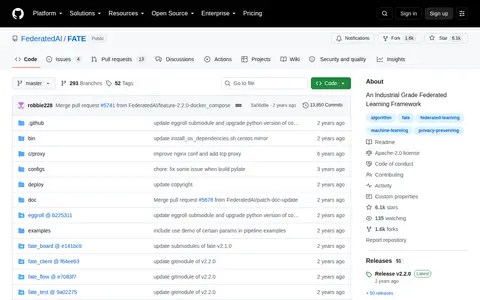
FATE (Federated AI Technology Enabler) is an industrial grade federated learning open source framework that enables enterprises and institutions to collaborate on data while protecting data security and privacy. It implements secure computation protocols based on homomorphic encryption and multi-party computation, and provides federated learning algorithms including logistic regression, tree-based algorithms, deep learning and transfer learning.
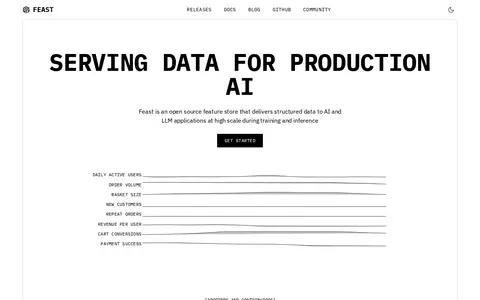
Feast is an end-to-end open source feature store for machine learning. It allows teams to define, manage, discover, and serve features, delivering structured data to AI and LLM applications during training and inference. Documented use cases include real-time recommendations, fraud detection, risk scoring, and customer segmentation.
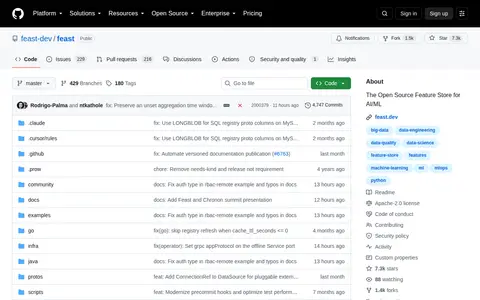
Feast is an open source feature store for machine learning. It manages an offline store for historical data, a low-latency online store, and a feature server. It generates point-in-time correct feature sets to avoid data leakage and provides a single data access layer abstracting feature storage from retrieval. Installable with pip and initialized through a CLI.


Open-source project that provides machine-learning models, research, training resources, or evaluation tools.
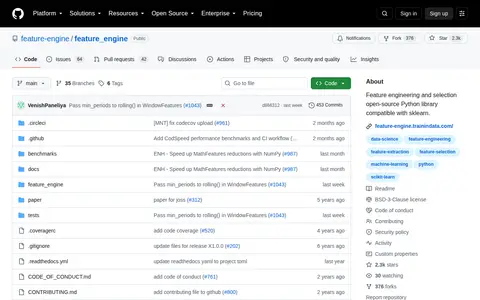
Feature engineering package with SKlearn like functionality.