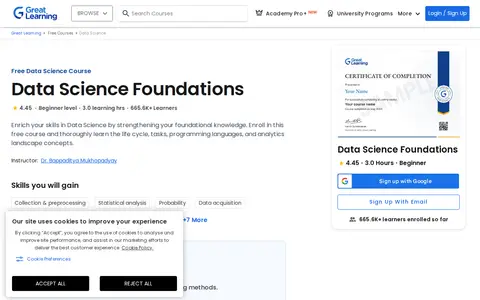

A free, self-paced beginner course on data science foundations. It covers the data science life cycle, tasks, programming languages, machine learning, and the analytics landscape, with an assessment. Study materials are provided after enrollment, and a certificate of completion is offered.
Directory
AI Education & Learning
AI education and learning covers courses, roadmaps, and guides for people studying machine learning. Entries include university courses, free video series, reading lists, hands-on notebooks, and roadmaps that map out a path through the field. They assume different starting points, so compare the maths and programming each one expects, whether it uses a current framework, and how much practice comes with the theory. Some are kept by a university or a company, others by one person who may move on, so check when the material was last revised. The field moves quickly, and an older guide can still teach the fundamentals.
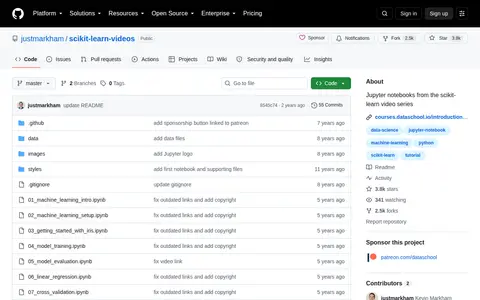
IPython notebooks from Data School's video tutorials on scikit-learn.
Access all JetBrains IDEs, plugins, and courses for your studies and future tech career.
A course on generative modelling, currently unfinished, with the first approximately five lessons mostly done. It covers topics such as PyTorch basics, representations, CLIP, GANs, sequence modelling and transformers. No prior deep learning knowledge is assumed, though comfort with some Python and Jupyter Notebooks is expected.

Supports teaching, studying or skills practice with AI-guided learning tools.
Open-source Java scientific computing library for JVM and Android platforms, with SciPy-like APIs for use in machine learning and data science workflows. It provides functionality for signal processing, FFT, filters, PSD, and DCT operations.
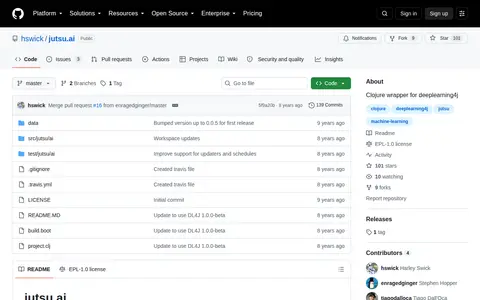
A Clojure wrapper for deeplearning4j with added syntactic sugar, aiming to provide a declarative API for machine learning on the JVM. It translates Clojure keywords into Java method calls, making many deeplearning4j configuration options accessible. The project is a work in progress, and configurations have been tested on basic feedforward nets, RNNs and CNNs.
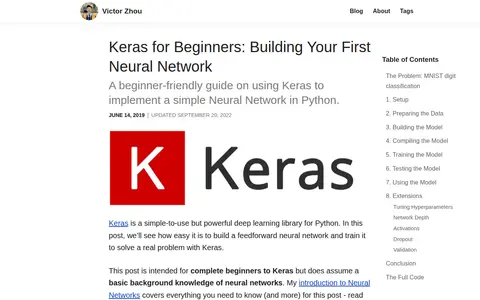
A beginner-friendly guide on using Keras to implement a simple neural network in Python. It walks through MNIST handwritten digit classification, covering setup, data preparation, building the model, compiling, training, testing and using the model. It is intended for complete beginners to Keras who have a basic background knowledge of neural networks.
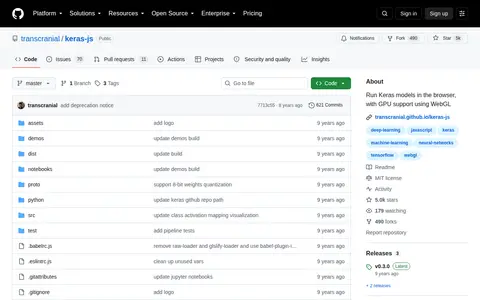
Keras.js runs Keras models in the browser with GPU support using WebGL 2, and models can also run in Node.js in CPU mode. Models can be trained in any backend, including TensorFlow and CNTK. The project is no longer active and no longer updated, though the demos still work.
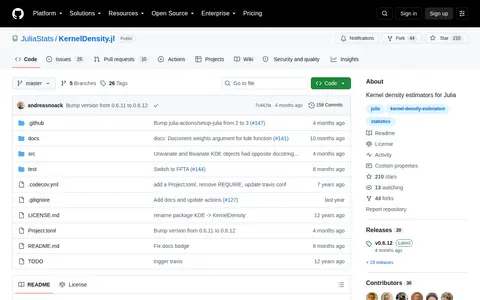
Kernel density estimators for Julia.
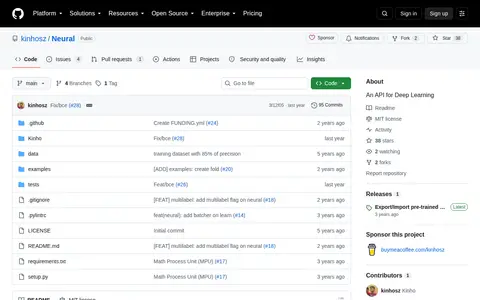
Simple API for Neural Network. Better for image processing with CPU/GPU + Transfer Learning.
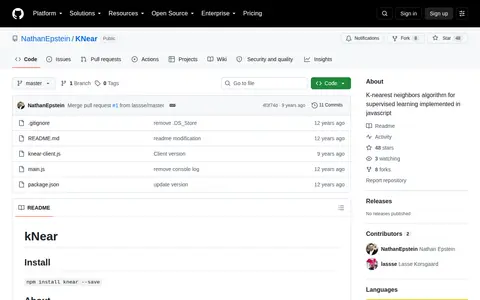
JavaScript implementation of the k nearest neighbors algorithm for supervised learning.
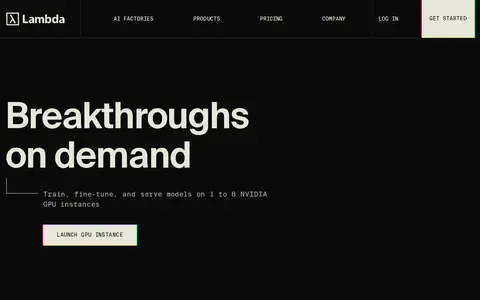
Lambda offers hourly rental of NVIDIA H100, H200, B200, and A100 GPUs through a self-serve interface, with instances launchable via UI, API, or CLI. Users can train, fine-tune, and serve models on one to eight GPU instances and pay by the minute, with no egress fees.
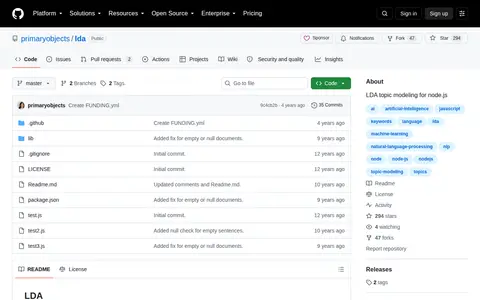
LDA is a JavaScript library for node.js that performs Latent Dirichlet allocation topic modeling, extracting topics and related keywords from a collection of documents. It returns an array of topics, each with an array of terms and probabilities, and uses English stop-words by default.
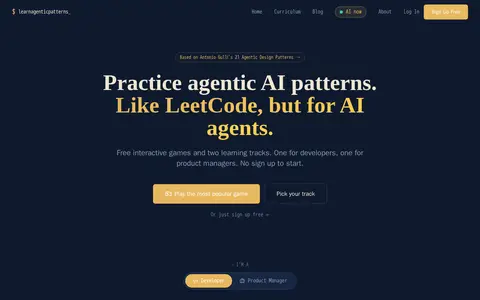
A free curriculum of six courses on agentic AI design patterns for developers and product managers. It covers code, architecture, decisions and hands-on games, with 21 patterns for developers and 15 modules for product managers. No account is needed to read the material.
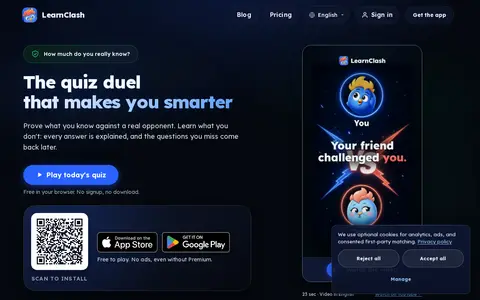
LearnClash is a quiz duel app in which players face a real opponent 1v1 on general knowledge or a chosen topic. Every answer is explained, and missed questions return after 7 days. Duels are turn-based with a 72-hour window per turn. Duels, explanations and missed-question reviews are free, with no ads.
Supports teaching, studying or skills practice with AI-guided learning tools.
AI-powered academic assistant for students with note-taking, essay writing, and presentation generation.
A pure Go implementation of the prediction part of GBRTs, including XGBoost and LightGBM.
A generic approach that allows to mimic most factorization models by feature engineering.
Supports teaching, studying or skills practice with AI-guided learning tools.
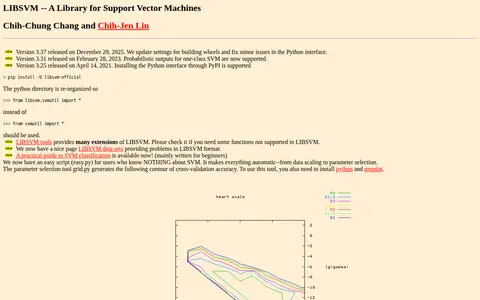
LIBSVM is an integrated software library for support vector classification, regression and distribution estimation. It provides a simple interface for linking with other programs and includes multi-class classification, cross-validation and probability estimates. Interfaces exist for Python, R, MATLAB and other languages.
LightFM is a Python implementation of recommendation algorithms for implicit and explicit feedback. It allows item and user metadata to be incorporated into matrix factorization algorithms, representing users and items as sums of latent feature representations. Installation is available from PyPI, and a Docker setup is provided for running examples and tests.
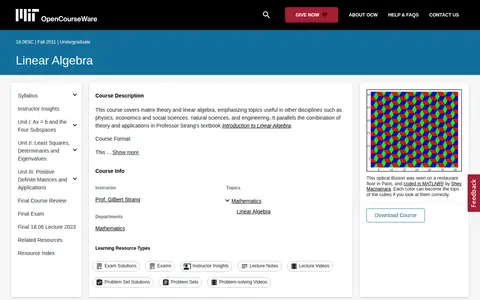
An MIT OpenCourseWare course covering matrix theory and linear algebra, emphasizing topics useful in physics, economics, social sciences, natural sciences and engineering. It is designed for independent study and includes lecture videos by Gilbert Strang, summary notes, problem solving videos, and problem sets with solutions.